
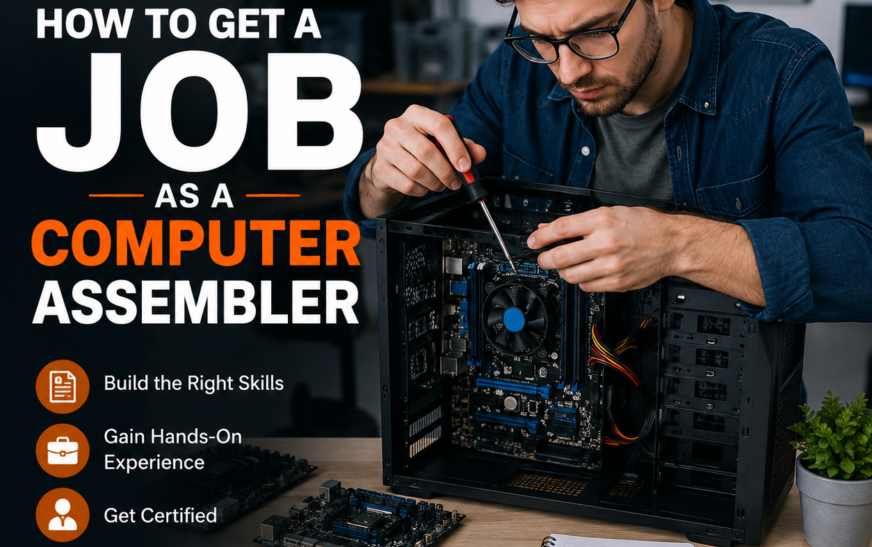
Ever wondered who builds the desktops, servers, and gaming rigs that power everything from small offices to massive data centers? That’s the work of a computer assembler , and right now, with hardware demand climbing thanks to AI servers, custom PC builds, and enterprise upgrades, companies are actively hiring for this role. The best part? You don’t need a four-year degree to break in. If you’re wondering how to get a job as a computer assembler, this guide walks you through everything: what the job actually involves, the skills and certifications that matter, where to find computer assembler jobs hiring now, and how to get hired even if you’ve never held the title before.
To get a job as a computer assembler: learn the basics of PC hardware (motherboards, CPUs, RAM, storage, cooling), get hands-on practice by building or repairing computers yourself, consider a low-cost certification like CompTIA A+, build a simple resume highlighting hardware skills, and apply to electronics manufacturers, PC-building companies, IT staffing agencies, and refurbishing/repair shops. Most entry-level roles only require a high school diploma , experience and demonstrated skill matter more than formal education.
Key Takeaways
- A computer assembler builds, tests, and troubleshoots computer hardware , no software programming involved, despite the similar-sounding name.
- A high school diploma is usually enough to start; certifications like CompTIA A+ boost your chances but aren’t always mandatory.
- Hands-on practice (building your own PC, volunteering, or freelance repairs) is one of the fastest ways to gain real experience without a job title yet.
- Attention to detail, basic technical knowledge, and comfort working with tools matter more than a formal résumé.
- Jobs exist across manufacturing floors, IT service companies, PC-building startups, and remote/contract hardware support roles.
- Entry-level pay is modest, but the role can lead into IT technician, hardware engineering, or server infrastructure careers.
- Demand is growing in 2026 due to AI hardware, custom builds, and server rack assembly.
Who Is a Computer Assembler?
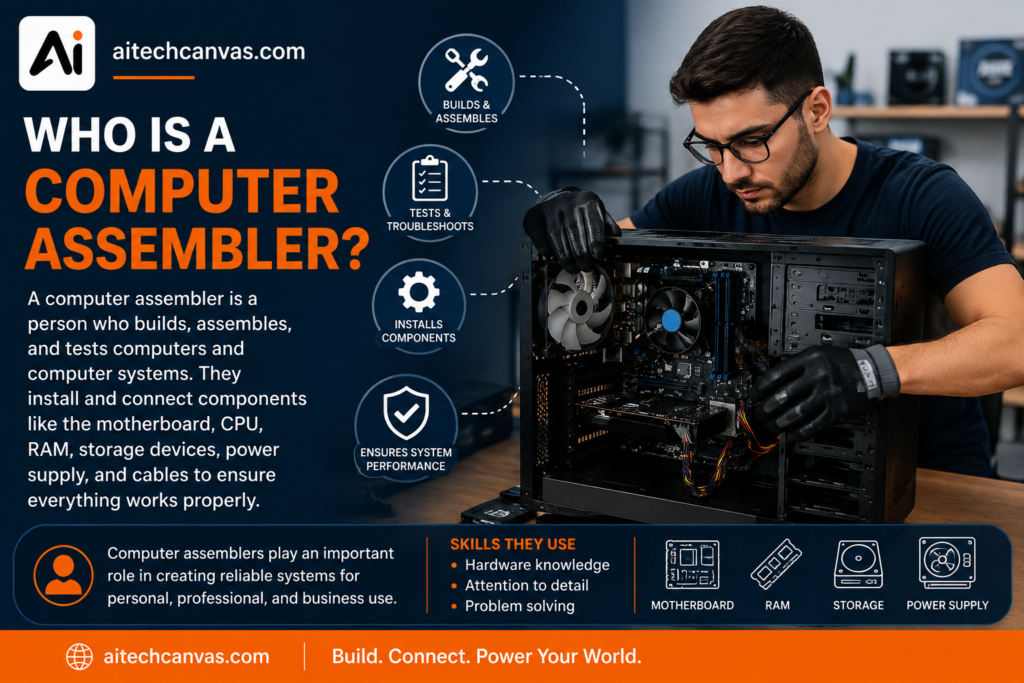
A computer assembler is someone who physically builds computers by installing and connecting hardware , the motherboard, CPU, RAM, GPU, storage devices, power supply, and computer case , into a fully working machine. It’s important to note this is a hardware role, not a software one: “assembler” also refers to a low-level programming language used to classify software applications components, but that’s a completely different job. That programming-side role involves understanding opcodes and memory addressing at the machine level, and typically requires a computer science background , a computer assembler, by contrast, needs strong hands-on knowledge of computer hardware itself, not code, and a high school diploma is enough for most jobs. Similarly, don’t confuse this role with computer-aided detection (CAD), a medical imaging term that has nothing to do with hardware assembly despite the similar-sounding name. If you’re searching for computer assembler jobs, you’re looking for hands-on hardware work, not coding.
Computer Assembler vs Computer Technician , What’s the Difference?
A computer assembler focuses on building and putting hardware together, while a computer technician usually diagnoses and repairs machines that are already in use , more troubleshooting, less assembly line work.
Computer Assembler vs PC Builder , What’s the Difference?
The terms overlap heavily, but “PC builder” often implies custom, one-off builds (like gaming rigs for individual clients built around the latest gaming technology trends , while “computer assembler” is more common in manufacturing and production settings.
Computer Assembler vs Electronics Technician , What’s the Difference?
Electronics technicians work with a broader range of devices and circuits, sometimes down to the component/soldering level, while computer assemblers focus specifically on full computer systems.
Computer Assembler vs IT Technician , What’s the Difference?
An IT technician typically supports software, networks, and end users after deployment, while a computer assembler’s job ends once the hardware is built, tested, and ready to ship or install.
What Does a Computer Assembler Do Daily?
Day to day, a computer assembler handles hardware installation, hardware testing, troubleshooting, and quality control , following technical diagrams, blueprints, and assembly instructions to put together and verify each unit. Cable management and checking hardware compatibility are also part of the daily computer assembler daily tasks routine.
What Are the Key Responsibilities of a Computer Assembler?
- Installing components (motherboard, CPU, RAM, GPU, storage, power supply) into the case
- Running post-build tests to confirm everything powers on and functions correctly
- Troubleshooting and fixing issues found during testing
- Following assembly instructions and technical diagrams precisely
- Managing cables neatly and checking for hardware compatibility issues
- Coordinating with system administration software teams when assembled units are deployed for enterprise or IT support roles
Where Do Computer Assemblers Typically Work?
Most work happens in a production environment , electronics manufacturing plants, assembly lines, or PC-building warehouses. Some roles are with smaller IT companies or repair shops that also build custom machines for clients.
What Are the Requirements and Qualifications for a Computer Assembler?
Most employers list a high school diploma as the main computer assembler requirement, along with basic hardware knowledge. Formal degrees are rarely required for entry-level computer assembler jobs , what matters more is proof you can work with hardware safely and accurately.
What Education Do You Need to Become a Computer Assembler?
A high school diploma or equivalent is typically enough to meet computer assembler education standards. Some people also attend a short technical school program, though it’s optional rather than required for most entry-level roles.
What Training and Certification Do Computer Assemblers Need?
On-the-job computer assembler training is common, and many assemblers start with zero certifications. That said, vocational training or a computer assembler certification like CompTIA A+ can help you stand out and may be required for some higher-paying or technical roles. Meeting basic computer assembler training requirements early on makes it easier to move into mid-level roles later.
What Skills Do You Need to Become a Computer Assembler?
Beyond hardware knowledge, employers want people who are careful, patient, and comfortable following precise instructions.
What Technical Skills Matter Most?
Understanding of PC components, basic soldering, comfort with a multimeter, and the ability to read assembly diagrams are the core computer assembler skills employers screen for.
What Soft Skills Matter Most?
Attention to detail, mechanical aptitude, and reliable hands-on focus matter just as much as technical know-how , a single loose connection can fail an entire build.
What Tools and Equipment Do Computer Assemblers Use?
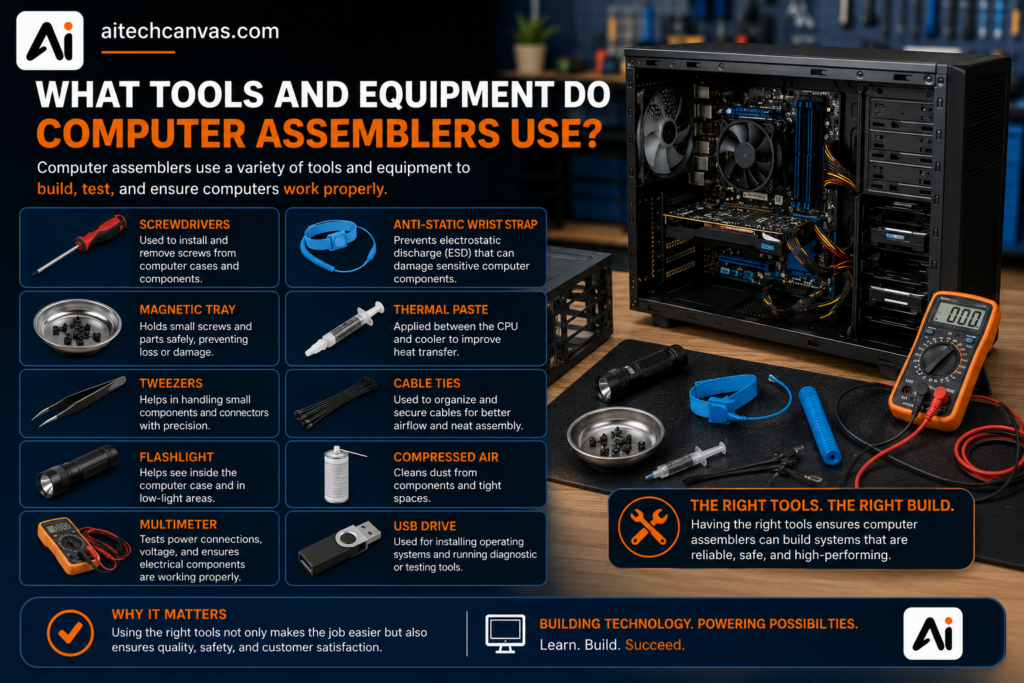
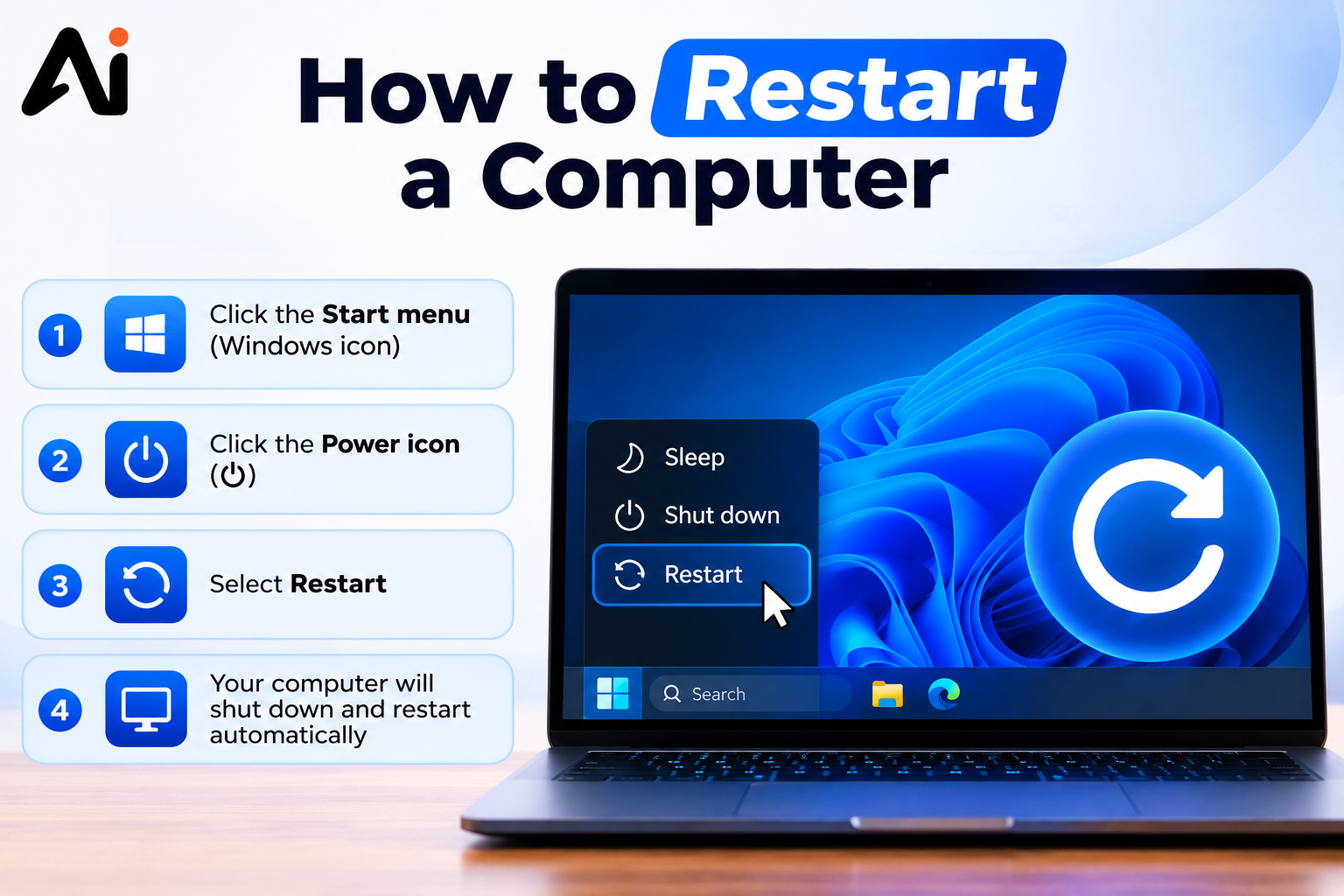
Computer assemblers typically work at a static-free workstation using an anti-static wrist strap for ESD safety, along with basic diagnostic tools, screwdrivers, and a multimeter for testing connections and power delivery. Assemblers often also need to know how to properly power cycle a build during testing , the same basic principle covered in guides on how to restart a computer for Windows, Mac, and Linux systems. Beginners who go on to build custom rigs at home may also run into software-level tools like SignalRGB for lighting and peripheral control once the hardware side is complete. Hands-on hobbyist projects , like learning how to connect a Pi 4 Modbus to Mango automation , are also a great way to build the kind of hardware-tinkering instincts employers look for. Knowing this basic computer assembler tools list is often the first thing beginners should learn before applying.
How Do You Become a Computer Assembler? (Step-by-Step)
If you’re wondering how to become a computer assembler or want to know how to start a career as a computer assembler, here’s a simple path:
- Learn the fundamentals , study PC hardware components and how they connect.
- Practice builds , assemble or upgrade real computers, even your own.
- Get certified (optional) , a certification like CompTIA A+ adds credibility.
- Build a resume , highlight any hands-on hardware experience.
- Apply , target manufacturers, IT companies, and repair shops.
- Prepare for interviews , be ready to discuss your builds and troubleshooting process.
Most people can start applying within a few weeks to a few months of focused practice , you don’t need years of schooling to know how to become a computer assembler with no experience.
How Do You Get a Computer Assembler Job With No Experience?
Plenty of people land computer assembler jobs with no experience and figure out how to get a job as a computer assembler without experience by proving their skills outside of a formal job first. Build your own PC, repair one for a friend, document what you did, and use that as your “experience” when applying. This is the fastest way of how to gain experience as a computer assembler and how to build computer assembly experience without a job title yet.
What Entry-Level Computer Assembler Jobs Are Available?
Look for listings labeled trainee, junior assembler, or entry-level. These entry-level computer assembler jobs and computer assembler jobs for beginners are designed for people without a job history in the field and often include on-the-job training. Many of these computer assembler jobs entry level postings are also listed as computer assembler jobs without a degree, since a diploma or certification isn’t always mandatory to get started.
Can You Become a Computer Assembler Online?
You can learn the theory and even earn certifications online, but the actual hands-on assembly and testing skills are best built with real hardware in front of you , online learning is a great starting point, not a full replacement. For those interested in the cloud and server side of hardware, it’s also worth exploring how Linux automation works in AWS, since server rack assemblers increasingly need to understand the systems their hardware will run.
Where Can You Find Computer Assembler Jobs?
Search job boards for computer assembler jobs hiring now, and don’t overlook staffing agencies , many manufacturers hire assemblers through third-party recruiters. This is often the fastest way to figure out how to find computer assembler jobs and how to get a computer assembler job without cold-applying everywhere. If you’re specifically searching how to get a job as a computer assembler near me, start with local classifieds, regional staffing agencies, and nearby manufacturing plants before widening your search nationally. When you apply, tailor your application to show you understand what companies hire computer assemblers and why you fit their needs.
Which Industries Are Hiring Computer Assemblers?
Electronics manufacturing, custom PC-building companies, server and data center hardware providers, and IT refurbishing/repair businesses are the biggest employers right now , this overlap with broader computer assembly jobs and electronics assembler jobs markets means opportunities aren’t limited to one type of company. Even industries you might not expect, like agriculture, are hiring hardware assemblers as they integrate technology with traditional farming methods.
Are There Remote Computer Assembler Jobs?
True hands-on assembly can’t be done remotely, but some companies offer computer assembler remote jobs for related hardware support, testing documentation, or quality-control review work.
Are There Contract Computer Assembler Jobs?
Yes , many companies hire assemblers on computer assembler contract jobs, especially seasonal work around high-demand periods like new product launches or holiday manufacturing pushes.
Full-Time vs Part-Time , Which Computer Assembler Work Fits You?
Full-time roles are common in manufacturing settings with set shifts, while part-time and contract work is more common with smaller repair shops or short-term production runs. Weighing computer assembler full time vs part time options often comes down to whether you’re comfortable with computer assembler shift work in a production environment.
How Do You Write a Computer Assembler Resume?
Keep your computer assembler resume simple and hardware-focused: list any hands-on builds or repairs, relevant tools you’re comfortable using, and any certifications. Even without job history, a short “projects” section describing PCs you’ve built or fixed can carry real weight with hiring managers , this is one of the most useful computer assembler job application tips for people starting from zero.
What Are the Best Computer Assembler Interview Tips?
Be ready to talk through your hands-on experience step by step , employers want to see that you understand the why behind each part of the build process, not just that you can follow instructions.
What Do Employers Look for in a Computer Assembler?
Employers look for attention to detail, mechanical aptitude, comfort with tools like a static-free workstation setup, and a track record , even an informal one , of successful builds or repairs.
What Are Common Computer Assembler Interview Questions?
Expect questions about troubleshooting a machine that won’t power on, reading an assembly diagram, handling ESD safety, and describing your cable management approach. Be ready to walk through a build from start to finish , a strong computer assembler interview performance often comes down to specific, detailed examples rather than general answers.
How Much Does a Computer Assembler Make? (Salary & Career Path)
Computer assembler salary varies by location, experience, and industry , similar to how pay ranges differ across other hands-on technical fields, such as how much surgical technologists make , but the role offers a clear path upward as you gain experience.
What Is the Salary by Experience Level (Junior → Mid → Senior → Lead)?
Junior assemblers typically start at entry-level hourly pay. Mid-level assemblers with a couple of years of experience earn more, especially with certifications. Senior and lead assemblers , who may train others or handle complex builds like server racks , earn the highest pay in this track, often close to what a computer assembly technician earns, and computer assembly technician salary figures are a useful benchmark when negotiating a raise.
What Does a Computer Assembler Career Progression Look Like?
Many assemblers move into computer assembly technician, hardware technician, or IT support roles after a couple of years, following a clear computer assembler career path. From there, some progress into hardware engineering, server infrastructure, or supervisory production roles.
What Are the Pros and Cons of Being a Computer Assembler?
Like any job, this career has real trade-offs worth knowing before you apply.
What Are the Pros?
- Low barrier to entry , no degree required
- Hands-on, tangible work you can see results from
- Growing demand tied to AI hardware and custom builds
- Clear path into higher-paying IT and hardware roles
- Some remote, contract, and flexible options exist
What Are the Cons?
- Entry-level pay can be modest
- Manufacturing environments may involve shift work
- Repetitive tasks on production lines
- Physical demands (standing, repetitive motion)
- Some competition for entry-level roles as automation increases
What Is the Job Outlook for Computer Assemblers ?
The computer assembler job outlook for 2026 is positive overall, and shows signs of the same broader computer assembler job growth seen in adjacent fields like the new grad embedded software engineer job market , driven by rising demand for custom PCs, enterprise servers, and AI hardware. But the picture isn’t without challenges.
What Are the Current Challenges?
Automation is slowly taking over some repetitive manufacturing tasks , much like how industrial robotic arms and even bio-mechanical robots have reshaped other production lines , and entry-level roles can see more competition as a result. Even major players like Apple are reportedly exploring whether they can lead the robotics wave, which signals how seriously the industry is investing in this space. It’s part of a wider conversation around whether automation and AI will replace human roles in technical fields altogether. Staying current with newer hardware and certifications helps offset this.
What Growth Opportunities Exist?
Custom PC building, server rack assembly, and AI hardware assembly are all growing niches within the field , areas where hands-on skill and attention to detail are still hard to automate. Companies working on AI automation tools, RPA and business automation, and the best AI developer platforms are increasingly reliant on the physical hardware assemblers build to run their systems, which is helping keep demand strong. In many ways, this race to build faster AI hardware echoes past shifts in the technology of the arms race, where physical hardware production became just as critical as the underlying innovation.
Is Being a Computer Assembler Hard or Stressful?
It’s generally considered a low-to-moderate stress job. The learning curve is gentle for beginners willing to practice, though production environments can bring deadline pressure and repetitive tasks. Compared to many technical careers, it’s approachable and beginner-friendly.
What Related Jobs Should You Consider Besides Computer Assembler?
If this role interests you, related titles worth exploring include computer hardware assembler, computer assembly technician, electronics assembler, and general assembler job listings in manufacturing , all of which share overlapping skills and can be natural next steps or alternatives.
Final Thoughts
Breaking into a computer assembler career doesn’t require years of schooling or a technical degree , it requires curiosity, hands-on practice, and a willingness to start small. Whether you’re assembling your first PC at home or applying to your first manufacturing job, every skill you build gets you closer to a paycheck and a career path with real room to grow. If you’ve been asking how to get a job as a computer assembler, the honest answer is: start building, start applying, and let your hands-on skill speak for itself.
Ready to start? Pick up a screwdriver, build (or upgrade) a PC this week, and start applying to entry-level listings , your first computer assembler job could be closer than you think.
Frequently Asked Questions
How to get a job as an assembler?
Start by learning basic hardware skills, practice building or fixing computers, and apply to manufacturing companies, IT firms, or staffing agencies that list entry-level assembler roles.
How much does a PC assembler make?
Pay varies by experience and location, but entry-level assemblers typically earn hourly wages comparable to other entry-level technical roles, with pay increasing as you gain experience or certifications.
Is being an assembler easy?
It’s beginner-friendly to learn, but it does require patience, attention to detail, and comfort working with small components and tools.
How to get a job as a computer assembler near me?
Search local job boards, staffing agencies, and electronics manufacturers in your area, and check with IT repair shops or PC-building businesses that may hire locally.
How to get a job as a computer assembler without experience?
Build your own PCs, take on small repair jobs for friends or family, complete a beginner certification, and apply for entry-level or trainee positions that don’t require prior work history.
Is computer assembling a good career in 2026?
Yes , rising demand for custom PCs, servers, and AI hardware is keeping assembly jobs in demand, and the role can be a stepping stone to higher-paying IT and hardware careers.
How long does it take to become a computer assembler?
Most people can gain enough basic skills in a few weeks to a few months of self-study and hands-on practice, especially if pairing it with a short certification course.
Is computer assembler job stressful?
It can involve repetitive tasks and deadlines in production settings, but it’s generally considered a low-stress role compared to many other technical jobs.
Can I become a computer assembler online?
You can learn the fundamentals and even earn certifications online, but the hands-on assembly and testing skills are best practiced with real hardware.