

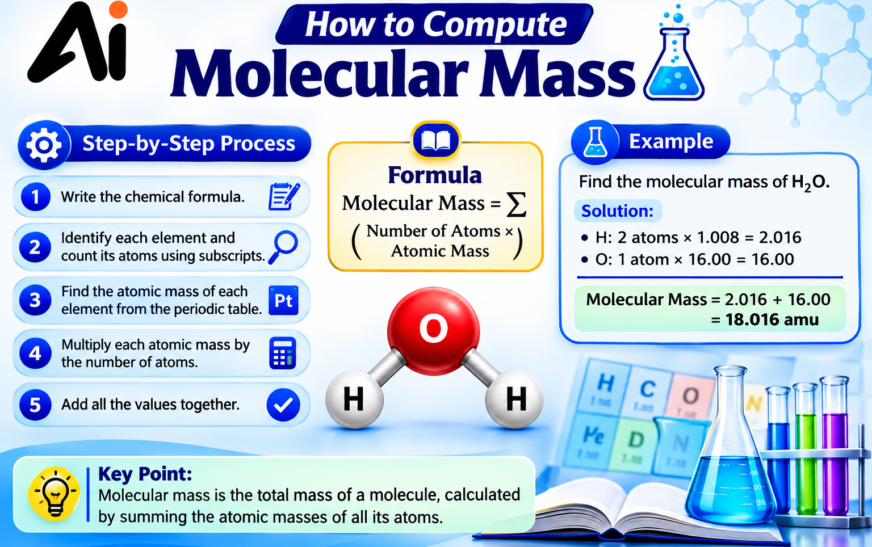
Every chemical compound possesses a unique mass determined by its specific structural assembly of atoms. Calculating this value accurately forms the bedrock of quantitative chemistry, enabling laboratory scientists, engineers, and students to predict yield outputs and balance complex reactions.
Computing molecular mass relies on combining data from the periodic table with the structural ratio provided in a chemical formula. Mastering this fundamental skill provides direct clarity when working with stoichiometry, concentration units, and empirical formula derivations.
What Is Molecular Mass?
Molecular mass represents the total mass of a single molecule, calculated by summing the individual atomic masses of every atom present in its chemical structure.
This quantity is expressed in unified atomic mass units (u) or daltons (Da). One atomic mass unit equals 1.66054 x 10⁻²⁴ grams, defined precisely as one-twelfth of the mass of an unbound carbon-12 atom.
Because molecules exist on a microscopic scale, molecular mass accounts for individual molecular entities rather than bulk physical samples handled in laboratory glassware.
Molecular Mass vs. Molar Mass
Although numerical values for molecular mass and molar mass frequently match for a given covalent substance, their conceptual definitions and physical units differ completely.
Molecular mass measures the mass of one single isolated molecule. Its standard units are atomic mass units (amu) or daltons (Da).
Molar mass measures the total mass of one mole of molecules, which contains 6.022 x 10²³ entities known as Avogadro’s number. Its standard scientific unit is grams per mole (g/mol).
For example, a single molecule of pure water has a molecular mass of approximately 18.015 Da, whereas one mole of water has a molar mass of 18.015 g/mol.
Molecular Mass vs. Atomic Mass
Atomic mass applies exclusively to a single atom of a single element, reflecting the combined mass of its protons, neutrons, and electrons.
Molecular mass applies only to chemical structures where two or more atoms are bonded together.
You find atomic mass listed directly on the periodic table for each individual element, whereas molecular mass must be calculated by identifying the number of atoms involved and aggregating their respective atomic values.
Why Understanding Molecular Mass Matters
Molecular mass serves as a core converting factor between microscopic atomic arrangements and macroscopic physical observations.
Without accurate molecular mass determinations, quantitative chemical synthesis would rely on trial and error rather than predictable mathematical relationships.
Why You Need to Compute Molecular Mass
Understanding how to computing molecular mass unlocks essential capabilities across diverse scientific domains.
Chemistry Calculations
Converting measurable masses in grams to molecular molar quantities requires exact mass calculations. Stoichiometric equations depend on these ratios to balance reactant inputs against theoretical product yields.
Laboratory Applications
Laboratory technicians rely on molecular mass determinations when preparing molar solutions of precise concentration.
Calculating solution molarity requires knowing the exact mass of solute needed per liter of solvent:
$$Molarity (M) = \frac{\text{Moles of Solute}}{\text{Liters of Solution}}$$
Evaluating gas density, vapor pressure lowering, and osmotic pressure shifts also depends directly on exact molecular values.
Academic and Competitive Exams
Examinations in general chemistry, biochemistry, and chemical engineering evaluate a candidate’s mastery of stoichiometric conversions. Molecular mass calculations form the core foundation for multi-step quantitative exam questions.
Industrial and Pharmaceutical Uses
In industrial chemical manufacturing, calculating molecular mass allows process engineers to maximize reaction yields and minimize raw material waste.
Pharmaceutical researchers rely on precise molecular mass data during mass spectrometry analyses to verify synthetic drug purity, analyze molecular degradation pathways, and confirm active pharmaceutical ingredient identities.
Understanding the Basic Terms Before You Calculate
Before performing calculations, reviewing foundational chemical terminology ensures accurate setup.
What Is an Atom?
An atom represents the basic structural unit of chemical matter. It consists of a dense central nucleus containing positively charged protons and uncharged neutrons, surrounded by a cloud of negatively charged electrons.
The number of protons defines the identity of the element, while the sum of protons and neutrons determines its individual mass number.
What Is a Molecule?
A molecule forms when two or more atoms bond together chemically through shared or transferred electrons.
Molecules can consist of identical bonded elements, such as diatomic oxygen gas (O₂), or different elements combined in fixed proportions, such as methane (CH₄).
What Is Atomic Mass?
Atomic mass represents the relative mass of an individual atom. The values displayed on standard periodic tables reflect the weighted average atomic mass of all naturally occurring isotopes of that element, based on their natural percent abundance on Earth.
For precise calculations, chemists use these average atomic weights recorded to two or more decimal places.
How to Read a Chemical Formula
A chemical formula uses standardized element symbols alongside numeric subscripts to convey chemical composition.
Element symbols indicate which specific elements are present in the compound.
Subscripts written directly to the right of an element symbol indicate how many atoms of that specific element exist within one molecule. If no subscript appears after a symbol, the count is implicitly 1.
Parentheses group specific polyatomic ion clusters together. A subscript outside a closing parenthesis multiplies every atom inside that bracket set.
Formula Used to Compute Molecular Mass
Calculating molecular mass follows a straightforward summation rule based on elemental composition.
The Molecular Mass Formula
The mathematical equation for calculating the molecular mass of any chemical compound is expressed as:
$$\text{Molecular Mass} = \sum_{i} \left( n_i \times A_i \right)$$
In this equation, $n_i$ represents the number of atoms of element $i$ in the molecule, and $A_i$ represents the standard atomic mass of element $i$.
How the Formula Works
The formula breaks a compound down into its constituent elements, multiplies each element’s atomic mass by its total count inside the molecular structure, and sums all individual elemental masses together to yield the final total value.
Step-by-Step Guide on How to Compute Molecular Mass
Follow this systematic five-step methodology to solve any molecular mass problem cleanly without errors.
The following list outlines the mandatory sequence for performing accurate calculations:
- Write down the complete chemical formula of the target compound.
- List every individual element symbol present in the formula.
- Look up the standard atomic mass for each element using a standard periodic table.
- Multiply each element’s atomic mass by its corresponding subscript count.
- Add all resulting elemental mass totals together to determine the final molecular mass.
Step 1: Write the Chemical Formula
Ensure the chemical formula is written correctly with all proper capital letters, lowercase letters, and subscript numbers intact. A single typo in a subscript will corrupt all subsequent calculations.
Step 2: Identify Every Element
Extract each unique uppercase letter symbol from the chemical formula. Separate the compound into its component elemental identities so you can evaluate each element individually.
Step 3: Find the Atomic Mass of Each Element
Consult an updated periodic table to retrieve the standard atomic weight for every identified element.
Common reference values include:
- Hydrogen (H): 1.008 amu
- Carbon (C): 12.011 amu
- Nitrogen (N): 14.007 amu
- Oxygen (O): 15.999 amu
- Sodium (Na): 22.990 amu
- Sulfur (S): 32.06 amu
- Chlorine (Cl): 35.45 amu
Step 4: Multiply by the Number of Atoms
Multiply the atomic mass of each element by the total count of those specific atoms inside the molecule.
If an element appears in multiple locations within a single structural formula, sum its total count across the entire formula before multiplying.
Step 5: Add All Atomic Masses Together
Sum the individual calculated mass contributions from each element. The final sum represents the overall molecular mass expressed in amu or Da.
Examples of How to Compute Molecular Mass
Examining step-by-step worked solutions for common chemical compounds clarifies the calculation process across various structural types.
Water (H₂O)
Water consists of two hydrogen atoms bonded to one single oxygen atom.
The step-by-step breakdown for calculating the molecular mass of water includes:
- Hydrogen (H): 2 atoms x 1.008 amu = 2.016 amu
- Oxygen (O): 1 atom x 15.999 amu = 15.999 amu
Summing these individual values gives:
$$\text{Molecular Mass of } H_2O = 2.016 + 15.999 = \mathbf{18.015\text{ amu}}$$
Carbon Dioxide (CO₂)
Carbon dioxide contains one carbon atom covalently bonded to two oxygen atoms.
The calculation sequence for carbon dioxide is as follows:
- Carbon (C): 1 atom x 12.011 amu = 12.011 amu
- Oxygen (O): 2 atoms x 15.999 amu = 31.998 amu
Adding these totals together yields:
$$\text{Molecular Mass of } CO_2 = 12.011 + 31.998 = \mathbf{44.009\text{ amu}}$$
Ammonia (NH₃)
Ammonia consists of one nitrogen atom central to three surrounding hydrogen atoms.
The component calculations for ammonia include:
- Nitrogen (N): 1 atom x 14.007 amu = 14.007 amu
- Hydrogen (H): 3 atoms x 1.008 amu = 3.024 amu
Combining these values results in:
$$\text{Molecular Mass of } NH_3 = 14.007 + 3.024 = \mathbf{17.031\text{ amu}}$$
Methane (CH₄)
Methane is the simplest hydrocarbon, composed of one carbon atom and four hydrogen atoms.
The calculation steps for methane are:
- Carbon (C): 1 atom x 12.011 amu = 12.011 amu
- Hydrogen (H): 4 atoms x 1.008 amu = 4.032 amu
Summing these calculated values gives:
$$\text{Molecular Mass of } CH_4 = 12.011 + 4.032 = \mathbf{16.043\text{ amu}}$$
Glucose (C₆H₁₂O₆)
Glucose is a monosaccharide containing six carbon atoms, twelve hydrogen atoms, and six oxygen atoms.
The individual mass contributions for glucose include:
- Carbon (C): 6 atoms x 12.011 amu = 72.066 amu
- Hydrogen (H): 12 atoms x 1.008 amu = 12.096 amu
- Oxygen (O): 6 atoms x 15.999 amu = 95.994 amu
Summing all three elemental totals provides:
$$\text{Molecular Mass of } C_6H_{12}O_6 = 72.066 + 12.096 + 95.994 = \mathbf{180.156\text{ amu}}$$
Sulfuric Acid (H₂SO₄)
Sulfuric acid contains two hydrogen atoms, one sulfur atom, and four oxygen atoms.
The step-by-step breakdown for sulfuric acid includes:
- Hydrogen (H): 2 atoms x 1.008 amu = 2.016 amu
- Sulfur (S): 1 atom x 32.06 amu = 32.06 amu
- Oxygen (O): 4 atoms x 15.999 amu = 63.996 amu
Combining these values yields:
$$\text{Molecular Mass of } H_2SO_4 = 2.016 + 32.06 + 63.996 = \mathbf{98.072\text{ amu}}$$
How to Compute Molecular Mass of Compounds with Parentheses
Chemical structures containing polyatomic ions use parentheses to denote distinct chemical groups. When calculating molecular mass for these formulas, the outer subscript must be distributed across every inner element.
Calcium Hydroxide: Ca(OH)₂
In calcium hydroxide, the subscript 2 outside the parentheses applies to both the oxygen and hydrogen atoms inside.
This means one formula unit contains 1 calcium atom, 2 oxygen atoms, and 2 hydrogen atoms.
The component calculations for calcium hydroxide are:
- Calcium (Ca): 1 atom x 40.078 amu = 40.078 amu
- Oxygen (O): 2 atoms x 15.999 amu = 31.998 amu
- Hydrogen (H): 2 atoms x 1.008 amu = 2.016 amu
Summing these individual mass values gives:
$$\text{Molecular Mass of } Ca(OH)_2 = 40.078 + 31.998 + 2.016 = \mathbf{74.092\text{ amu}}$$
Aluminum Sulfate: Al₂(SO₄)₃
In aluminum sulfate, the subscript 3 outside the parentheses multiplies all atoms within the sulfate group.
Multiplying the internal subscripts yields 2 aluminum atoms, 3 sulfur atoms (1 x 3), and 12 oxygen atoms (4 x 3).
The calculation breakdown for aluminum sulfate includes:
- Aluminum (Al): 2 atoms x 26.982 amu = 53.964 amu
- Sulfur (S): 3 atoms x 32.06 amu = 96.18 amu
- Oxygen (O): 12 atoms x 15.999 amu = 191.988 amu
Adding these totals together yields:
$$\text{Molecular Mass of } Al_2(SO_4)_3 = 53.964 + 96.18 + 191.988 = \mathbf{342.132\text{ amu}}$$
How to Compute Molecular Mass: Step-by-Step Guide with Formula and Examples (Part 2)
Continuing from Part 1, mastering molecular mass requires navigating specific periodic table rules, avoiding common mathematical traps, applying these calculations to real-world scenarios, and completing hands-on practice problems.
How to Compute Molecular Mass Using the Periodic Table
The accuracy of your final calculated mass depends directly on how you read and interpret data from the periodic table.
Finding Atomic Mass Values
In a standard periodic table cell, the atomic number sits at the top, representing the number of protons in the nucleus. The element symbol occupies the center.
The atomic mass value appears at the bottom of the element box, usually written as a decimal number. Always verify you are using the decimal atomic weight rather than the whole-number atomic number when performing molecular mass calculations.
Choosing the Correct Atomic Weights
Standard periodic tables list IUPAC conventional atomic weights based on terrestrial isotopic abundances.
Depending on your academic or laboratory requirements, you may encounter different levels of precision:
- High-precision research uses unrounded atomic weights recorded to three or four decimal places.
- Introductory chemistry courses often permit using standard values rounded to two decimal places.
Rounding Rules for Accurate Results
Rounding values too early in multi-step calculations causes compounding rounding errors that skew final results.
Follow these rules for accurate rounding:
- Keep all full decimal places provided by your periodic table during every intermediate multiplication step.
- Perform all additions using the complete, unrounded values.
- Round your final answer to match the number of decimal places present in your least precise periodic table input value.
Common Mistakes When Computing Molecular Mass
Even experienced chemistry students occasionally make simple errors when processing chemical formulas. Recognizing these frequent pitfalls helps prevent calculation errors.
Ignoring Subscripts
A common error involves treating a subscript as an additive constant or ignoring it entirely. A subscript indicates a multiplier applied strictly to the atom directly to its left.
Missing Parentheses
Failing to distribute an external subscript across every element located inside parentheses disrupts the atomic count. In Mg(NO₃)₂, the subscript 2 must multiply both the 1 nitrogen atom and the 3 oxygen atoms, giving 2 nitrogens and 6 oxygens.
Using Atomic Number Instead of Atomic Mass
Confusing the atomic number with the atomic mass produces severe miscalculations.
For instance, carbon has an atomic number of 6 and an atomic weight of 12.011 amu. Using 6 in your formula will cut your calculated carbon contribution in half.
Incorrect Addition of Atomic Weights
Mixing up multiplication and addition leads to invalid calculations. Always multiply elemental counts by their respective atomic masses first, then sum those product totals together.
Rounding Too Early
Rounding individual atomic weights to whole numbers prior to multiplication introduces significant discrepancies, especially in large molecules like proteins or complex polymers containing hundreds of atoms.
Tips to Compute Molecular Mass Faster and More Accurately
Developing structured habits improves speed and prevents calculation mistakes during exams or laboratory procedures.
Use these practical strategies to streamline your workflow:
- Memorize the atomic weights of high-frequency elements.
- Break complex polyatomic structures into smaller, isolated ion components.
- Perform a quick manual inventory count of all atoms before opening a calculator.
- Estimate your expected total to verify that your final calculated answer makes logical sense.
Memorize Common Atomic Masses
Memorizing rounded values for the most frequently encountered elements speeds up calculations during timed exams:
- Hydrogen (H): 1.008 amu (or 1.01 amu)
- Carbon (C): 12.01 amu
- Nitrogen (N): 14.01 amu
- Oxygen (O): 16.00 amu
- Sodium (Na): 22.99 amu
- Chlorine (Cl): 35.45 amu
Break Complex Formulas into Smaller Parts
When working with hydrate crystals or large metal-organic complexes, calculate the individual molecular mass of the main ionic core and the attached water clusters separately before adding them together.
For example, in Copper(II) Sulfate Pentahydrate (CuSO₄·5H₂O), calculate the mass of CuSO₄ (159.61 amu) and add it to the mass of 5 water molecules (5 x 18.015 amu = 90.075 amu) to get 249.685 amu.
Double-Check Subscripts and Multipliers
Verify that every subscript has been identified correctly before performing math operations. Pay extra attention to formulas that list the same element in multiple places, such as acetic acid (CH₃COOH).
Verify Your Final Calculation
Compare your calculated total against your initial structural estimate. If a molecule contains heavy transition metals or iodine, the final value should be significantly larger than a simple hydrocarbon molecule of similar size.
Molecular Mass Calculation Practice Problems
Test your understanding by solving these sample problems across three difficulty levels.
Beginner Practice Questions
Calculate the molecular mass for these basic compounds:
- Sodium Chloride (NaCl)
- Carbon Monoxide (CO)
- Hydrochloric Acid (HCl)
Worked Solutions for Beginner Questions
- NaCl: 1 Na (22.990 amu) + 1 Cl (35.453 amu) = 58.443 amu
- CO: 1 C (12.011 amu) + 1 O (15.999 amu) = 28.010 amu
- HCl: 1 H (1.008 amu) + 1 Cl (35.453 amu) = 36.461 amu
Intermediate Practice Questions
Calculate the molecular mass for these multi-atom and parenthetical structures:
- Nitric Acid (HNO₃)
- Sodium Carbonate (Na₂CO₃)
- Magnesium Nitrate – Mg(NO₃)₂
Worked Solutions for Intermediate Questions
- HNO₃: 1 H (1.008) + 1 N (14.007) + 3 O (3 x 15.999) = 1.008 + 14.007 + 47.997 = 63.012 amu
- Na₂CO₃: 2 Na (2 x 22.990) + 1 C (12.011) + 3 O (3 x 15.999) = 45.980 + 12.011 + 47.997 = 105.988 amu
- Mg(NO₃)₂: 1 Mg (24.305) + 2 N (2 x 14.007) + 6 O (6 x 15.999) = 24.305 + 28.014 + 95.994 = 148.313 amu
Challenge Problems
Solve these advanced hydrated and complex formulas:
- Iron(III) Sulfate – Fe₂(SO₄)₃
- Caffeine (C₈H₁₀N₄O₂)
- Copper(II) Sulfate Pentahydrate (CuSO₄·5H₂O)
Worked Solutions for Challenge Problems
- Fe₂(SO₄)₃: 2 Fe (2 x 55.845) + 3 S (3 x 32.06) + 12 O (12 x 15.999) = 111.690 + 96.180 + 191.988 = 399.858 amu
- C₈H₁₀N₄O₂: 8 C (8 x 12.011) + 10 H (10 x 1.008) + 4 N (4 x 14.007) + 2 O (2 x 15.999) = 96.088 + 10.080 + 56.028 + 31.998 = 194.194 amu
- CuSO₄·5H₂O: 1 Cu (63.546) + 1 S (32.06) + 4 O (4 x 15.999) + 10 H (10 x 1.008) + 5 O (5 x 15.999) = 63.546 + 32.06 + 63.996 + 10.080 + 79.995 = 249.677 amu
Real-World Applications of Molecular Mass
Molecular mass is not just an academic concept. It is applied routinely across modern scientific and industrial fields.
Chemical Reactions
Industrial manufacturing relies on stoichiometric balances calculated from molecular masses to optimize reaction conditions, determine limiting reagents, and minimize chemical waste.
Medicine and Pharmaceuticals
In drug development, active pharmaceutical ingredients are formulated based on precise molecular weight ratios. Dosing calculations, pharmacokinetic modeling, and drug purity tests using mass spectrometry require exact molecular mass data.
Environmental Science
Environmental monitoring stations measure pollutant concentrations in parts per million (ppm) or micrograms per cubic meter. Converting gas volume measurements to mass values requires using the exact molecular mass of target atmospheric gases like nitrogen dioxide (NO₂) or sulfur dioxide (SO₂).
Food and Agriculture
Agrochemists calculate fertilizer application rates based on the percentage composition of active nutrients like nitrogen, phosphorus, and potassium, which are derived directly from the molecular masses of agricultural compounds.
Material Science
Polymer scientists tune the mechanical strength, elasticity, and melting point of synthetic plastics by controlling average polymer molecular mass during synthesis reactions.
Molecular Mass Calculator vs. Manual Calculation
While online digital tools offer rapid results, manual calculation skills remain essential for chemistry professionals.
Benefits of Manual Calculation
Manual calculation builds a deep understanding of chemical proportions and stoichiometry. It sharpens your ability to catch input errors when using automated tools and is essential during closed-book exams or field situations without internet access.
When to Use an Online Molecular Mass Calculator
Digital calculators excel when working with extremely large molecules like proteins, DNA fragments, or synthetic polymers. They save time when running routine high-volume laboratory assays.
Conclusion
Learning How to Compute Molecular Mass is an essential chemistry skill that helps you understand the relationship between chemical formulas, atomic masses, and the total mass of a molecule. By identifying each element, counting its atoms using subscripts, finding the correct atomic masses, and adding the values together, you can calculate molecular mass accurately. This skill is also useful for stoichiometric calculations, chemical analysis, concentration calculations, and understanding chemical compounds.
Frequently Asked Questions
What is the formula for molecular mass?
The formula is the sum of the atomic masses of all atoms present in a molecule.
Molecular Mass = Σ (Number of Atoms × Atomic Mass)
How do you calculate molecular mass step by step?
Write the chemical formula, identify and count each element, find its atomic mass, multiply the atomic mass by the number of atoms, and add all the results together.
Is molecular mass the same as molar mass?
Molecular mass and molar mass have the same numerical value for a substance, but their units are different. Molecular mass is expressed in atomic mass units (u or amu), while molar mass is expressed in grams per mole (g/mol).
Can molecular mass be calculated without a periodic table?
Yes, if the required atomic masses are already provided or memorized. Otherwise, you generally need a periodic table to obtain the atomic masses of the elements.
Why is molecular mass important in chemistry?
Molecular mass is important because it helps with stoichiometric calculations, chemical analysis, concentration calculations, and identifying chemical compounds.
What unit is used for molecular mass?
Molecular mass is commonly expressed in unified atomic mass units (u), atomic mass units (amu), or daltons (Da).