

The Cold War never produced the war it was designed for. It produced the satellite navigation in your phone instead. Between 1945 and 1991, the United States and the Soviet Union spent more on weapons research than any two nations in history. Almost none of those weapons were used. Nearly all of the supporting technology survived.
Arms race technology was never a single invention. It was a forty-six year competition across four connected fronts: nuclear warheads, the systems built to deliver them, the networks built to detect an incoming attack, and the computers built to process all of it fast enough to matter. Each breakthrough on one side forced a countermeasure on the other, and that loop drove the entire period. This guide explains what the technology of the arms race actually was, how each category worked, which country led at which point, what the treaties tried to stop, and which parts of it you still use every day without noticing.
Key Takeaways
- Arms race technology developed in four linked areas: warheads, delivery systems, detection networks, and computing.
- The real competition was in delivery building a warhead is difficult, but placing it accurately on another continent is far harder.
- Sputnik in 1957 changed everything, because a rocket that lifts a satellite can also lift a warhead.
- The space race and the arms race were the same programme with two public faces.
- Computing was the quiet winner: air-defence and missile-guidance funding built the early integrated circuit and networking industries.
- Nothing was ever “won.” The arms race ended through economic collapse and negotiated treaties, not through technological victory.
What Was the Technology of the Arms Race?
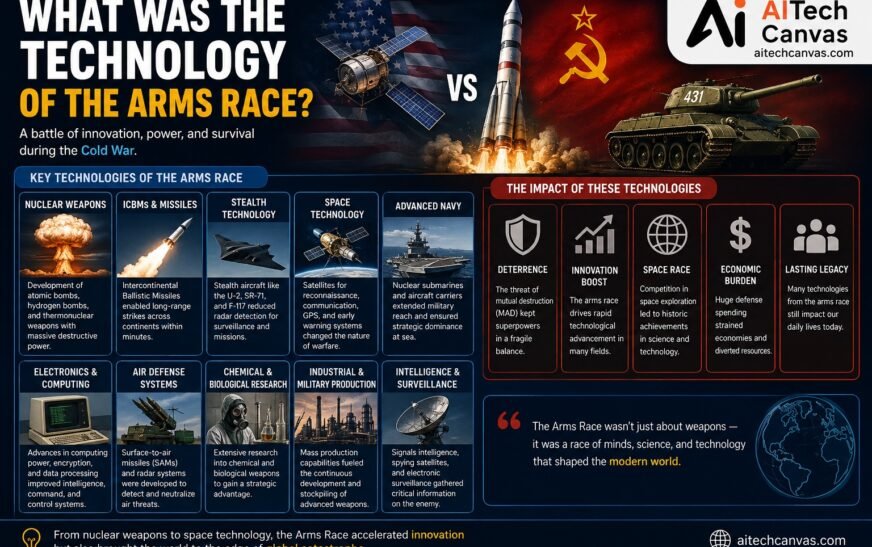
The Technology of the arms race falls into four categories, each solving a problem created by the previous one.
Nuclear weapons came first, from 1945 onward atomic fission devices, then thermonuclear designs several hundred times more powerful. Delivery systems followed, because a warhead is useless without a way to place it on target: strategic bombers, then intercontinental ballistic missiles, then ballistic missile submarines. Detection and early warning developed in response, since a thirty-minute missile flight time made continental radar networks and reconnaissance satellites essential. Computing and communications grew out of all three, because no human staff could track thousands of radar contacts or calculate missile trajectories at the required speed.
Understanding that sequence is the key to the whole period. Each layer existed to answer the layer before it. For a technology audience this is the most consequential section, and the one where the civilian legacy is clearest. The arms race helped accelerate computing, networking, and Software Application Components that later became important in modern computer systems.
What Nuclear Weapons Were Developed During the Arms Race?
The atomic bomb, 1945
The Manhattan Project, run largely at Los Alamos National Laboratory under Robert Oppenheimer’s scientific direction, produced the first working fission weapons. The Trinity test took place in New Mexico in July 1945, followed by the bombings of Hiroshima and Nagasaki in August of that year.
For four years the United States held a monopoly. That monopoly was the entire strategic picture, and it was shorter-lived than American planners expected.
The Soviet response, 1949
The Soviet programme, directed by Igor Kurchatov, tested its first fission device in August 1949 — considerably earlier than Western intelligence had projected. This single event created the arms race. Before 1949 there was an American nuclear advantage. After 1949 there was a competition.
Thermonuclear weapons, 1952 onward
Fission weapons had a practical ceiling on yield. Thermonuclear designs, advanced in the United States by Edward Teller among others, removed that ceiling. The Ivy Mike test of November 1952 demonstrated a two-stage thermonuclear device with a yield hundreds of times greater than the Hiroshima weapon. The Soviet Union tested a thermonuclear device in 1953 and a fully staged design in 1955.
Why warheads kept getting smaller
This is the part most summaries skip, and it is the hinge of the entire story.
Early thermonuclear devices were enormous too heavy for anything but a large bomber. Miniaturisation, the process of achieving high yield in a compact package, is what made missiles viable. Without smaller warheads there are no ICBMs, no submarine-launched missiles, and no nuclear triad. Warhead design and missile development were therefore the same problem approached from two ends.
| Period | Development | Strategic effect |
| 1945 | First fission weapons | US monopoly established |
| 1949 | Soviet fission test | Competition begins |
| 1952–55 | Thermonuclear weapons | Yield ceiling removed |
| Late 1950s | Warhead miniaturisation | Missile delivery becomes possible |
| 1960s–80s | Stockpile expansion | Estimated global peak of roughly 70,000 warheads |
How Were Nuclear Weapons Actually Delivered?
Strategic bombers
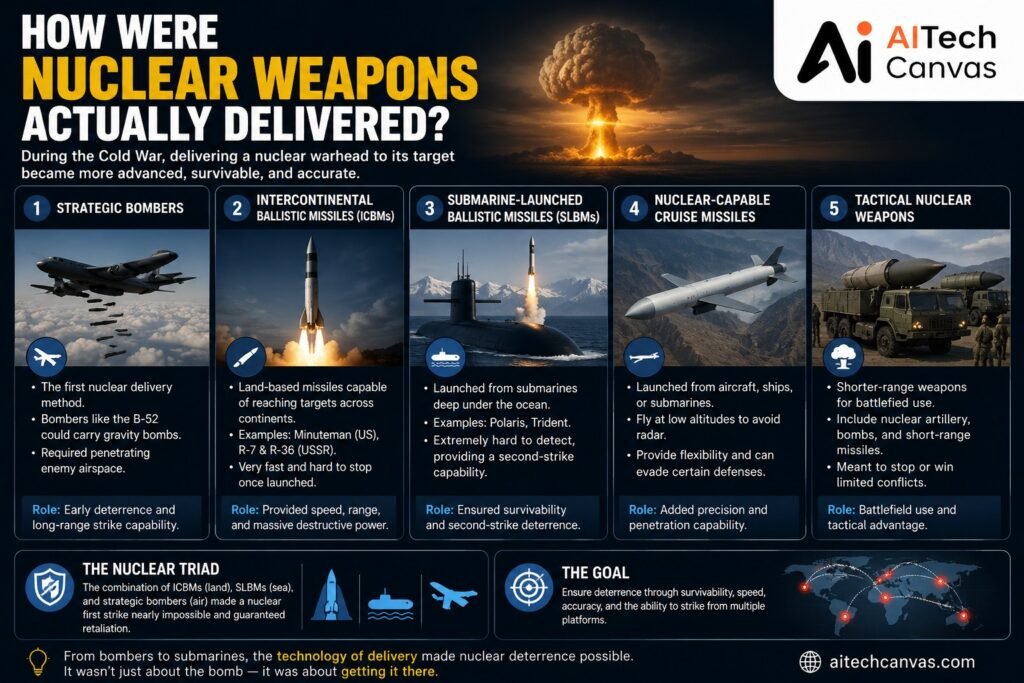
The first delivery method was the aircraft. The B-29 Superfortress carried the 1945 weapons. It was succeeded by the B-52 Stratofortress, which entered service in 1955 and remarkably remains in service today. The Soviet equivalent was the Tupolev Tu-95, also introduced in the mid-1950s and also still flying.
Bombers had a fundamental weakness. They were slow, they could be intercepted, and improving surface-to-air missile technology made deep penetration of defended airspace increasingly costly.
Intercontinental ballistic missiles
The ICBM solved the interception problem by removing the option. The Soviet R-7 Semyorka, designed under Sergei Korolev, achieved successful flight in 1957. The American Atlas became operational in 1959, followed by Titan and then Minuteman from 1962.
An ICBM crossed continents in roughly thirty minutes on a ballistic trajectory. There was no practical defence. Warning time collapsed from hours to minutes, and every system built afterwards was shaped by that compression.
Ballistic missile submarines
Land-based missiles have a location, and a known location can be targeted in a first strike. Submarines solved that.
USS Nautilus, the first nuclear-powered submarine, was commissioned in 1954. Nuclear propulsion allowed a submarine to remain submerged for months rather than hours. Combined with the Polaris missile first deployed aboard USS George Washington in 1960 this produced a launch platform that could not be found and therefore could not be eliminated.
What was the nuclear triad?
The triad was the combination of all three: land-based missiles, air-delivered weapons, and submarine-launched missiles.
Its purpose was survivability. No first strike, however well executed, could destroy all three legs simultaneously. That guaranteed retaliation, and guaranteed retaliation is what made the attack irrational. The triad was less a weapon system than an argument built out of hardware.
MIRV: multiple warheads, one missile
Multiple Independently targetable Re-entry Vehicles, deployed from around 1970, allowed a single missile to carry several warheads aimed at separate targets. MIRV multiplied warhead counts without a matching increase in missiles, and it made arms-control verification substantially harder. You can count missiles from a satellite image, but you cannot count what is inside them.
Was the Space Race Part of the Arms Race?
Yes. The two were largely the same technology programme with different public presentations.
Sputnik and the panic of 1957
Sputnik 1 launched in October 1957. The satellite itself did almost nothing it transmitted a radio beep. The rocket that carried it was the point. The R-7 that lifted Sputnik was an ICBM, and its success demonstrated to Washington that Soviet rocketry could reach American territory.
The institutional response was immediate. ARPA later DARPA was created in 1958. NASA followed the same year. American science education funding expanded sharply. A single small satellite reorganized national research priorities.
Reconnaissance from the air
Before satellites, the United States relied on the U-2 aircraft, which began overflights in 1956 at altitudes intended to be beyond Soviet reach. That assumption failed publicly in May 1960 when a U-2 was shot down over Soviet territory. The SR-71 Blackbird followed, flying higher and considerably faster.
Reconnaissance from orbit
The Corona programme delivered the durable solution. From 1960, satellites photographed Soviet territory and returned film capsules to Earth for recovery.
The strategic value was enormous and slightly counterintuitive. Satellite reconnaissance replaced guesswork with counting. Once each side could verify the other’s actual force levels, the wildly inflated threat estimates of the 1950s became untenable — and arms control agreements became technically possible, because compliance could be checked without on-site inspection.
How Did Each Side Detect an Incoming Attack?
This category receives the least attention and arguably matters most, because a deterrent is worthless if you cannot detect the attack you are deterring.
Radar networks
The Distant Early Warning Line, completed in 1957, was a chain of radar stations across the Arctic designed to detect Soviet bombers approaching North America. Building and supplying it across permafrost was an engineering project on the scale of the weapons it watched for.
NORAD
The North American Aerospace Defense Command, established in 1958, centralised American and Canadian air defence into a single continental picture. It is the direct institutional ancestor of every integrated air-defence system operating today.
Submarine detection
SOSUS was a network of seabed hydrophone arrays used to detect submarine movement across ocean basins by listening for propulsion noise. It drove a long, quiet technological contest in acoustics: quieter Soviet submarine designs against more sensitive American detection, iterating for decades. Almost none of it was public at the time.
What Computing Technology Came Out of the Arms Race?
For a technology audience this is the most consequential section, and the one where the civilian legacy is clearest.
SAGE and real-time computing
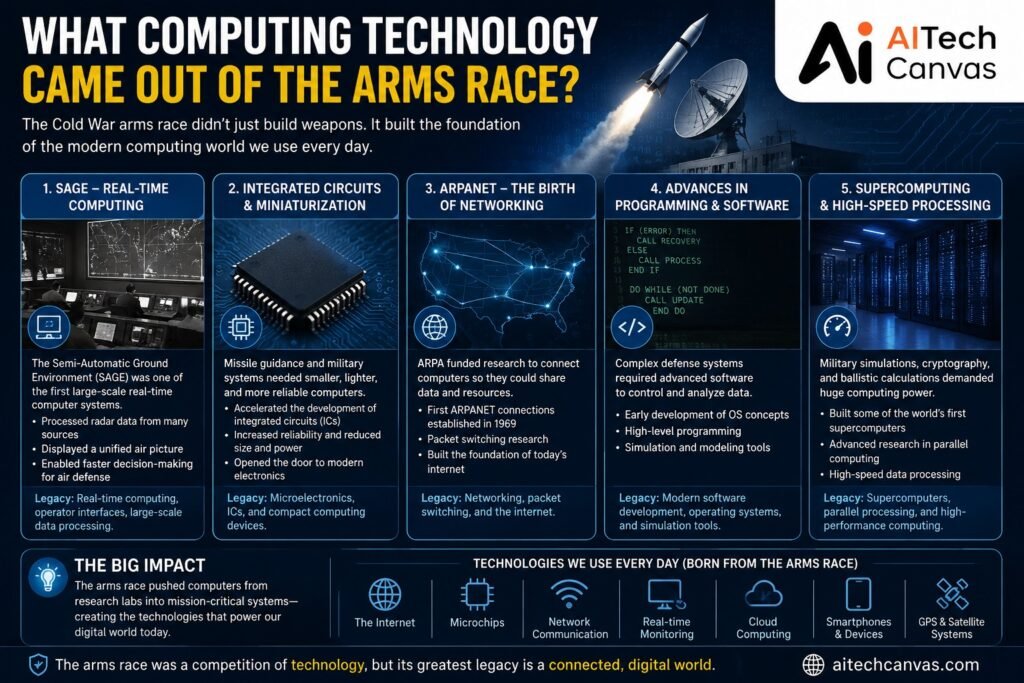
The Semi-Automatic Ground Environment, operational from the late 1950s, was built to coordinate continental air defence. It processed radar data from many sources simultaneously and presented a unified picture to operators on screens in real time.
SAGE ran on room-sized vacuum-tube computers and cost an amount frequently estimated to exceed the Manhattan Project. What it produced, beyond air defence, was foundational: real-time interactive computing, graphical operator displays, computer networking over telephone lines, and a large trained workforce that carried those methods into commercial computing. SAGE processed radar data from many sources simultaneously and presented a unified picture to operators in real time. This development helped establish the importance of complex System Administration Software and large-scale computing environments for managing interconnected systems.
Miniaturisation and the integrated circuit
The transistor was invented at Bell Labs in 1947 as civilian research. What militarised it was demand. Missile guidance systems needed computers that were small, light, and able to survive launch acceleration requirements no commercial market was producing at the time.
Guidance packages for programmes including Minuteman became major early customers for integrated circuits, purchasing at prices and volumes that let manufacturers scale production and drive unit costs down. The consumer electronics industry inherited a mature manufacturing base it did not have to fund. Military demand for smaller and more reliable computers also contributed to the development of technologies used in Embedded Software Engineering, where software operates within specialized hardware and electronic systems
ARPANET and packet switching
ARPA funded research into networks that could route data around damaged nodes rather than depending on fixed point-to-point links. The first ARPANET connections were established in 1969. ARPA funded research into networks that could route data around damaged nodes rather than depending on fixed point-to-point links. The first ARPANET connections were established in 1969. These developments eventually contributed to modern networked computing and technologies such as Linux Automation used to manage computing environments today.
One clarification worth making, because it is widely repeated incorrectly: ARPANET was not built as a command system designed to survive nuclear attack. It was a research network built to share scarce computing resources between institutions, developed within a defence research agency whose existence and funding came directly from the arms race. The distinction matters. The internet’s ancestry is real; the nuclear-bunker origin story is not.
How Did Arms Race Technology Change Military Strategy?
Technology did not simply serve strategy during the Cold War. It wrote it.
Mutually assured destruction
Once both sides held survivable retaliatory forces, the strategic logic inverted. Attacking first guaranteed your own destruction, because enough of the opponent’s arsenal would survive to respond. Mutually assured destruction was not a policy anyone designed and chose it was a condition the technology produced.
Second-strike capability
This is the concept underneath MAD. What deters an attack is not the ability to strike, but the demonstrated ability to strike back after absorbing one. Submarines provided that certainty better than anything else, which explains the enormous investment in them.
The Strategic Defense Initiative
Announced in 1983, SDI, quickly nicknamed “Star Wars” proposed a layered system to intercept incoming ballistic missiles, including space-based components.
It was never deployed as conceived. The technical requirements exceeded what was achievable, and the cost was extraordinary. Its strategic significance was different: a working missile defence would have undermined mutually assured destruction entirely, since a nation immune to retaliation is a nation that can strike first. SDI’s main effect was political and economic pressure on a Soviet economy already struggling to match American research spending.
Which Treaties Tried to Limit These Weapons?
Arms control developed alongside the weapons, and its progress depended directly on verification technology. Satellites made agreements enforceable.
| Year | Agreement | What it addressed |
| 1963 | Partial Test Ban Treaty | Banned atmospheric, underwater and outer-space nuclear tests |
| 1968 | Non-Proliferation Treaty | Limited the spread of nuclear weapons to additional states |
| 1972 | SALT I and ABM Treaty | Capped strategic launchers; restricted missile defence systems |
| 1979 | SALT II | Further limits; signed but never ratified by the US Senate |
| 1987 | INF Treaty | Eliminated an entire class of intermediate-range missiles |
| 1991 | START I | Substantial reductions in deployed strategic warheads |
The ABM Treaty deserves particular note. Restricting missile defence sounds backwards until you follow the logic: defence undermines deterrence, deterrence was keeping the peace, so both sides agreed to limit their own protection deliberately.
What Arms Race Technology Do We Still Use Today?
Most of it, in civilian form.
- Satellite navigation. GPS grew out of military positioning research, with the NAVSTAR satellite programme beginning in 1978 and reaching full operational status in the 1990s.
- The internet. Packet switching and ARPANET, funded through a defence research agency created after Sputnik.
- Modern microelectronics. Military and space procurement scaled early integrated circuit manufacturing.
- Jet aviation and aerospace materials. Bomber and reconnaissance programmes drove engine, airframe and high-temperature materials development.
- Nuclear power generation. Reactor technology developed for submarines and weapons programmes.
- Weather and Earth observation satellites. Direct descendants of reconnaissance platforms.
- Real-time computing and networked displays. From SAGE into air traffic control, finance, and effectively every control room in use today.
This is the honest summary: an enormous, unrepeatable public research investment, undertaken for reasons nobody would defend as sound, whose weapons mostly sat unused while its infrastructure quietly became the modern world. Most of it, in civilian form. Military research helped advance computing, microelectronics, aerospace, and networking, creating a foundation for modern AI Developer Platforms and today’s software ecosystem.
Is There an Arms Race Today?
Several, and they no longer look like the original.
Hypersonic weapons compress warning time further, in a period when several major treaties have lapsed the INF Treaty ended in 2019, and the ABM Treaty was exited in 2002. Cyber capability creates the ability to disable infrastructure without a physical strike and without clear attribution. Military applications of artificial intelligence raise the prospect of engagement speeds faster than human decision-making. Space is contested again, and satellites that everything else depends on are recognized as targets. Military applications of artificial intelligence raise the prospect of engagement speeds faster than human decision-making. This also connects with the broader question of Will AI replace software developers as AI becomes increasingly capable of automating software-related tasks.
One structural difference from the Cold War is worth noting. Between 1945 and 1991, defence spending led civilian technology. Today, for computing and AI, commercial research leads and defence adopts. That reversal changes who sets the pace, and it is genuinely new.
Conclusion
Arms race technology is best understood as one long chain of responses rather than a list of inventions. Warheads created the need for delivery systems. Delivery systems compressed warning time, which created the need for detection networks. Detection networks generated more data than humans could process, which created the need for computers. Computers then made the weapons more accurate, restarting the cycle.
The outcome nobody planned is that the peripheral technology outlasted the central one. Warheads were dismantled and stockpiles reduced through treaty after treaty. The satellites, the networks, the semiconductors and the real-time systems all stayed, shed their military purpose, and became ordinary. When you check a map on your phone, you are using the residue of a competition that was meant to end civilisation and instead accidentally built the infrastructure of it.
That is the part worth remembering about what the technology of the arms race actually was. Not the yields or the throw-weights, but the fact that the most consequential thing two superpowers built while preparing to destroy each other turned out to be the tools everyone now uses to talk.
Frequently Asked Questions
What was the technology of the arms race?
Nuclear warheads, delivery systems such as missiles and submarines, radar and satellite detection networks, and the computing built to coordinate them.
What was the most important arms race technology?
The intercontinental ballistic missile, because it removed any practical defence and reduced warning time to roughly thirty minutes.
Which country was technologically ahead?
Neither consistently the Soviet Union led early in rocketry and the United States led in computing, miniaturisation and reconnaissance.
Was the space race part of the arms race?
Yes, because the rockets that launched satellites were the same rockets designed to carry warheads.
What was the nuclear triad?
The combination of land-based missiles, bombers and submarines, designed so that no single first strike could eliminate all retaliatory capability.