

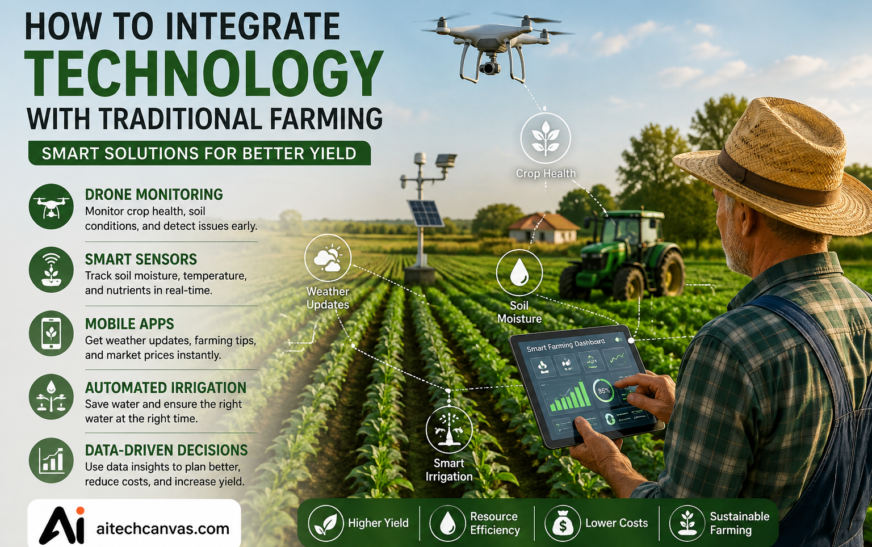
Your grandfather could read the sky and tell you when the rain was coming. A ₹900 sensor can tell you exactly how much water is left in your soil. The farmers making real money right now are the ones using both.
There is a version of the agritech conversation that annoys every practical farmer, and it goes like this: throw out the old methods, buy an app, become “smart.” It doesn’t work, and anyone who has actually stood in a field at 4 a.m. knows why. Traditional practice carries decades of local information about which corner of the plot holds water, which pest arrives after the first heavy rain, which seed variety survives a bad year. No sensor knows any of that yet.
This guide breaks that into six areas, ordered by how quickly you get your money back. Nothing here assumes a large holding, a bank loan, or an engineering degree. Costs are rough Indian market ranges and shift with brand, region, and subsidy, so treat them as a starting point for your own quotes rather than a price list.
Quick Key Takeaways
- Start with one problem, one tool. Farmers who try to digitise the whole farm in a single season usually quit by harvest.
- The cheapest high-return entry points are soil moisture sensors and irrigation timers, not drones.
- Traditional knowledge is your baseline. Technology tells you how much and when; your experience still tells you what.
- Rented equipment beats owned equipment on farms under five acres.
- Expect two to three seasons before the numbers look convincing. Anyone promising results in one crop cycle is selling something.
Soil and Water Technology: Start Here, Always
Why water is where the invisible money goes
Water is the biggest silent loss on most traditional farms. Flood irrigation on a habit-based schedule Tuesday and Friday, the way it has always been done, means you are regularly watering soil that needs nothing while a drier patch fifty feet away goes short. Because both patches look the same from the bund, the loss never registers as a loss. Modern farms can also use AI automation tools to monitor irrigation, automate repetitive tasks, and improve resource management.
A basic soil moisture sensor costs roughly ₹700 to ₹2,500 depending on whether you want a handheld probe or a wired unit that stays in the ground. Install two: one in your driest patch, one in your wettest. Inside three weeks you will understand your farm’s actual water behaviour better than the previous ten years of guessing allowed.
Adding control without adding complexity
The next step up is putting a timer on the line. A mechanical tap timer runs around ₹1,200 to ₹2,000. An electronic controller with a moisture cutoff sits closer to ₹4,000 to ₹8,000 and will stop the pump on its own when the soil has had enough. That single function eliminates the most common waste on any irrigated farm the pump nobody remembered to switch off.
Solar pumps deserve a mention and a warning. A 3 HP setup commonly falls between ₹1.8 and ₹3 lakh before subsidy, and schemes such as PM-KUSUM cover a large share in many states. The payback is genuine if you currently run diesel. It weakens considerably if you already have reliable subsidised grid power, so check your actual electricity bill before a salesman checks it for you.
What should stay traditional
Field bunding, residue mulching, contour layout on sloped land, and reading soil texture by hand remain better and cheaper than any electronic substitute. These practices shape where water goes. Sensors only report how much there is. Replacing the former with the latter is a mistake; stacking them is the point.
Crop Monitoring: Let the Phone Handle the Boring Part
Disease identification apps and their real accuracy
You already scout your fields, and technology’s job is not to replace that walk. Free disease-identification apps have become genuinely usable you photograph an affected leaf and the app suggests likely causes. They are not always correct. Treat one as a second opinion, roughly as reliable as asking a neighbour who grows a different crop.
Where they earn their place is speed. Catching a problem on day two instead of day nine changes the entire treatment cost, and sometimes changes whether treatment is possible at all. Use the app to shorten the gap between noticing and acting, not to make the final call. As agricultural automation develops, technologies such as industrial robotic arms can also support repetitive handling and processing tasks.
Satellite crop health, free of cost
Satellite-based crop health monitoring is now available at no charge through several public platforms. You get a periodic image showing which parts of the field are growing well and which are lagging. On two acres this is a curiosity. Across fifteen acres in separate parcels it saves considerable walking and flags stress early.
The images tell you where to look, never why. That second half is your job, and it is where accumulated local knowledge outperforms every model currently available. A forty-year familiarity with your area’s stem borer cycle beats a general-purpose algorithm, every time.
Drones and Machinery: Rent Long Before You Buy
Drone spraying makes sense as a service
Drone spraying genuinely works. Coverage is more even than a backpack sprayer, chemical volume drops meaningfully, and you avoid walking through a freshly sprayed field. Service rates in India commonly land somewhere around ₹400 to ₹800 per acre per pass, varying widely by state and how many operators compete locally.
Ownership is an entirely different calculation. A certified agricultural drone plus pilot licensing and DGCA compliance runs into lakhs of rupees. That maths only closes if you farm a large area or intend to sell spraying to others as a business. On five acres it will not pay for itself in any realistic timeframe. Emerging robotics approaches, including bio mechanical robots, could eventually provide new ways to automate physical tasks in agriculture.
The same rule applies to tractors and harvesters
Custom hiring centres and app-based equipment rental have made short-term machinery access normal across most districts. A thresher used eleven days a year is capital sitting idle for the other three hundred and fifty-four.
Owning machinery is itself a traditional habit worth questioning honestly. The money locked in an under-used tractor would usually do more work as a buried drip line or a second borewell. Rent the seasonal items and own only what you touch weekly.
Farm Apps and Record-Keeping: The Unglamorous Money-Maker
Why written numbers change decisions
Nobody gets excited about bookkeeping, and it is still probably the highest-return change on this entire list. You cannot improve a number you have never written down. Most farms run on remembered numbers a general sense that maize did fine last year and the vegetable patch was a headache.
That vague sense hides the things that matter: your real per-acre cost, your margin by crop, which input line quietly doubled. Without those figures, every planting decision is a guess wearing a confident expression. Three seasons of written records will change what you plant more than any gadget will. As farm operations become more digital, business automation can help streamline repetitive record-keeping and workflow tasks.
Start with paper, upgrade only when it pinches
You do not need software. A notebook with four columns date, item, amount, crop beats an unused app every single time. When the notebook starts feeling limiting, move to a spreadsheet: one sheet per season, one row per transaction, nothing fancier.
Beyond your own records, two app categories earn phone space. Mandi price tracking, so you negotiate against today’s rate instead of last week’s rumour. And localised weather forecasting, which has improved substantially and now gives usable three-to-five day windows for spraying and harvest calls. What the app cannot give you is leverage in the mandi that stays with your relationships and your judgement about when to hold stock.
Cost, Subsidy, and Why Most Adoption Quietly Fails
The five real reasons technology ends up in a drawer
Farm Technology rarely fails for technical reasons. It fails because too much was bought too fast and none of it got learned properly. It fails because nothing was repairable locally, so a sensor broke in month five and became an expense instead of an investment. It fails because equipment sized for fifty acres does nothing useful on three.
It also fails because no baseline was recorded. Without last season’s numbers you cannot prove the new thing helped, so it feels useless and gets abandoned. And it fails at the paperwork stage; subsidy schemes exist, but application windows and documentation are real work, and many farmers stop halfway through.
A first-year plan that survives a bad season
Working out how to integrate technology with traditional farming on a budget means treating each purchase the way you would treat buying a bullock. What specific job does it do, what does it cost to keep, and who fixes it when it stops.
A sensible first year runs about ₹10,000 to ₹15,000 total: two soil moisture sensors, one irrigation timer, a notebook filled in weekly, and free apps only. Prove those work across a full cycle. Then, and only then, spend more.
Polyhouse, Hydroponics and the Newer Methods
Protected cultivation is a real option, with real demands
Polyhouse and shade-net cultivation genuinely expand what you can grow and when. Off-season vegetables at premium prices, protection from erratic rain, far better water efficiency per kilo produced. Costs commonly fall in the ₹8 to ₹15 lakh per acre range for a decent structure, with substantial state subsidy available in many places.
The catch is the skill set. Protected cultivation demands near-daily monitoring, tighter disease management, and a buyer arranged in advance for higher-value produce. Field experience helps but does not transfer directly, which is why this belongs late in the sequence rather than early.
Hydroponics and vertical farming: treat as a separate business
These attract enormous attention and produce a long list of failed ventures. They make sense as high-value niche production close to a city market where you can sell fresh at a premium. They make very little sense as a substitute for staple field crops, whatever the video suggested.
Electricity dependence alone disqualifies many locations. If the idea appeals, plan it as a second business with its own capital and its own buyer, not as an upgrade to the farm you already run.
Conclusion
The farmers doing best right now are neither the most traditional nor the most technological. They are the ones who kept inherited knowledge and added measurement on top of it. Their fathers knew the field needed water. They know it needs eleven millimetres.
If you take one thing from this guide, take the order of operations. Fix water first, because that is where the invisible losses live. Write your numbers down, because that is the only way you will ever know something worked. Rent the expensive machinery. Let apps handle what is tedious and keep the judgement calls for yourself. Ignore anyone telling you to abandon methods that have kept your family fed through decades of difficult seasons.
How to integrate technology with traditional farming finally comes down to a small, unromantic discipline: one problem, one tool, three seasons of honest record-keeping. Do that and the next decision more or less makes itself. Start this week with a ₹900 sensor and a notebook.
Frequently Asked Questions
What is the cheapest way to integrate technology with traditional farming?
A soil moisture sensor and an irrigation timer, roughly ₹2,000 to ₹4,000 together.
Will technology completely replace traditional farming methods?
No, sensors measure conditions, but they hold none of your plot’s history or local pest knowledge.
How much money do I need to start?
Under ₹15,000 covers basic sensors, a timer, free apps, and a written expense record.
Is drone spraying worth it on a small farm?
Yes as a rented service at ₹400 to ₹800 per acre, almost never as a purchase.
How long before farm technology shows returns?
Water and input savings appear in season one; yield gains usually take two to three cycles.