
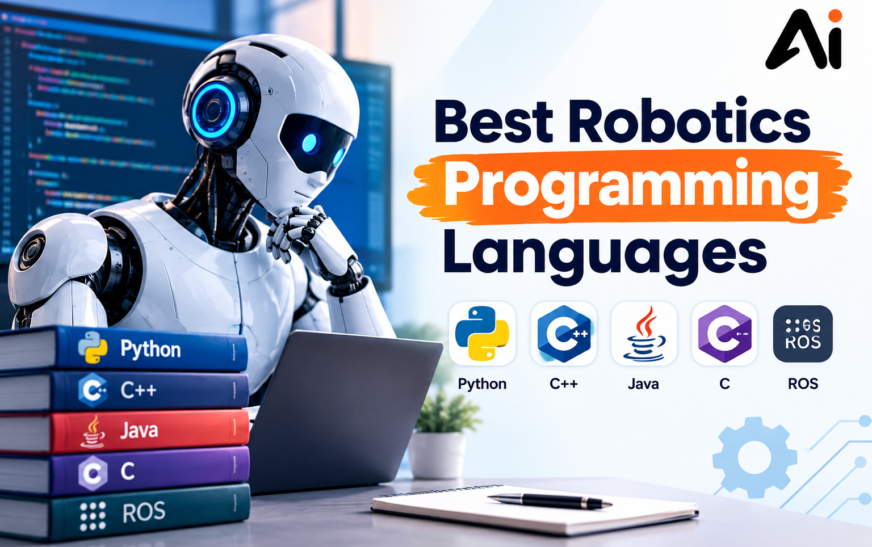
Want to build smarter robots? Choosing the right programming language can make it easier to control hardware, process sensor data, develop autonomous behavior, and create reliable robotic systems.
Robotics programming is the process of creating software that controls a robot’s movement, sensors, motors, communication, decision-making, and automated tasks. Python and C++ are two of the most widely useful choices, while C, MATLAB, Java, JavaScript, Rust, and specialized robot languages can be valuable for specific applications.Modern robots depend on software to turn hardware into useful machines. Motors, cameras, sensors, controllers, and actuators all need instructions that tell them what to do and how to respond to changing conditions. From educational robots to industrial robotic arms and autonomous vehicles, programming plays a central role in how robotic systems operate.
The best programming language depends on the robot, hardware, performance requirements, development framework, and application. Python is popular for beginners, artificial intelligence, computer vision, and rapid prototyping, while C and C++ are especially useful for embedded systems, hardware control, and performance-sensitive applications.
In this guide, we will explore the best programming languages for robotics, compare Python and C++, explain robotics software and frameworks such as ROS and ROS 2, and discuss the skills beginners should learn.
Key Takeaways
- Python is an accessible choice for beginners, AI, automation, and rapid prototyping.
- C++ is valuable for high-performance robotic systems and ROS development.
- C is particularly useful for embedded systems and microcontrollers.
- MATLAB is useful for robotics simulation, mathematical modeling, and research.
- Java, JavaScript, and Rust can support specialized robotics applications.
- Industrial robots may use manufacturer-specific programming languages.
- ROS and ROS 2 help developers build complex robotic applications.
- Robotic arms and autonomous robots may require different programming approaches.
- Strong programming fundamentals are more important than learning one language alone.
What Are Robotics Programming Languages?
Robotics programming languages are languages used to create instructions and software for robots. They allow developers to control movement, read sensors, process information, communicate with other systems, and automate tasks.
The term covers both general-purpose languages and specialized robot programming languages. A developer might use Python for computer vision, C++ for motion planning, C for a microcontroller, and a manufacturer-specific language for an industrial robot.
Programming Languages for Robots
Programming languages for robots connect software logic with physical components. A robot may receive information from cameras, ultrasonic sensors, encoders, or other devices. Software then processes that information and determines what action the robot should take.
For example, a mobile robot could detect an obstacle, calculate a different route, and continue moving. An industrial robot could use programmed coordinates to pick up a component and place it in a precise location.
Robotics Coding Languages
Robotics coding languages are important because robots operate in the physical world. Unlike ordinary software applications, robotic systems must account for movement, timing, sensor accuracy, hardware limitations, and safety.
This is why robotics software development often combines several technologies instead of relying on one language.
Programming for Robotics
Programming for robotics can start with simple commands, such as turning a motor on or reading a sensor, and progress to advanced applications involving navigation, computer vision, artificial intelligence, and autonomous decision-making.
What Programming Language Is Best for Robotics?
There is no single best programming language for every robot. The right option depends on the project’s goals, hardware, required performance, development environment, and developer experience.
Python is often a strong starting point because it is relatively easy to learn and has extensive libraries for AI, computer vision, and automation. C++ is an excellent option when performance, robotics frameworks, and complex control systems are important.
The best language to learn for robotics also depends on your career direction. Someone interested in AI robotics may start with Python, while an engineer working with embedded controllers may benefit from C or C++.
Best Programming Languages for Robotics
The most commonly considered programming languages include:
- Python
- C++
- C
- MATLAB
- Java
- JavaScript
- Rust
- Specialized industrial robot languages
7 Best Robotics Programming Languages
1. Python for Robotics
Python is one of the most beginner-friendly choices for robotics. Its readable syntax allows new developers to focus on programming concepts instead of complicated language syntax.
Python robotics programming is also useful for artificial intelligence, computer vision, data processing, automation, and rapid prototyping. Libraries and frameworks make it possible to connect Python applications with sensors, cameras, robotic platforms, and development environments.
For developers interested in Robotics Operating System projects, Python can also be used for ROS robotics applications.
2. C++ for Robotics
C++ is one of the most important languages for advanced robot systems. It offers strong performance and efficient memory management, making it useful for applications that need fast processing and close interaction with hardware.
C++ can be used for motion planning, navigation, perception, control systems, and complex robotic applications. It is also widely used with ROS and ROS 2.
3. C Programming for Robotics
C remains highly relevant to embedded robotics. Microcontrollers often need efficient programs that communicate directly with motors, sensors, and electronic components.
C programming for robotics is particularly useful when developers need low-level control over hardware resources. It can be found in projects involving motor controllers, sensors, embedded boards, and real-time hardware systems.
4. MATLAB for Robotics
MATLAB is widely used for mathematical modeling, simulation, control systems, and robotics research. Developers and researchers can use MATLAB to test algorithms and study how robotic systems behave before deploying them to physical hardware.
MATLAB robotics programming can be particularly useful for students, researchers, engineers, and projects that require mathematical analysis or simulation.
5. Java for Robotics
Java can support certain robotics applications where portability and its established software ecosystem are useful. It is not always the first choice for low-level robot control, but it can be appropriate for specific applications and educational projects.
Java robotics programming may also be useful when a robotic application needs to integrate with existing Java-based software.
6. JavaScript for Robotics
JavaScript can be used for web-based robotics interfaces, dashboards, monitoring systems, and connected robotic applications.
Developers can use JavaScript for robotics projects where a browser-based interface is useful for viewing robot status, sending commands, or displaying sensor information.
7. Rust for Robotics
Rust is attracting interest in systems programming because it combines performance with strong memory-safety features.
Rust for robotics can be considered for applications where developers want systems-level performance while reducing certain classes of memory-related programming errors. Its role in robotics continues to develop as the ecosystem grows.
Python vs C++ for Robotics
Python and C++ are often compared because both can play important roles in modern robot development.
Python is generally easier to learn and is particularly useful for AI, computer vision, data processing, automation, and rapid experimentation. C++ provides strong performance and is useful for applications where efficient execution and lower-level control are important.
C++ vs Python Robotics
For beginners, Python may provide a smoother introduction. For advanced robotic control, high-performance applications, and many ROS-based systems, C++ can be a valuable skill.
In practice, developers do not always need to choose only one. A robotics project can use Python for high-level logic or AI while C++ handles performance-sensitive components.
C vs C++ for Robotics
C is especially useful for embedded programming and direct hardware interaction. C++ builds on many concepts from C while providing additional programming features that can make large robotic software systems easier to structure.
Python vs MATLAB for Robotics
Python is often more flexible for general programming, AI, automation, and software development. MATLAB is particularly useful for mathematical modeling, simulation, control engineering, and research.
Best Robotics Programming Language for Beginners
Beginners should focus first on learning programming fundamentals rather than trying to master every robotics language at once.
Python is often a good starting point because its syntax is relatively simple and its ecosystem supports many areas relevant to robotics. After learning variables, loops, functions, classes, data structures, and debugging, students can move into robotics-specific concepts.
Robotics Programming for Beginners
A beginner-friendly path can look like this:
- Learn basic Python programming.
- Build small sensor and motor projects.
- Learn basic electronics.
- Work with Arduino or Raspberry Pi.
- Experiment with a simple mobile robot.
- Learn computer vision and sensors.
- Explore ROS or ROS 2.
- Move into C or C++ for advanced applications.
Easiest Programming Language for Robotics
Python is often considered one of the easiest languages for beginners because its syntax is straightforward. However, the easiest language depends on the project and the hardware being used.
Robotics Coding for Beginners
Beginners can practice coding for robots by creating simple projects such as controlling an LED, reading sensor values, moving a motor, detecting an object, or programming a robot to avoid obstacles.
Educational platforms can provide practical experience before students move to more advanced autonomous robots.
Best Language for Industrial Robotics
Industrial robotics has different requirements from educational or hobby projects. Industrial systems need reliability, precise movement, repeatability, safety, and integration with manufacturing equipment.
Programming Industrial Robots
Programming industrial robots may involve general-purpose languages such as C++ or specialized manufacturer-specific programming environments.
Manufacturers can provide their own programming systems for robotic arms. These environments are designed around the controller and capabilities of a specific robot platform.
KUKA Robot Language
KUKA industrial robots can be programmed using KRL, commonly called the KUKA Robot Language. It is designed specifically for controlling and programming KUKA robotic systems.
Learning a manufacturer-specific language can therefore be important for engineers who work with a particular industrial robot platform.
Robotic Programming Software
Robotic programming software can provide tools for creating, testing, simulating, debugging, and deploying robot applications. Depending on the platform, it may include robot controllers, simulation environments, motion planning tools, SDKs, and programming interfaces.
Best Programming Language for ROS and ROS 2
ROS, or Robot Operating System, provides tools, libraries, and frameworks that help developers create complex robotic applications. ROS 2 is the newer generation of the framework and is designed for modern distributed robotic systems.
Python and C++ are especially important in the ROS ecosystem.
ROS Python and ROS C++
ROS Python is useful for accessible application development, prototyping, automation, and many higher-level robotics tasks. ROS C++ is often preferred for applications where performance and efficient processing are important.
The choice between ROS Python and ROS C++ depends on the application’s requirements, existing libraries, performance needs, and developer experience.
Robotics Software Frameworks
Robotics software frameworks help developers organize communication between different parts of a robotic system. They can provide tools for sensors, movement, navigation, simulation, and hardware integration.
Robotics SDK and Programming Tools
A robotics SDK can provide libraries, APIs, documentation, and development tools for communicating with a particular robot or hardware platform.
Common robotics programming tools may also include debugging environments, simulators, visualization tools, motion planners, and hardware interfaces.
Gazebo Robotics
Gazebo is a robotics simulation environment that can help developers test robotic systems in a virtual environment. Simulation can reduce the need to test every early-stage idea on physical hardware.
MoveIt Robotics
MoveIt is used for robotic manipulation and motion planning. It can help developers work with robotic arms, plan movements, and integrate motion-related functionality into robotic applications.
Best Language for Robotic Arms and Autonomous Robots
Different robots create different programming challenges. A robotic arm needs accurate movement and control, while an autonomous mobile robot may need navigation, mapping, perception, and obstacle avoidance.
Best Programming Languages for Robotic Arms
C++, Python, C, and specialized manufacturer languages can all be useful for robotic arms.
C++ can support complex motion planning and control applications, Python can help with AI and computer vision, and manufacturer-specific languages can directly control industrial robotic platforms.
Best Programming Language for Autonomous Robots
Autonomous robots often combine multiple languages and technologies. Python can be useful for AI, machine learning, and computer vision, while C++ can handle performance-sensitive navigation and control components.
Mobile Robot Programming
Mobile robot programming commonly involves navigation, sensor processing, localization, mapping, and obstacle avoidance.
Humanoid Robot Programming
Humanoid robots require software for balance, movement, perception, interaction, and sometimes natural-language processing. Such systems often combine several programming languages and robotics frameworks.
Drone Programming Languages
Drone applications may use languages such as C++, Python, or specialized SDK-supported languages depending on the flight controller and development platform.
Arduino and Raspberry Pi Robotics Programming
Arduino is commonly used for beginner and embedded robotics projects, particularly when controlling sensors and motors. Raspberry Pi provides a more powerful computing environment that can support Python, computer vision, networking, and more advanced applications.
VEX and LEGO robotics platforms are also useful for students learning programming and robotic concepts.
What Is the Purpose of the Robot Program?
The purpose of a robot program is to give a robot instructions for performing tasks and responding to its environment.
A program can tell a robot how to move, when to activate a motor, how to interpret sensor readings, how to communicate with another system, or how to respond when it detects an object.
For example, a warehouse robot may use software to navigate through aisles, while an industrial robotic arm may follow programmed positions to assemble or move products.
Robotics Programming Skills You Should Learn
Learning a programming language is only one part of becoming a capable robotics developer. Strong robotics projects require a combination of software, hardware, mathematics, and engineering knowledge.
Important skills include:
- Programming fundamentals
- Algorithms and data structures
- Debugging
- Electronics
- Sensors and actuators
- Motor control
- Embedded systems
- Computer vision
- Artificial intelligence
- Machine learning
- Linux
- ROS and ROS 2
- Simulation
- Networking
- System integration
Robotics Programming Tips
Developers should test small components before combining them into a complete robot system. Simulation can be useful for testing algorithms, while logging sensor data can make debugging easier.
It is also important to document code, create safety checks, and avoid assuming that a robot will behave exactly as expected in the physical world.
For more practical guidance, check 12 Robotics Programming Tips to explore additional techniques for improving development, testing, and debugging workflows.
How to Choose a Robotics Programming Language
The right language depends on several factors.
1. Consider the Robot Hardware
First, determine which programming languages and SDKs the robot’s controller supports. Hardware compatibility can immediately narrow your options.
2. Consider Performance
If your application requires fast processing, real-time control, or efficient hardware interaction, C or C++ may be more appropriate.
3. Consider the Application
AI and computer vision projects may benefit from Python, while embedded systems may require C or C++. Simulation and control research may benefit from MATLAB.
4. Check Framework Compatibility
If you plan to use ROS or ROS 2, consider which languages are best supported for the specific packages and components you need.
5. Think About the Learning Curve
Beginners may want to start with Python before learning C++ or other systems-oriented languages.
6. Look at Community and Documentation
Strong communities, libraries, tutorials, and documentation can make it easier to solve problems and build projects.
7. Match the Language to Your Career Goals
If you want to work in industrial robotics automation, embedded systems, autonomous vehicles, AI robotics, or research, choose languages that are relevant to your target field.
Future of Robotics Programming
The future of robotics will increasingly combine traditional software development with artificial intelligence, machine learning, computer vision, simulation, and autonomous decision-making.
Robots are becoming capable of processing more information and adapting to complex environments. As this happens, developers may spend more time integrating AI models, perception systems, autonomous navigation, and high-level decision-making with reliable low-level control.
However, fundamental programming knowledge will remain important. AI can assist with software development, but robotic systems still need carefully designed code to communicate with hardware, manage sensors, control movement, and handle unexpected conditions.
For developers building their skills, 12 Robotics Programming Tips can also serve as a practical resource for improving development workflows and approaching more advanced robotics projects.
Conclusion
Choosing among programming languages for robotics depends on what you want to build. Python is an excellent starting point for beginners, AI, computer vision, and rapid development, while C++ is particularly valuable for high-performance robotic systems and ROS applications. C remains important for embedded hardware, while MATLAB, Java, JavaScript, Rust, and specialized industrial languages can support specific use cases.
The most effective approach is to build a strong foundation in programming and then expand into sensors, electronics, control systems, computer vision, AI, simulation, and robotics frameworks. With these skills, you can progress from simple educational robots to sophisticated autonomous machines and industrial robotic systems.
FAQs About Robotics Programming Languages
What is the best programming language for robotics?
Python and C++ are two of the most useful choices. Python is easier for beginners and works well for AI and rapid prototyping, while C++ is valuable for high-performance and complex robotic applications.
Is Python or C++ better for robotics?
Neither is universally better. Python is easier to learn and useful for AI, computer vision, and prototyping. C++ is generally better suited to performance-sensitive applications and many advanced robotics systems.
What is the easiest programming language for robotics?
Python is often one of the easiest languages for beginners because of its readable syntax and large collection of libraries.
Is C++ important for robotics?
Yes. C++ is an important skill for developers working with high-performance robotics, motion planning, ROS, perception, navigation, and hardware-related applications.
Can I use Python for robot programming?
Yes. Python can be used for AI, computer vision, automation, sensor processing, prototyping, and many robotics frameworks.
What programming language is used in ROS 2?
Python and C++ are two major programming choices for ROS 2. The best option depends on the application and performance requirements.
What programming language is used for industrial robots?
Industrial robots can use C++, C, Python, and specialized manufacturer-specific languages. The exact language depends on the robot manufacturer and controller.
Which language should beginners learn for robotics?
Python is a strong starting point for beginners. After learning programming fundamentals, students can add C or C++ and then explore robotics frameworks such as ROS 2.