
Customer expectations are changing as businesses look for faster and more convenient ways to provide support. Customers want quick answers, helpful recommendations, and assistance whenever they need it. Traditional customer service teams can struggle to manage large numbers of inquiries, especially during busy periods. This is where an AI customer service agent can help.
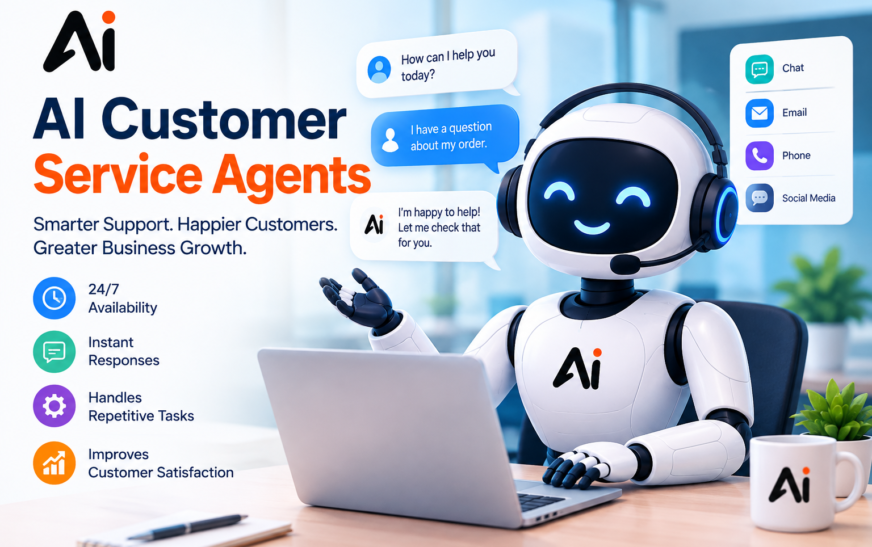
AI customer service agents use artificial intelligence to understand customer questions, provide relevant answers, automate repetitive tasks, and support human representatives. They can assist with common inquiries, order updates, appointment scheduling, troubleshooting, and other routine activities.
For businesses of different sizes, these tools can improve response times, reduce repetitive workloads, and create a more consistent customer experience. However, their effectiveness depends on the quality of their data, integration with business systems, and ability to transfer complex issues to human employees.
In this guide, you will learn what AI customer service agents are, how they work, their key benefits, common applications, and how to choose the right solution for your business.
What Is an AI Customer Service Agent?
An AI customer service agent is a software-based assistant that uses artificial intelligence to interact with customers and help resolve their requests. Unlike basic automated systems that follow fixed scripts, modern AI agents can interpret natural language, identify customer intent, and use approved information or connected tools to complete certain tasks.
For example, an AI customer service agent can answer frequently asked questions, explain a return policy, check an order status through an integrated system, or help a customer troubleshoot a technical problem.
Some agents work through website chat, while others support email, messaging platforms, and voice interactions. Their capabilities depend on the software and permissions provided by the business.
AI customer service agents can also work alongside human representatives. When a request involves sensitive information, an unusual situation, or a complicated complaint, the agent can transfer the conversation to an appropriate employee.
How Do AI Customer Service Agents Work?
AI customer service agents combine several technologies to understand requests and provide useful responses. The exact process varies by platform, but most solutions follow a similar workflow.
1. Understanding Customer Questions
The agent analyzes a customer’s message using natural language processing and other AI techniques. It attempts to identify what the customer wants, whether the person needs information, and what action may be required.
For instance, when a customer asks, “Where is my order?”, the agent recognizes that the request concerns order tracking rather than a general product question.
2. Finding Relevant Information
The agent searches approved knowledge sources, such as FAQs, help articles, product documentation, and company policies. More advanced systems can retrieve information from connected customer relationship management (CRM) platforms or order management software.
Accurate and updated information is essential because outdated policies or incomplete records can lead to incorrect responses.
3. Completing Tasks
When integrations and permissions are available, an AI agent may perform specific actions. These can include creating a support ticket, updating a customer record, checking an order, or scheduling an appointment.
Businesses should limit these permissions according to the risk of each action and require human approval when necessary.
4. Escalating Complex Requests
Not every customer issue should be handled automatically. When an agent cannot confidently resolve a problem, it should pass the conversation to a human representative with relevant context.
This approach combines the speed of automation with human judgment and empathy.
Key Benefits of AI Customer Service Agents
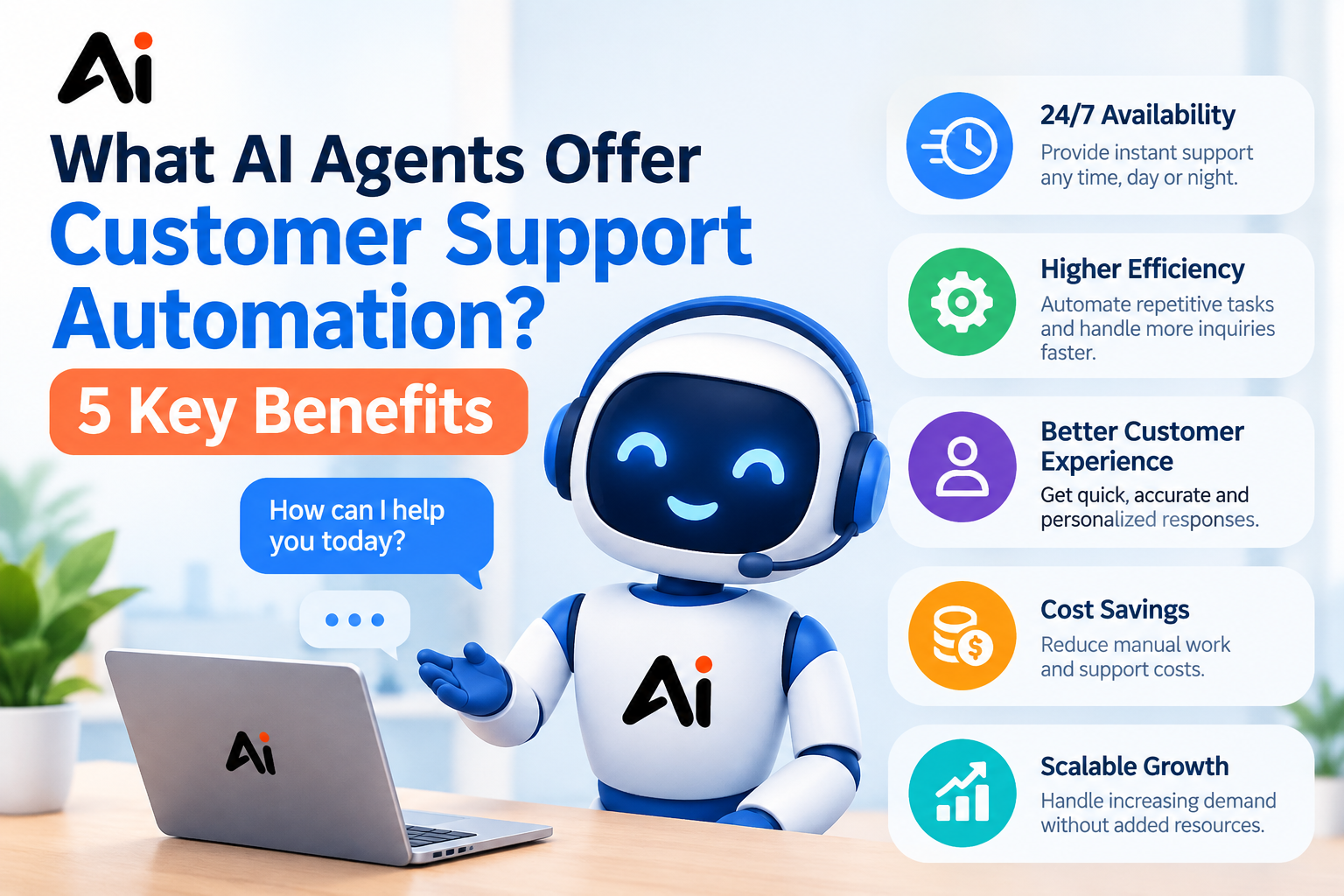
AI customer service agents can support businesses by automating repetitive tasks and helping service teams manage customer inquiries more efficiently.
1. Provide 24/7 Customer Support
Human customer service teams usually work in shifts, and smaller businesses may not have enough staff to provide assistance around the clock. An customer support automation agent can respond to routine questions outside normal business hours.
For example, an online store can use an AI agent to explain shipping policies, share product information, and guide customers through basic troubleshooting at night or during weekends.
This availability can make it easier for customers to find information without waiting for the next working day. However, live human assistance may still be necessary for complex or urgent problems.
2. Reduce Repetitive Work
Customer service employees often answer the same questions about returns, delivery times, account access, and product features. AI agents can handle many of these routine inquiries automatically.
This gives employees more time to focus on complicated cases that require investigation, negotiation, or personal attention.
The result depends on how frequently customers ask questions the agent can reliably answer and how well the system connects with the company’s existing processes.
3. Improve Response Times
Long queues and delayed replies can frustrate customers. AI customer support agents can respond to multiple routine inquiries without requiring each customer to wait for an available representative.
For example, an AI agent can immediately explain a return policy or guide a customer through a common technical issue.
Faster responses do not automatically guarantee better service. Businesses must also monitor answer accuracy, successful resolutions, customer satisfaction, and the number of conversations that require additional help.
4. Support Business Growth
As a business attracts more customers, its support workload often increases. Hiring additional representatives may be necessary, but automation can help manage predictable demand.
AI agents can assist with common requests while human employees handle exceptions and higher-value interactions.
This can make support operations more flexible, although businesses should still plan staffing carefully and monitor service quality as customer volume grows.
5. Deliver More Consistent Answers
An AI agent connected to a well-maintained knowledge base can provide consistent information about product specifications, company policies, and standard procedures.
This helps reduce variations between responses from different representatives.
However, consistency depends on the quality of the underlying information. Businesses should regularly review knowledge sources, test the agent, and correct inaccurate or incomplete responses.
Common Uses of AI Customer Service Agents
AI customer service agents can support many departments and industries. Their practical value depends on the tasks they are authorized to perform and the systems they can access.
E-Commerce Customer Support
Online retailers can use AI agents to answer product questions, explain shipping options, provide return instructions, and help customers track orders through connected systems.
An agent may also guide shoppers toward relevant products based on their stated needs. Refunds, payment disputes, and unusual delivery problems may require human review.
Technical Support and Troubleshooting
Software companies and technology providers can use AI agents to guide customers through installation steps, explain common error messages, and recommend solutions from approved documentation.
For example, an agent can walk a user through basic connection checks before creating a ticket for a more complicated issue.
Technical support agents should recognize when a problem requires specialist assistance rather than repeating unsuccessful troubleshooting steps.
Banking and Financial Services
Financial institutions may use AI-powered customer service tools to explain general account procedures, answer common service questions, and guide customers toward the appropriate support channel.
Because financial information is sensitive, these systems need strong access controls, appropriate verification, and clear limits on the actions they can perform. High-impact financial decisions should not be delegated without suitable safeguards and oversight.
Healthcare Administration
Healthcare organizations can use AI assistants for administrative tasks such as explaining appointment procedures, sharing general office information, and helping patients navigate scheduling systems.
These tools should protect personal information and avoid presenting unverified medical guidance as professional advice. Clinical questions and urgent concerns should be directed to qualified healthcare professionals or appropriate emergency services.
Travel and Hospitality
Hotels, travel agencies, and other hospitality businesses can use AI agents to answer questions about bookings, check-in procedures, cancellation policies, and available services.
With suitable integrations, an agent may help customers retrieve reservation details or request a booking change. Changes involving fees, availability, or special circumstances may require confirmation or human assistance.
AI Customer Service Agent vs. Traditional Chatbot
Although the terms are sometimes used interchangeably, AI customer service agents and traditional chatbots can have different capabilities.
| Feature | Traditional Chatbot | AI Customer Service Agent |
| Customer questions | Often follows predefined rules | Can interpret natural-language requests |
| Conversation | May rely on fixed menus | Can support more flexible conversations |
| Task automation | Usually limited to configured flows | May complete tasks using connected tools |
| Personalization | Often limited | Can use authorized customer context |
| Complex requests | Commonly routes to staff | May handle some requests and escalate others |
| Human oversight | Depends on implementation | Important for sensitive or high-risk tasks |
These categories overlap. Modern chatbots can use generative AI, while some AI agents have limited capabilities. The most useful comparison is based on what a specific product can actually do, not its marketing label.
Best AI Customer Service Tools to Consider in 2026
The right tool depends on your business size, support channels, existing software, budget, and automation requirements. The following platforms are worth evaluating for different needs.
1. Intercom
Intercom provides customer messaging and support software with AI-powered support capabilities. It is worth considering for businesses that want to combine automated customer conversations with human support workflows.
Before choosing it, review supported integrations, automation limits, pricing, and the features available under your intended plan.
2. Zendesk
Zendesk offers customer service software with ticketing, knowledge management, and AI-supported service features. It may suit organizations that need structured support workflows across multiple channels.
Businesses should evaluate how its AI capabilities fit their current ticketing setup and whether the available automation features meet their needs.
3. Salesforce Service Cloud
Salesforce Service Cloud supports customer service operations and CRM-connected workflows, including AI capabilities. It may be suitable for organizations that already use Salesforce or require customer service processes connected to broader business data.
Implementation requirements, licensing, permissions, and configuration should be reviewed before deployment.
4. Freshdesk
Freshdesk provides customer support and ticket management features, with AI capabilities available through its product offerings. It may be useful for teams seeking to organize support requests and automate selected tasks.
Compare the available AI features, integrations, reporting, and plan restrictions to determine whether it matches your team’s requirements.
5. Ada
Ada focuses on AI-powered customer service automation. It is worth evaluating for businesses that want to automate customer conversations across supported channels and integrate automated assistance into existing service operations.
Check its current capabilities, supported integrations, implementation requirements, and pricing directly with the provider.
Important: Product capabilities and prices can change. Confirm current plans and features on official product websites before making a purchasing decision.
How to Choose the Right AI Customer Service Agent
Choosing an AI customer service agent requires more than comparing feature lists. The best solution should address real customer problems while fitting your existing workflow.
Identify Your Most Common Customer Questions
Review support tickets, emails, live chats, and customer feedback to identify repetitive inquiries. Start with tasks such as order tracking, product information, appointment scheduling, or basic troubleshooting.
Selecting a clear initial use case makes it easier to evaluate whether automation provides meaningful value.
Check Integration Options
Look for compatibility with your CRM, help desk, e-commerce platform, knowledge base, and communication channels.
An agent that cannot access the necessary information may give generic answers without resolving the customer’s actual problem.
Evaluate Security and Privacy
Review how the provider handles customer data, access permissions, retention, and security controls. Limit the agent’s access to information and actions necessary for its assigned tasks.
Businesses handling sensitive information should also assess applicable legal and regulatory requirements.
Test Accuracy and Escalation
Before launching the system, test common questions, unusual requests, ambiguous messages, and situations where the correct answer is unavailable.
Make sure the agent can acknowledge uncertainty and transfer conversations to human representatives when needed.
Measure Performance
Track useful metrics such as resolution rate, first response time, customer satisfaction, escalation rate, and cost per resolved conversation.
Compare results with your existing support process and adjust the agent based on real customer interactions.
Challenges and Limitations of AI Customer Service Agents
Despite their advantages, AI customer service agents are not a complete replacement for human support teams.
Incorrect or Incomplete Answers
AI systems can misunderstand questions or generate inaccurate information. Connecting agents to approved knowledge sources, limiting their scope, and testing their responses can help reduce this risk.
Privacy and Security Concerns
Customer conversations may contain personal or confidential information. Businesses need appropriate data protection measures, access controls, and clear policies for handling sensitive information.
Limited Human Understanding
AI can recognize patterns in language and respond conversationally, but it may struggle with emotional situations, unusual circumstances, or complex complaints.
Human representatives remain important when customers need empathy, discretion, or judgment.
Setup and Maintenance Costs
AI customer service software may involve subscription fees, integration work, staff training, and ongoing maintenance. Businesses should calculate the total cost rather than comparing subscription prices alone.
Customer Trust
Some customers prefer speaking with a person, especially when resolving a complaint or discussing a sensitive issue. Businesses should clearly identify automated assistance and provide an accessible way to reach a human representative.
What Is the Future of AI Customer Service Agents?
AI customer service is moving toward more connected and task-oriented systems. Rather than simply answering questions, some agents can retrieve relevant information, use approved business tools, and complete specific workflow steps.
For example, a customer service agent may identify a delivery problem, retrieve an order record, explain the available options, and prepare a support ticket if the issue cannot be resolved automatically.
As these capabilities develop, businesses will need to focus on reliable integrations, accurate knowledge, clear permissions, and effective human oversight. The goal should be to improve customer outcomes rather than automate every conversation.
Organizations that begin with well-defined use cases and measure performance carefully will be better positioned to determine where AI provides genuine value.
Frequently Asked Questions
What is an AI customer service agent?
An AI customer service agent is software that uses artificial intelligence to understand customer requests, answer questions, retrieve information, and perform approved support tasks. Depending on its capabilities, it can also connect customers with human representatives.
How do AI customer service agents help businesses?
They can automate repetitive inquiries, provide support outside normal business hours, reduce response delays, and help employees focus on more complicated cases. Results depend on implementation quality and the tasks being automated.
Can AI customer service agents replace human representatives?
AI agents can handle some routine interactions, but they do not eliminate the need for human representatives. Complex complaints, sensitive situations, exceptions, and decisions requiring human judgment often need personal assistance.
Are AI customer service agents suitable for small businesses?
Yes. Small businesses may benefit from automating frequent questions and providing basic support when staff members are unavailable. They should select a solution that fits their workload, budget, technical requirements, and privacy needs.
What is the difference between an AI agent and an AI chatbot?
A traditional chatbot often follows predefined conversational rules. An AI agent may have additional capabilities, such as interpreting more complex requests, retrieving information from connected systems, and executing authorized tasks. Actual capabilities vary by product.
How much does an AI customer service agent cost?
Costs vary depending on the provider, subscription plan, interaction volume, AI usage, integrations, and implementation requirements. Businesses should review current pricing and calculate the total cost of ownership before selecting a platform.
Are AI customer service agents safe?
They can be deployed with appropriate safeguards, but no system is automatically risk-free. Businesses should evaluate data protection, permissions, security controls, accuracy, and human escalation procedures before deployment.
Conclusion
An AI customer service agent can help businesses provide faster responses, automate repetitive tasks, and manage customer inquiries more efficiently. From e-commerce and technical support to travel and healthcare administration, these systems can support a wide range of customer service activities.
The best results come from choosing the right use cases, connecting the agent to reliable information, protecting customer data, and maintaining human oversight. Instead of trying to automate every interaction, businesses should begin with repetitive, low-risk tasks and measure their impact.
With a thoughtful implementation strategy, AI customer service agents can become a useful part of a modern customer support operation while allowing human representatives to focus on situations where their expertise matters most.