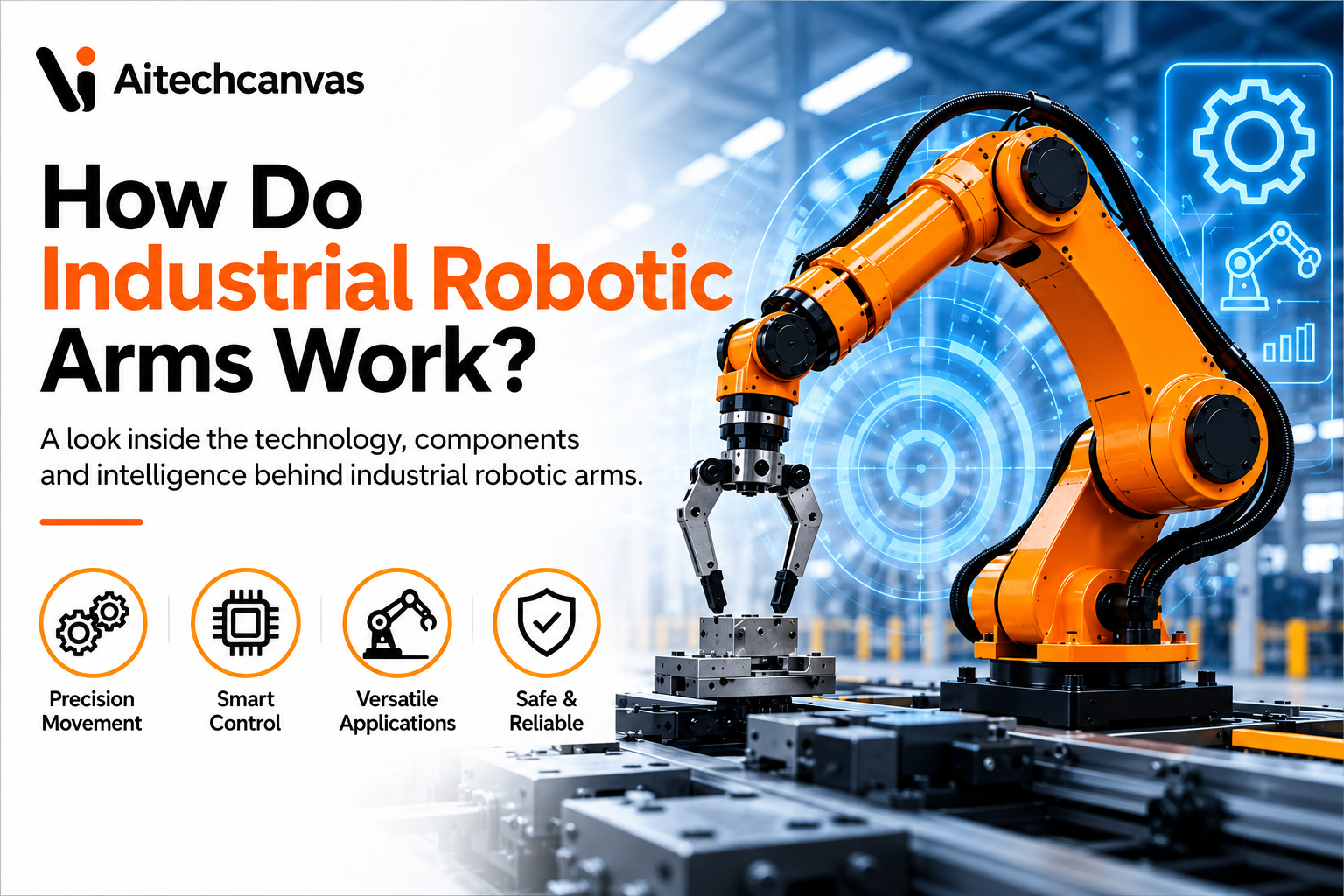

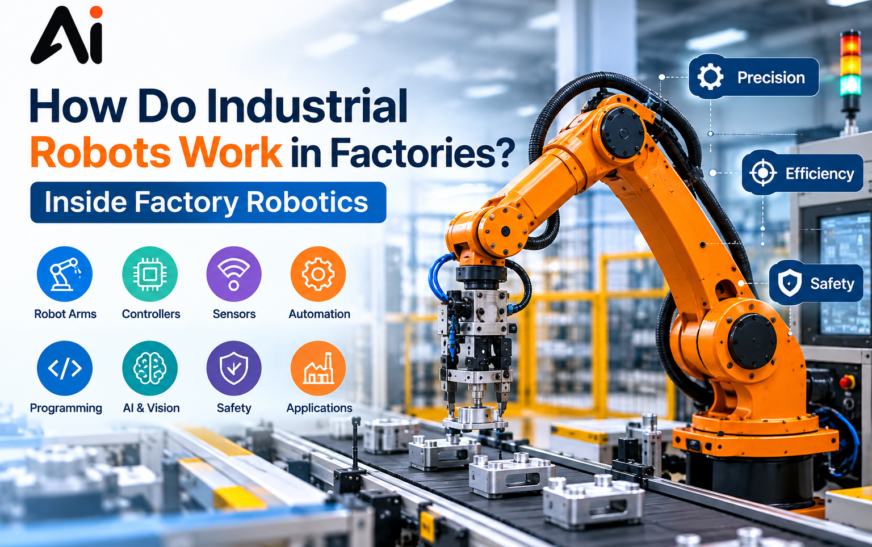
Industrial robots work in factories by combining programmable controllers, motors, joints, sensors, software, and specialized end effectors to perform precise and repeatable tasks. They receive programmed instructions, calculate movement, use feedback from sensors to control their motion, and interact with machines, conveyors, components, and products inside a robotic workcell.
From welding car bodies to packaging products, modern factory robots can perform repetitive, hazardous, high-speed, and precision-dependent operations with consistent results.
Industrial robots follow a coordinated process:
Programming → sensing → processing → motion control → task execution → feedback
We first define the task and program the robot’s movements. The robot controller interprets those instructions and commands servo motors and actuators to move individual robot joints. Sensors provide information about position, force, speed, or objects in the work area. An end effector, such as a gripper or welding tool, then performs the required operation.
In a real factory, the robot usually operates as part of a robotic workcell containing conveyors, fixtures, machines, sensors, safety equipment, and industrial control systems.
Key Takeaways
- Industrial robots combine mechanical arms, controllers, actuators, sensors, software, and end effectors.
- The controller coordinates robot movement according to programmed instructions.
- Servo motors and actuators move the robot’s joints and axes.
- Sensors provide feedback that helps the robot maintain accurate movement.
- Machine vision can help robots locate, inspect, classify, or guide objects.
- Different robot configurations are designed for different manufacturing applications.
- Robots can perform welding, assembly, packaging, palletizing, inspection, pick-and-place, and material handling.
- Most industrial robots operate within integrated automated workcells rather than independently.
- Safety systems help control access to hazardous robot movements and machinery.
- AI, machine vision, connectivity, and Industry 4.0 technologies are expanding what factory robots can do.
How Do Industrial Robots Work in Factories?
To understand how industrial robots work, we can think of a factory robot as a programmable machine designed to control movement and tools with high repeatability.
A typical system begins with a programmed sequence of operations. The robot controller converts this sequence into commands for the robot’s motors and other equipment. The motors move joints through specific positions while sensors monitor the robot’s state.
Suppose a robot is responsible for picking a component from a conveyor. The system may coordinate the conveyor, sensors, robot arm, controller, and gripper. Once the component reaches the required position, the robot moves toward it, closes the gripper, lifts it, and transports it to another location.
The same basic principle can be adapted to welding, painting, assembly, packaging, machine tending, inspection, and many other tasks.
The Basic Industrial Robot Working Principle
The industrial robot working principle can be divided into several connected stages.
First, the task is defined and programmed. Next, the controller determines the required movements. Servo systems drive the robot’s axes, while sensors provide feedback about movement and operating conditions. The end effector performs the physical task.
The controller continuously coordinates these elements so that the robot reaches programmed positions and follows the required trajectory.
This explains how factory robots work at a fundamental level: software controls mechanical movement, sensors provide feedback, and specialized tooling allows the robot to interact with the manufacturing process.
What Are the Main Parts of an Industrial Robot?
The main industrial robot components work together as one automated system. Although designs vary, a typical robot includes a manipulator, controller, motors and actuators, sensors, programming interface, power system, and end effector.
Industrial Robot Arm
The industrial robot arm is the mechanical structure that positions the tool or gripper. In articulated robots, the arm contains multiple connected sections and rotating joints.
Its geometry determines important characteristics such as reach, workspace, speed, and the number of available axes.
Robot Joints and Actuators
Robot joints allow the manipulator to rotate or move. Actuators generate the force required to move these joints.
Many industrial robots use electric servo motors in industrial robots because servo systems can provide controlled movement and feedback. Depending on the application, industrial automation equipment can also use other drive technologies.
Robot Controller
The robot controller functions as the central control unit. It processes programmed instructions and coordinates movement across the robot’s axes.
It can also communicate with other factory equipment, including PLCs, sensors, conveyors, safety devices, and production machinery.
Robot Sensors
Robot sensors provide information about the robot and its environment. Position sensors can monitor joint movement, while force or torque sensors can detect physical interaction.
Sensors are particularly important when the robot needs feedback rather than simply following a fixed sequence.
Robot End Effector
The robot end effector is the tool attached to the end of the robotic arm. Examples include:
- Grippers
- Welding guns
- Vacuum cups
- Paint spray equipment
- Screwdriving tools
- Cutting tools
- Inspection cameras
The end effector determines what the robot can physically do.
Robot Teach Pendant
A robot teach pendant provides an interface for programming, positioning, testing, and controlling many industrial robot systems. An operator or technician can use it to teach positions and create or modify robot routines.
How Are Industrial Robots Programmed?
How Are Industrial Robots Programmed?
Industrial robot programming determines how the robot moves and performs its assigned task. Programming tells the robot where to move, how fast to move, when to perform an operation, and how to coordinate with other equipment in the factory.
One common method is teach pendant programming. A technician guides or commands the robot to specific positions and records those positions as part of a program. The robot can then reproduce the programmed sequence with a high level of repeatability.
Another approach is offline robot programming, where programs are created or simulated using software away from the production robot. This allows engineers to develop, test, and optimize robot trajectories before transferring them to the factory system. For a deeper look at the software and coding technologies used in robotics, explore Best Robotics Programming Languages.
Depending on the robot and application, programming may involve motion commands, logic, sensor inputs, tool control, safety conditions, and communication with PLCs or other factory machines. This makes robot programming an important part of building reliable robot automation systems.
Robot Motion Control and Trajectory Planning
The controller must determine how each axis should move between programmed positions. Robot trajectory planning helps establish the path, speed, acceleration, and timing needed for the operation.
For example, a welding robot needs a controlled path along a joint, while a packaging robot may prioritize fast movement between known pickup and placement positions.
This is why robot motion control is more sophisticated than simply telling a robot to move from point A to point B.
How Do Robotic Arms Move in Factories?
A robotic arm moves through coordinated changes in its joints and axes. The number of degrees of freedom determines how many independent movements the robot can make.
A common six-axis articulated robot can rotate and position its tool in multiple directions, allowing it to reach objects from different angles.
Two important concepts help explain this movement:
Kinematics describes the relationship between joint movement and the position and orientation of the robot’s tool.
Dynamics concerns forces, torque, mass, acceleration, and the physical behavior involved in robot movement.
Together, these principles allow a controller to calculate and coordinate robotic arm movement accurately.
How Do Robot Sensors and Machine Vision Work?
Traditional robots can repeatedly execute predefined movements, but industrial robot sensors provide additional information about what is happening around them. These sensors help robots monitor their position, detect objects, respond to physical forces, and maintain accurate movement during manufacturing operations.
Industrial robot sensors can detect position, proximity, force, torque, speed, temperature, and other operating conditions. This feedback helps the robot controller adjust movement and coordinate tasks more precisely. To learn more about the mechanical design, movement, and operation of robotic arms, see How Do Industrial Robotic Arms Work?.
For applications involving variable object positions or automated inspection, sensors can work alongside cameras and machine vision systems, allowing robots to respond to information from their environment rather than relying only on fixed programmed movements.
Machine Vision in Robotics
Robot vision systems use cameras and image-processing technology to help robots identify and locate objects.
For example, a vision-guided robot can inspect products moving along a conveyor and determine where a component is located. The robot can then adjust its movement instead of relying entirely on a fixed object position.
Machine vision can support:
- Object detection
- Quality inspection
- Part orientation
- Product identification
- Pick-and-place operations
- Measurement
- Defect detection
More advanced systems can combine AI vision in manufacturing with machine-learning techniques to recognize patterns and variations.
What Are the Different Types of Industrial Robots?
There are several types of industrial robots, and each configuration has characteristics suited to particular manufacturing tasks.
Articulated Robots
Articulated robots use rotary joints and are among the most recognizable industrial robot designs. Six-axis models can provide substantial flexibility for welding, assembly, material handling, and other applications.
Cartesian Robots
Cartesian robots move along linear axes, typically using a rectangular coordinate system. Their predictable movement can be useful in machine tools, handling, and automated production systems.
SCARA Robots
SCARA robots are commonly used for fast horizontal assembly and material-handling operations. Their mechanical design can provide speed and repeatability for suitable applications.
Delta Robots
Delta robots use a parallel-arm structure and are often associated with high-speed picking, sorting, and packaging.
Six-Axis Industrial Robots
A six-axis robot provides multiple degrees of rotational freedom, allowing complex positioning and orientation of tools.
The choice between configurations depends on factors such as required reach, payload, speed, workspace, precision, tooling, and application requirements.
How Are Industrial Robots Used in Manufacturing?
Industrial robots perform many different tasks across modern manufacturing environments.
Robotic Welding
Welding robots can follow programmed paths and maintain consistent positioning during repetitive welding operations. They are widely used where consistent cycle times and repeatability are important.
Robotic Assembly
In robotic assembly, robots position, insert, fasten, or manipulate components according to programmed sequences.
Robotic Pick and Place
Pick-and-place robots move products or components from one location to another. When combined with vision, the system can locate objects that are not perfectly positioned.
Robotic Packaging
Robots can place products into containers, arrange packages, handle cases, and perform other repetitive packaging operations.
Robotic Palletizing
Robotic palletizing involves arranging boxes, bags, containers, or other products onto pallets according to a programmed pattern.
Robotic Machine Tending
In machine tending, robots can load and unload equipment such as CNC machines. This allows production equipment and robots to work together as an integrated system.
Robotic Inspection
Robots can carry cameras, measurement equipment, or other inspection tools to examine products and manufacturing processes.
How Do Robots Work on Assembly Lines?
On an automated production line, robots often operate alongside conveyor belts, fixtures, sensors, PLCs, and other machines.
A conveyor may transport a product into a robot’s working area. A sensor can signal that the product has arrived. The PLC and robot controller can exchange signals, allowing the robot to begin its programmed operation.
After completing the task, the robot can send a completion signal and the production process can continue.
This coordination is central to factory automation systems because manufacturing automation depends on multiple machines communicating and operating according to a shared production sequence.
What Is a Robotic Workcell?
A robotic workcell is the controlled area in which a robot performs a manufacturing operation.
Rather than viewing the robotic arm as a standalone machine, we can understand the workcell as a complete system containing the robot, tooling, fixtures, sensors, control equipment, safety devices, and sometimes other industrial machines.
For example, an automated welding cell could include a six-axis robot, welding equipment, fixtures, positioners, sensors, controllers, and safety equipment.
This approach allows manufacturers to design automation around an entire production task rather than simply installing a robot.
Industrial Robot Safety in Factories
Industrial robot safety is essential because automated machinery can move quickly and generate substantial mechanical forces.
A properly designed robot workcell can incorporate physical guarding, safety-rated controls, emergency-stop systems, interlocks, presence-sensing devices, and controlled access.
Safety requirements depend on the specific robot, application, equipment layout, workplace, and applicable regulations and standards.
For collaborative applications, risk assessment is especially important because humans and robots may share a workspace.
Industrial Robots vs Humans in Manufacturing
Robots and human workers generally have different strengths.
Industrial robots are well suited to repetitive operations, consistent trajectories, high-volume production, and tasks involving hazardous or physically demanding conditions. Human workers can provide adaptability, judgment, problem-solving, maintenance expertise, process knowledge, and handling of unexpected situations.
Modern manufacturing can therefore combine automation with human-robot collaboration rather than treating automation as a simple replacement for every human task.
Collaborative robots, commonly called cobots, are designed for applications in which humans and robots can work in closer proximity under appropriate safety controls and risk assessments.
How Does AI Improve Industrial Robotics?
AI in industrial robotics is expanding the capabilities of automated systems beyond fixed sequences.
AI can support computer vision, anomaly detection, predictive maintenance, object recognition, optimization, and adaptive automation.
For example, a conventional robotic system may expect an object to appear at a known location. A vision-enabled system can identify the object’s position and orientation, allowing the robot to adapt its movement.
AI-powered systems can also analyze production data to identify patterns associated with equipment performance or product quality.
This connects industrial robotics with Industry 4.0, smart manufacturing, connected sensors, industrial software, and data-driven production.
What Are the Benefits of Industrial Robots?
The benefits of industrial robots depend on the application and implementation, but several characteristics explain their widespread use.
Robots can perform repetitive tasks with consistent programmed movements. They can operate at defined speeds for extended production cycles and can be equipped with specialized tools for specific processes.
Automation can also reduce the need for people to perform certain hazardous or physically demanding operations.
In suitable applications, manufacturers may use robots to improve production consistency, process repeatability, throughput, workplace safety, and manufacturing efficiency.
The actual results depend on factors such as robot selection, integration quality, cycle time, maintenance, tooling, production volume, and process design.
How Much Does an Industrial Robot Cost?
The industrial robot cost is not limited to the price of the robotic arm itself.
A complete automation project may involve:
- Robot hardware
- Controller
- End effector
- Sensors and cameras
- Safety equipment
- Fixtures
- Conveyors
- PLC and control hardware
- Programming
- System integration
- Installation
- Training
- Maintenance
Consequently, the cost of robotic automation can vary substantially between applications.
Manufacturers generally evaluate potential industrial robot ROI by considering automation investment against factors such as labor requirements, production volume, cycle time, quality, downtime, maintenance, and expected operating life.
How Do Industrial Robots Communicate With Factory Machines?
Modern robots rarely operate completely alone. They can communicate with production equipment through industrial control systems and communication networks.
A robot may receive a signal from a PLC indicating that a component is ready. After completing its task, it can return a status signal to the PLC.
This communication can coordinate:
Robot + PLC + conveyor + sensors + machine tools + safety system
Such integration allows factories to build connected and automated production processes.
How Do Robots Improve Modern Factory Automation?
The biggest change brought by industrial robotics is not simply the presence of robotic arms. It is the ability to integrate programmable motion with sensing, software, machines, and production data.
A modern automated manufacturing system can combine robots with machine vision, connected sensors, programmable logic controllers, manufacturing software, conveyors, and industrial networks.
As these technologies become more connected, factories can create flexible production systems capable of monitoring processes, collecting data, and adapting selected operations to changing conditions.
Conclusion
Industrial robots work in factories through the coordinated operation of mechanical structures, robot joints, servo motors, actuators, controllers, sensors, software, and end effectors. The robot receives programmed instructions, converts them into controlled movements, and performs a specific manufacturing operation with repeatable motion.
The most important point is that a factory robot is usually only one part of a larger robotic workcell. Conveyors, PLCs, fixtures, cameras, safety systems, machines, and specialized tools all contribute to the completed automation process.
From welding and assembly to packaging, palletizing, inspection, and machine tending, industrial robots can handle a broad range of manufacturing tasks. Advances in machine vision, AI, connected sensors, and Industry 4.0 technologies are also making robotic systems increasingly capable of responding to variable production conditions.
FAQs About Industrial Robots
How do industrial robots work in factories?
Industrial robots work by following programmed instructions that control motors and joints. Sensors provide feedback, while the controller coordinates movement and the end effector performs the required manufacturing task.
How does an industrial robotic arm work?
A robotic arm uses joints, actuators, servo motors, sensors, and a controller to move its tool through programmed positions and trajectories.
How are industrial robots programmed?
Industrial robots can be programmed using teach pendants, robot programming software, simulation platforms, and offline programming methods. The exact process depends on the robot manufacturer and application.
How do robots detect objects in factories?
Robots can detect objects using proximity sensors, position sensors, machine vision cameras, force sensors, and other sensing technologies. Vision systems can identify an object’s location, orientation, or characteristics.
What are industrial robots used for?
Industrial robots are used for welding, assembly, painting, packaging, palletizing, pick-and-place, material handling, machine tending, inspection, and other repetitive manufacturing operations.
What is the difference between a six-axis robot and a SCARA robot?
A six-axis articulated robot provides several rotational movements and is suited to complex positioning and orientation. A SCARA robot is designed around a different mechanical configuration and is commonly used for fast assembly and handling operations.
Are industrial robots replacing human workers?
Industrial robots automate selected tasks rather than eliminating every type of human work. Manufacturing still requires people for programming, maintenance, engineering, supervision, quality management, troubleshooting, and many adaptable tasks.
What makes industrial robots accurate?
Accuracy and repeatability come from the robot’s mechanical construction, joint control, servo systems, sensors, calibration, programming, tooling, and operating conditions.
What is a robotic workcell?
A robotic workcell is an integrated production area containing a robot and the equipment required for its task, such as tooling, fixtures, sensors, conveyors, controllers, machines, and safety systems.
How does AI improve industrial robots?
AI can enhance industrial robots through machine vision, object recognition, anomaly detection, predictive maintenance, process optimization, and adaptive automation.