
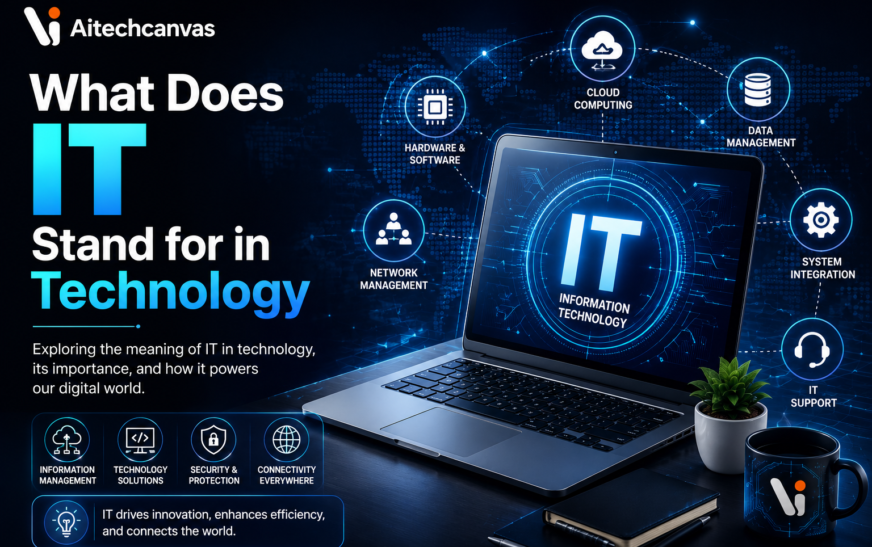
IT stands for Information Technology. It refers to the use of computers, software, networks, databases, cloud systems, and digital tools to create, store, process, manage, and protect information.
From smartphones and websites to cloud apps and business networks, IT is behind much of the technology we use every day. But what does IT actually mean, and why is it so important in the digital world? IT stands for Information Technology. It refers to the use of computers, software, networks, databases, cloud systems, and other digital technologies to create, store, process, secure, and manage information. If you have ever wondered what does IT stand for in technology, the simple answer is Information Technology. You may see the term IT in job postings, college programs, business websites, or technology news, but its meaning goes far beyond its full form.
Information Technology covers the systems and tools people and organizations use to work with digital information. From managing company data and securing computer networks to developing software and supporting cloud services, IT plays a central role in how modern businesses, schools, governments, and individuals use technology.
In this guide, we’ll explain what does IT stand for in technology, what Information Technology includes, how IT works, common examples of IT, the different areas of the field, and why IT skills are increasingly important in today’s digital economy.
What Does IT Stand For in Technology? The Basic Meaning
Information Technology refers to the use of computers, networks, software, and other electronic systems to store, process, retrieve, and exchange data. So when someone asks what does IT stand for in technology, the simplest way to explain it is this: IT is the backbone that allows businesses, governments, and individuals to manage information electronically instead of relying on paper files and manual record-keeping.
Every time you send an email, use a mobile banking app, book a flight ticket online, or even scroll through social media, you are relying on Information Technology. It covers hardware (like computers, servers, and mobile devices), software (like operating systems and applications), and the networks that connect everything together.
Technology is everywhere, but some of its most common terms are surprisingly easy to misunderstand. You may see “IT” in a job description, college program, business website, or technology article and wonder what it actually means.
So, what does IT stand for in technology? IT stands for Information Technology. In simple terms, it refers to the computers, software, networks, data systems, cloud services, and related technologies used to create, process, store, manage, communicate, and protect information.
But IT is much broader than simply using a computer. It supports businesses, schools, healthcare organizations, governments, websites, online services, and countless everyday digital activities. According to the National Institute of Standards and Technology (NIST), information technology includes equipment, interconnected systems, software, services, and related resources used to handle data and information.
Key Takeaways
- IT stands for Information Technology.
- IT focuses on using technology to manage, process, store, transmit, and protect information.
- IT includes hardware, software, networks, databases, cloud computing, cybersecurity, and technical services.
- Businesses use IT for communication, automation, data management, security, collaboration, and digital services.
- IT is a specific field within the much broader world of technology.
- Modern IT increasingly connects with artificial intelligence, cloud computing, automation, cybersecurity, and data analytics.
What Does IT Stand For in Technology?
IT stands for Information Technology. The term describes technologies and systems used to work with digital information.
When people talk about IT, they may be referring to computers, servers, software applications, networks, databases, cloud platforms, cybersecurity tools, or technical support services.
For example, imagine an online business. Employees may use laptops to perform their work, cloud storage to save files, a database to manage customer information, communication software to collaborate, and cybersecurity tools to protect accounts. All of these areas can fall within IT.
NIST describes information technology in terms of systems and resources involved in acquiring, storing, processing, managing, transmitting, and receiving information. This is why the answer to what does IT stand for in technology is simple, but the field itself is extensive.
What Does Information Technology Include?
- Information Technology includes several major areas:
- Business technology solutions
- Computer hardware and devices
- Software and applications
- Computer networks
- Databases and data management
- Cloud computing
- Cybersecurity
- IT support and system administration
- Digital communication systems
What Is Information Technology?
Information Technology is the practical use of computing and digital systems to handle information.
At its core, IT helps people and organizations perform tasks such as:
- Creating and collecting information
- Storing digital files
- Processing data
- Sharing information
- Communicating through networks
- Managing databases
- Protecting systems
- Supporting software and hardware
- Accessing cloud services
- Automating digital processes
A useful way to understand IT is to think of it as the infrastructure and services that allow digital information to move from one place to another and become useful. For instance, when you send an email, several IT components may work together. Your device runs software that creates the message, a network transfers it, servers process it, and the recipient’s system makes it available to them.
Examples of Information Technology
| IT Area | Example |
|---|---|
| Hardware | Computers, servers, laptops |
| Software | Business applications and operating systems |
| Networking | Wi-Fi, routers, and enterprise networks |
| Data | Databases and data management systems |
| Cloud Computing | Online storage and cloud applications |
| Cybersecurity | Firewalls, authentication, and security software |
| Communication | Email and video conferencing |
| Business Systems | CRM, accounting, and enterprise software |
What Does IT Mean in Simple Terms?
In simple terms, IT means using technology to manage information and perform digital tasks. For example, businesses use IT to store customer data, communicate with employees, manage software, protect information, operate websites, and provide online services.
What Does Information Technology Include?
IT is made up of several interconnected areas. These areas work together rather than existing as completely separate technologies.
1. Computer Hardware
Hardware refers to the physical equipment used in an IT environment.
Examples include:
- Desktop computers
- Laptops
- Servers
- Monitors
- Storage devices
- Routers
- Network switches
- Printers
- Smartphones
- Data center equipment
Hardware provides the physical foundation for many IT systems.
2. Software and Applications
Software consists of programs that tell computers and other devices what to do.
Examples include operating systems, productivity applications, business software, databases, mobile applications, and web applications.
Software allows users to perform tasks such as writing documents, managing finances, communicating with customers, analyzing information, and running online businesses.
3. Computer Networks
Networks allow computers and other devices to communicate.
A business network, for example, can connect employee computers, servers, printers, applications, and internet services.
Networking is an important part of IT because modern organizations depend on reliable communication between systems.
4. Databases and Data Management
Organizations generate large amounts of information. Databases provide structured ways to store, organize, retrieve, and manage that information.
A company might use databases for customer records, inventory, transactions, employee information, website content, or business analytics.
5. Cloud Computing
Cloud computing allows organizations and individuals to access computing resources and services over networks rather than relying entirely on locally installed infrastructure.
Cloud-based services can provide storage, software, computing resources, databases, backups, and collaboration tools.
This has made it easier for organizations to access technology without maintaining every component on their own premises.
6. Cybersecurity
Cybersecurity focuses on protecting systems, networks, applications, and information from unauthorized access, misuse, disruption, or other threats.
Security has become a fundamental part of IT because organizations increasingly depend on digital systems to operate.
NIST defines information security around protecting information and systems while supporting confidentiality, integrity, and availability.
7. IT Support and Technical Services
IT also includes services that help people and organizations keep their technology working properly.
IT support may involve troubleshooting computers, configuring software, managing user accounts, maintaining networks, resolving technical problems, and helping employees use digital systems.
How Does Information Technology Work?
A simple way to understand IT is to look at the information lifecycle:
Input → Processing → Storage → Communication → Output
For example, consider an online store.
A customer enters information when placing an order. The company’s software processes that information, a database stores the order details, networks transmit the information between systems, and the business receives an output such as an order confirmation.
Behind this simple experience can be a combination of hardware, software, networks, databases, cloud services, and security controls.
An IT system is therefore not necessarily one individual device. It can be a connected collection of resources working together to accomplish a specific purpose. NIST describes an IT system as an organized assembly of resources and procedures that interact to perform specific functions.
What Are Examples of Information Technology?
Information Technology appears in almost every modern environment.
Common examples include:
- Computers and laptops
- Smartphones
- Servers
- Computer networks
- Cloud storage
- Business applications
- Databases
- Email platforms
- Video conferencing tools
- Cybersecurity software
- Website hosting
- Data analytics systems
- Customer relationship management software
- Online collaboration platforms
- IT help-desk systems
Even something as familiar as online banking can involve multiple IT components working together, including applications, databases, networks, authentication systems, servers, and security technologies.
What Is IT Used For?
Information Technology is used wherever digital information needs to be created, processed, stored, communicated, or protected.
How Is Information Technology Used in Business?
Businesses rely heavily on IT for daily operations.
IT can support:
- Internal communication
- Customer communication
- Data management
- Business applications
- Online sales
- Employee collaboration
- Automation
- Cybersecurity
- Cloud computing
- Data analysis
- Remote work
For small businesses in particular, choosing appropriate technology can help create a more organized digital environment. You can explore related technology solutions for small businesses in this guide on AITechCanvas.
How Is IT Used in Education?
Schools, colleges, universities, and training organizations use IT for online learning platforms, digital classrooms, student records, research, communication, file sharing, and educational software.
Students can also use computers, cloud applications, collaboration tools, and online resources to support learning.
How Is IT Used in Healthcare?
Healthcare organizations use IT for managing digital information, communication, electronic records, scheduling, data analysis, and other technology-supported processes.
The goal is not simply to use more technology. IT systems need to be properly managed and secured because healthcare organizations handle sensitive information.
How Is IT Used in Everyday Life?
You interact with IT throughout the day, often without thinking about it.
Examples include:
- Sending messages
- Using search engines
- Streaming videos
- Shopping online
- Using cloud storage
- Making online payments
- Using navigation applications
- Joining video meetings
- Managing social media accounts
- Using smartphone applications
This shows why IT has become a normal part of modern life rather than something limited to technology companies.
Why Is Information Technology Important?
Information Technology is important because modern organizations depend on digital information and connected systems.
IT can help organizations:
Improve Communication
Email, messaging platforms, video conferencing, and collaboration software allow people to communicate across locations.
Manage Information
Digital systems make it easier to organize, search, update, analyze, and share information.
Automate Repetitive Tasks
Software can automate many routine processes, allowing employees to spend more time on tasks requiring human judgment and creativity.
Support Remote Work
Cloud services, collaboration applications, secure networks, and communication tools enable employees to work from different locations.
Protect Digital Information
Cybersecurity technologies help organizations protect accounts, systems, networks, and data.
Support Business Growth
Reliable IT infrastructure can help businesses introduce digital services, reach customers online, and manage increasingly complex operations.
What Are the Main Types of Information Technology?
There is no single universal list of IT categories, but several major areas appear across modern IT environments.
| IT Area | What It Does | Common Examples |
| Hardware | Provides physical computing resources | Computers, servers, storage |
| Software | Runs applications and processes | Operating systems, business apps |
| Networking | Connects systems and devices | Routers, switches, networks |
| Databases | Stores and organizes information | Customer and inventory databases |
| Cloud Computing | Provides computing services over networks | Cloud storage, hosted applications |
| Cybersecurity | Protects systems and information | Firewalls, authentication, security tools |
| IT Support | Maintains and troubleshoots systems | Help desks, technical support |
| Data Analytics | Turns data into useful insights | Reporting and analytics platforms |
These areas often overlap. For example, a cloud application can depend on servers, databases, networks, cybersecurity, software, and technical support at the same time.
IT vs Technology: What Is the Difference?
The words IT and technology are sometimes used interchangeably, but they do not mean exactly the same thing.
| Information Technology (IT) | Technology |
| A specific field focused heavily on information and digital systems | A much broader concept |
| Includes computers, software, networks, databases, and cloud systems | Can include IT as well as robotics, biotechnology, engineering, energy, transportation, and more |
| Often associated with business computing and digital information | Applies across many scientific and industrial fields |
| Focuses strongly on managing and using information | Can involve physical, digital, scientific, and engineering technologies |
For example, cybersecurity software is part of IT. A robotic arm used in manufacturing is also technology, but it is not necessarily what someone means when they use the term IT.
If you want to explore the broader technology landscape, see this guide to innovations in technology, which covers areas such as AI, robotics, IoT, automation, and other emerging technologies.
IT vs Computer Science: What Is the Difference?
IT and computer science are closely related, but their typical focus can differ.
| IT | Computer Science |
| Focuses on implementing, managing, and supporting technology systems | Focuses heavily on computing principles and computational methods |
| Includes networks, databases, cloud services, systems administration, and support | Includes algorithms, programming, computation, and software concepts |
| Often has a practical systems and infrastructure focus | Often has a stronger theoretical and computational focus |
| Can include IT support, network administration, and cybersecurity roles | Can include software development, research, and computing-focused roles |
The two fields overlap considerably. A person studying computer science may work in an IT-related role, while an IT professional may use programming and computer science concepts.
IT vs Information Systems: What Is the Difference?
Information Technology and Information Systems are related terms, but they emphasize different aspects.
IT generally focuses on the technology, infrastructure, software, networks, services, and systems used to handle information.
Information systems can be understood more broadly as organized resources designed to collect, process, maintain, use, share, and distribute information.
An information system can therefore involve technology as well as people, processes, data, and organizational requirements.
What Does an IT Professional Do?
An IT professional can perform many different types of work depending on their specialization.
Typical responsibilities may include:
- Managing computer systems
- Supporting employees
- Maintaining networks
- Configuring software
- Managing databases
- Monitoring systems
- Protecting digital resources
- Managing cloud services
- Troubleshooting technical issues
- Setting up user accounts
- Maintaining IT infrastructure
Not every IT professional does all of these tasks. IT is a broad field with many specialized career paths.
Common IT Jobs and Career Paths
People interested in Information Technology can pursue different roles based on their skills and interests.
Some common examples include:
IT Support Specialist
Helps users troubleshoot hardware, software, account, and connectivity problems.
Systems Administrator
Manages operating systems, servers, user accounts, and organizational technology environments.
Network Administrator
Maintains and monitors networks and related infrastructure.
Cybersecurity Specialist
Works to protect systems, networks, applications, and information from security threats.
Database Administrator
Helps manage database systems, performance, access, availability, and maintenance.
Cloud Engineer
Works with cloud infrastructure, services, deployments, and related systems.
IT Manager
Coordinates technology operations, projects, systems, teams, and organizational IT requirements.
What Skills Are Needed for IT?
The skills required depend on the specific IT career, but useful areas include:
- Computer fundamentals
- Networking
- Operating systems
- Cloud computing
- Cybersecurity
- Database management
- Troubleshooting
- Problem-solving
- Technical communication
- Data management
- Basic programming
- System administration
Communication and problem-solving are also important because many IT roles involve helping people solve technical problems.
How Is IT Changing With Modern Technology?
IT continues to evolve as organizations adopt new digital technologies.
Artificial intelligence, cloud computing, automation, cybersecurity, Internet of Things devices, data analytics, and edge computing are influencing how modern systems are designed and managed.
This means the meaning of IT remains rooted in information and digital systems, but the technologies used to handle that information continue to change.
For example, AI can be integrated into software applications and business workflows, while cloud computing changes how organizations access computing resources. Cybersecurity must also adapt as systems become increasingly connected.
These developments are part of the wider evolution of technology, rather than replacing the basic meaning of IT. So, what does IT stand for in technology? IT stands for Information Technology.
Although the full form is simple, IT covers a broad range of systems and services. Computers, software, networks, databases, cloud computing, cybersecurity, technical support, and data management can all play important roles within an IT environment.
IT is also closely connected with modern developments such as artificial intelligence, automation, cloud technology, data analytics, and cybersecurity. As organizations become more dependent on digital systems, understanding what IT means in technology provides a useful foundation for understanding how modern businesses and digital services work.
Whether you are researching an IT career, studying technology, reading a job description, or simply trying to understand a common technology term, remembering the basic definition is a good starting point: IT means Information Technology the field concerned with using digital systems and resources to work with information.
How Does IT Support Digital Marketing?
IT plays an important technical role in modern digital marketing.
Marketing teams may depend on:
- Websites
- Analytics platforms
- CRM systems
- Marketing automation
- SEO tools
- Customer databases
- Email platforms
- Cloud software
- AI-powered applications
Marketing technology therefore sits at the intersection of business, marketing, data, software, and IT.
For a broader explanation, read what is technology in marketing, including how technology supports analytics, automation, customer management, and digital marketing activities.
How Does Marketing Technology Depend on IT?
Modern marketing technology often relies on an underlying IT environment.
A simplified relationship looks like this:
IT Infrastructure → Data → Software → Marketing Technology → Customer Experience
For example, a company may use IT systems to store customer information, software to analyze that data, marketing platforms to create campaigns, and analytics tools to measure results.
This is also why digital teams increasingly need to understand technology, data, security, and software alongside traditional marketing skills.
You can learn more about this relationship in the AITechCanvas article on how marketing technology news shapes modern digital teams, which explores marketing technology, automation, AI, analytics, and digital team workflows.
What Is the Future of Information Technology?
Information Technology will continue to develop alongside advances in computing and digital systems.
Several areas are receiving significant attention, including:
- Artificial intelligence
- Cloud computing
- Cybersecurity
- Automation
- Data analytics
- Internet of Things
- Edge computing
- AI-powered applications
- Advanced computing
The specific technologies organizations adopt will depend on their goals, resources, security requirements, and business needs.
The underlying purpose of IT, however, remains consistent: helping people and organizations work with information and digital systems effectively. Modern businesses use technology in marketing to manage customer data, automate campaigns, analyze performance, and improve digital experiences.
Frequently Asked Questions
What does IT stand for in technology?
IT stands for Information Technology. It refers to technology systems, equipment, software, services, and resources used to handle information and data.
What is IT in simple words?
IT is the use of computers, software, networks, databases, cloud services, and related systems to manage, process, store, communicate, and protect information.
What does IT mean in a job?
In a job context, IT usually refers to work involving computer systems, software, networks, databases, cybersecurity, cloud services, technical support, or other digital infrastructure.
What are examples of IT?
Examples include computers, servers, software applications, databases, computer networks, cloud computing, cybersecurity systems, and technical support services.
Is IT the same as technology?
No. Technology is a broader term. IT is a specific field focused primarily on digital information, computing systems, software, networks, data, and related services.
What is the difference between IT and computer science?
IT generally focuses on implementing, managing, and supporting technology systems, while computer science focuses more heavily on computation, algorithms, programming, and computer science principles.
Why is Information Technology important?
IT helps organizations manage information, communicate, automate processes, support digital services, protect data, and operate connected technology systems.
What are the main areas of IT?
Major areas include hardware, software, networking, databases, cloud computing, cybersecurity, IT support, systems administration, and data management.
Is cybersecurity part of IT?
Yes. Cybersecurity is commonly considered an important area of IT because organizations need to protect their systems, networks, applications, and information.
What does an IT department do?
An IT department may manage an organization’s computers, networks, software, databases, cloud services, cybersecurity, technical support, and other technology infrastructure.
Frequently Asked Questions
What does IT stand for?
IT stands for Information Technology.
What does IT stand for in technology?
IT stands for Information Technology, which involves using computers, software, networks, data, and digital systems to manage information.
What does IT mean in simple terms?
IT means using technology to store, process, communicate, manage, and protect information.
What are examples of IT?
Examples include computers, software, databases, networks, cloud computing, cybersecurity systems, and digital communication tools.
Is IT the same as technology?
No. Technology is a broad term, while Information Technology is a specific field focused mainly on computers, information, software, networks, and digital systems.
Final Thoughts
So, what does IT stand for in technology? It stands for Information Technology, a field dedicated to using computers and digital systems to manage and process information efficiently. From the hardware we use every day to the software applications that power businesses, IT is deeply embedded in almost every aspect of modern life. At AI Tech Canvas, we explore the latest IT trends, emerging technologies, and practical insights to help you stay informed in the ever-evolving digital world.
As technology continues to evolve, the importance of understanding what does IT stand for in technology will only increase. This knowledge can help individuals and businesses make better decisions about adopting new tools and staying competitive in a digital-first world.