
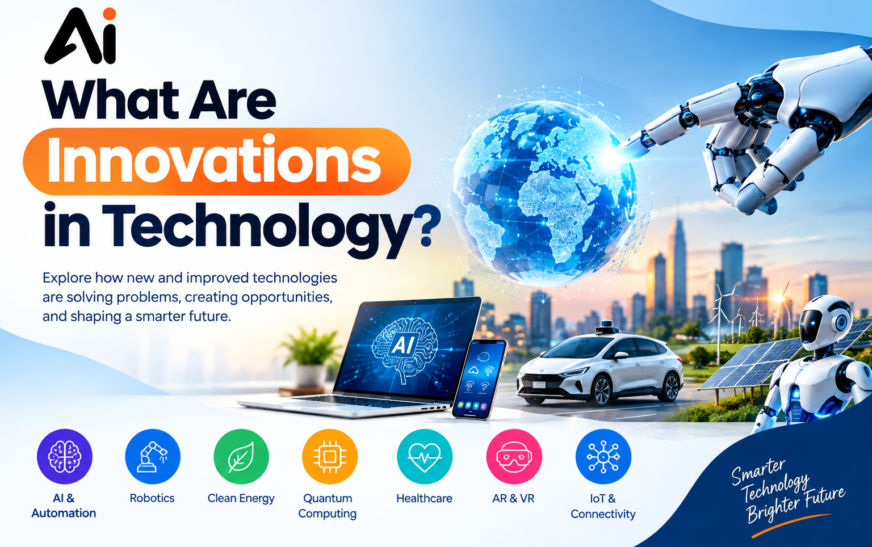
Technology innovation is no longer limited to faster computers or smarter phones. From artificial intelligence and robotics to quantum computing, biotechnology, smart devices, and renewable energy, new technologies are changing how people work, learn, communicate, travel, and solve complex problems.
What are innovations in technology? They are new or improved ways of creating, combining, or using technology to solve problems, improve efficiency, create new experiences, or make previously difficult tasks possible. Technology innovation can involve a completely new invention, but it can also come from improving an existing technology or combining several technologies.
Key Takeaways
- Technology innovation involves creating or improving technology to produce useful results.
- Innovation is different from invention because innovation focuses on applying ideas and creating practical value.
- Artificial intelligence, robotics, quantum computing, biotechnology, and advanced energy are major areas of innovation.
- Technology innovations can improve healthcare, education, business, transportation, communication, and everyday life.
- AI is increasingly being combined with robotics, automation, sensors, and other technologies.
- Emerging technologies are becoming interconnected through technology convergence.
- The future of technology innovation will likely depend on combining multiple technologies rather than developing them in isolation.
- Privacy, cybersecurity, affordability, reliability, and environmental impact remain important challenges.
What Is Innovation in Technology?
Technology is changing at a remarkable speed. Artificial intelligence can generate content and assist with software development, robots can perform increasingly complex physical tasks, quantum computers are being developed for specialized problems, and biotechnology is creating new possibilities in medicine. But what is innovation in technology, and why does it matter?
Technology innovation means creating, improving, or combining technologies to solve problems, increase efficiency, create new experiences, or make difficult tasks easier. An innovation does not always need to be completely new. Improving an existing technology so that it becomes faster, cheaper, safer, smarter, or easier to use can also be innovation.
This is why innovations in technology should not be viewed simply as a list of new gadgets. Modern technological innovations increasingly connect different fields. AI can work with robotics, sensors can support autonomous vehicles, machine learning can assist biotechnology, and advanced computing can help researchers solve complex scientific problems.
What Does Technology Innovation Mean?
What does technology innovation mean? In simple terms, it means using knowledge, creativity, engineering, and technology to create something useful or significantly improve something that already exists.
A smartphone provides a useful example. Mobile phones existed before smartphones, while cameras, GPS, touchscreens, internet connectivity, processors, and applications also existed independently. The innovation came from combining these technologies into one device capable of communication, navigation, photography, entertainment, payments, and computing.
This shows why examples of technology innovation do not always involve an entirely new invention. Sometimes the most successful innovation comes from combining existing technologies in a new way. The same principle applies to Technology Solutions for Small Businesses, where companies can combine tools such as cloud software, artificial intelligence, automation, cybersecurity, data analytics, and digital communication platforms to improve everyday operations, reduce repetitive work, and serve customers more efficiently.
Technology Innovation vs Invention
Technology innovation vs invention is an important distinction.
An invention generally involves creating something new, while innovation involves applying an idea or improving technology in a way that creates meaningful value.
For example, developing a new battery chemistry in a laboratory can be considered an invention. Turning that chemistry into a reliable, affordable, mass-produced battery for electric vehicles or energy storage moves the idea toward technological innovation.
Therefore, invention and innovation examples can overlap, but successful innovation requires practical implementation, usability, reliability, affordability, and adoption.
Why Is Technology Innovation Important?
Why is technology innovation important? Because it expands what individuals, businesses, researchers, and governments can accomplish.
A task that once took hours may be completed in minutes. A manufacturing process can become automated. Medical information can be analyzed digitally. Businesses can use software to automate repetitive operations, while students can access educational tools from almost anywhere.
Technology innovation also influences competition. Companies using useful technology can reduce costs, improve customer experiences, develop new products, and react more quickly to changing markets.
How Technology Innovations Change the World
How technology innovations change the world can be seen across almost every major industry.
Healthcare uses digital tools and AI-assisted systems. Education uses adaptive learning platforms. Agriculture can use sensors and data analytics. Transportation increasingly depends on navigation systems, automation, connected vehicles, and intelligent infrastructure.
The impact of technological innovation is therefore much broader than the technology itself.
How Do Technological Innovations Affect Our Lives?
How do innovations in technology affect our lives? Often, they make everyday activities faster, easier, more connected, or more personalized.
GPS navigation is one simple example. People can now receive routes, traffic information, estimated arrival times, and turn-by-turn directions from a smartphone. Cloud computing has similarly changed how people store information, collaborate remotely, stream content, and use software. Smart technologies are also improving the way systems understand information and provide faster, more relevant responses. For example, What Is Smart Response Technology? explains how intelligent response systems can use technology to improve communication and deliver more efficient interactions.
Many technologies become so common after adoption that people stop thinking of them as innovations.
What Are the Types of Technological Innovation?
There are several broad types of technology innovation, including:
1. Artificial Intelligence Innovation
AI innovation involves systems capable of analyzing information, understanding language, generating content, recognizing images, making predictions, and supporting complex tasks.
2. Automation Innovation
Automation uses software, machines, robotics, and increasingly AI to perform tasks with limited human intervention.
3. Product Innovation
Product innovation improves an existing technology or creates a new technology-based product.
4. Process Innovation
Process innovation changes how a task is performed to make it faster, more efficient, accurate, or affordable.
5. Business Technology Innovation
Businesses can combine cloud computing, AI, data analytics, automation, and other tools to create new services and workflows.
Latest Technology Innovations
The latest technology innovations are increasingly focused on technologies that can work together.
Major areas include:
- Artificial intelligence
- Generative AI
- AI agents
- Robotics
- Quantum computing
- Biotechnology
- Advanced batteries
- Renewable energy
- Spatial computing
- Autonomous systems
- IoT
- Edge computing
- Advanced connectivity
The important trend is technology convergence, where different technology fields combine to create capabilities that would be difficult for one technology to provide alone.
AI Technology Innovations
AI technology innovations are among the most influential developments in modern technology.
Latest AI Innovations
Generative AI has made it possible for people to interact with computers using natural language. Users can ask AI systems to generate text, analyze information, create images, assist with coding, and perform other tasks.
AI agents represent another important development. Instead of simply answering questions, these systems are being developed to complete sequences of actions, interact with software, analyze information, and support structured workflows.
AI Innovation Examples
Common AI innovation examples include:
- Generative AI
- AI coding assistants
- AI search systems
- AI-powered recommendation engines
- AI customer support
- AI-assisted scientific research
- AI automation technology
- AI agents
- Machine learning systems
Robotics Technology Innovations
Robotics technology innovations combine mechanical systems with sensors, computer vision, AI, machine learning, and advanced control technologies.
Latest Robotics Innovations
Modern robots are being used in manufacturing, warehouses, healthcare, agriculture, logistics, and other environments.
Innovations in robotics are increasingly focused on making machines capable of operating outside highly controlled environments. This is difficult because real-world environments contain unpredictable objects, people, lighting conditions, obstacles, and situations.
Robotics Innovation Examples
Examples include:
- Industrial robots
- Autonomous mobile robots
- Surgical robotic systems
- Agricultural robots
- Warehouse robots
- AI-powered autonomous machines
Quantum Computing Innovations
Quantum computing innovations represent a fundamentally different approach to computing.
Traditional computers use bits represented by zeros and ones, while quantum computers use qubits and quantum-mechanical effects. Quantum computing is being explored for specialized problems involving areas such as molecular simulation, materials science, optimization, chemistry, and cryptography.
However, quantum computing remains an emerging field. Hardware, error correction, algorithms, and control systems still need substantial development before many potential applications become practical.
Biotechnology and Healthcare Technology Innovations
Biotechnology innovations are increasingly connected with AI, computational tools, robotics, advanced imaging, sensors, and large biological datasets.
AI can help researchers analyze biological information, identify patterns, support drug discovery, and assist with medical imaging. Wearable technology can also collect information such as activity and heart-rate measurements, which can then be analyzed through software.
These developments demonstrate how healthcare technology innovations can emerge from combining multiple fields rather than relying on one technology.
Renewable Energy and Battery Technology Innovations
Renewable energy technology innovations are becoming increasingly important as electricity demand grows and energy systems evolve.
Battery technology innovations can improve energy density, charging speed, lifespan, safety, and cost. These improvements can influence electric vehicles, renewable energy storage, portable electronics, and electricity grids.
Smart energy systems can also use sensors and software to monitor consumption, predict demand, and coordinate distributed energy resources.
Smart Home and IoT Technology Innovations
IoT technology innovations connect physical objects to digital networks.
Examples include:
- Smart thermostats
- Connected security systems
- Wearable devices
- Industrial sensors
- Connected vehicles
- Smart agricultural equipment
Edge computing can process information closer to where it is generated, potentially reducing delays and dependence on distant cloud systems.
This creates smarter environments where devices can communicate, analyze conditions, and respond automatically.
Virtual Reality and Augmented Reality Innovations
Virtual reality innovations and augmented reality innovations are changing how people interact with digital information.
Virtual reality can place users inside simulated environments, while augmented reality overlays digital information onto the physical world. Mixed reality combines physical and virtual elements.
These technologies can support gaming, engineering, medical training, product visualization, education, and workplace assistance.
Examples of Innovations in Technology in Everyday Life
Some examples of technological innovations that people interact with regularly include:
- Smartphones
- GPS navigation
- Cloud computing
- AI assistants
- Wearable technology
- Smart home devices
- Online payment systems
- Streaming platforms
- Connected vehicles
- Machine-learning recommendation systems
These are real-world technology innovations because they solve practical problems and have become part of everyday activities.
Most Important Technology Innovations
The most important innovations in technology are not necessarily the newest products. Their importance often depends on how widely they solve meaningful problems.
Some of the most influential areas include:
Artificial Intelligence
AI is changing software, research, automation, content creation, business operations, and many other fields.
Internet and Cloud Computing
The internet and cloud systems created the foundation for modern online services, remote collaboration, software-as-a-service, and digital businesses.
Mobile Technology
Smartphones combined communication, computing, cameras, GPS, applications, payments, and entertainment into portable devices.
Robotics
Robotics brings automation into the physical world.
Biotechnology
Biotechnology combines biological science with advanced technological tools to support research and healthcare.
Renewable Energy
Renewable energy and storage innovations are helping transform energy generation and infrastructure.
Benefits of Technology Innovation
The benefits of technology innovation can be seen at both individual and organizational levels.
Technology innovation can:
- Improve efficiency
- Reduce repetitive work
- Increase productivity
- Improve communication
- Support scientific research
- Create new products and services
- Improve customer experiences
- Enable automation
- Expand access to information
- Support new business models
However, these benefits depend on responsible implementation and whether the technology actually addresses a meaningful need.
Technology Innovations for Businesses
Technology innovations for businesses can help organizations automate workflows, analyze data, improve customer service, reduce operational costs, and create new products.
For example, a company could combine AI, cloud computing, data analytics, and automation without inventing any of those technologies itself. The innovation can come from combining them into a useful business solution.
This makes technology strategy less about buying the newest tool and more about identifying the right problem to solve.
Emerging Technology Innovations in 2026
Emerging technology innovations in 2026 include developments across AI, robotics, quantum technologies, advanced materials, biotechnology, energy, connectivity, and spatial computing.
Emerging Technologies 2026
Important areas to watch include:
- Generative AI
- AI agents
- Autonomous robotics
- Quantum computing
- Engineering biology
- Advanced materials
- Next-generation batteries
- Spatial intelligence
- Edge computing
- Smart connected systems
The major theme is not simply the emergence of individual technologies but their increasing integration.
How Technology Innovation Is Changing the Future
The future of technology innovation will likely be defined by convergence.
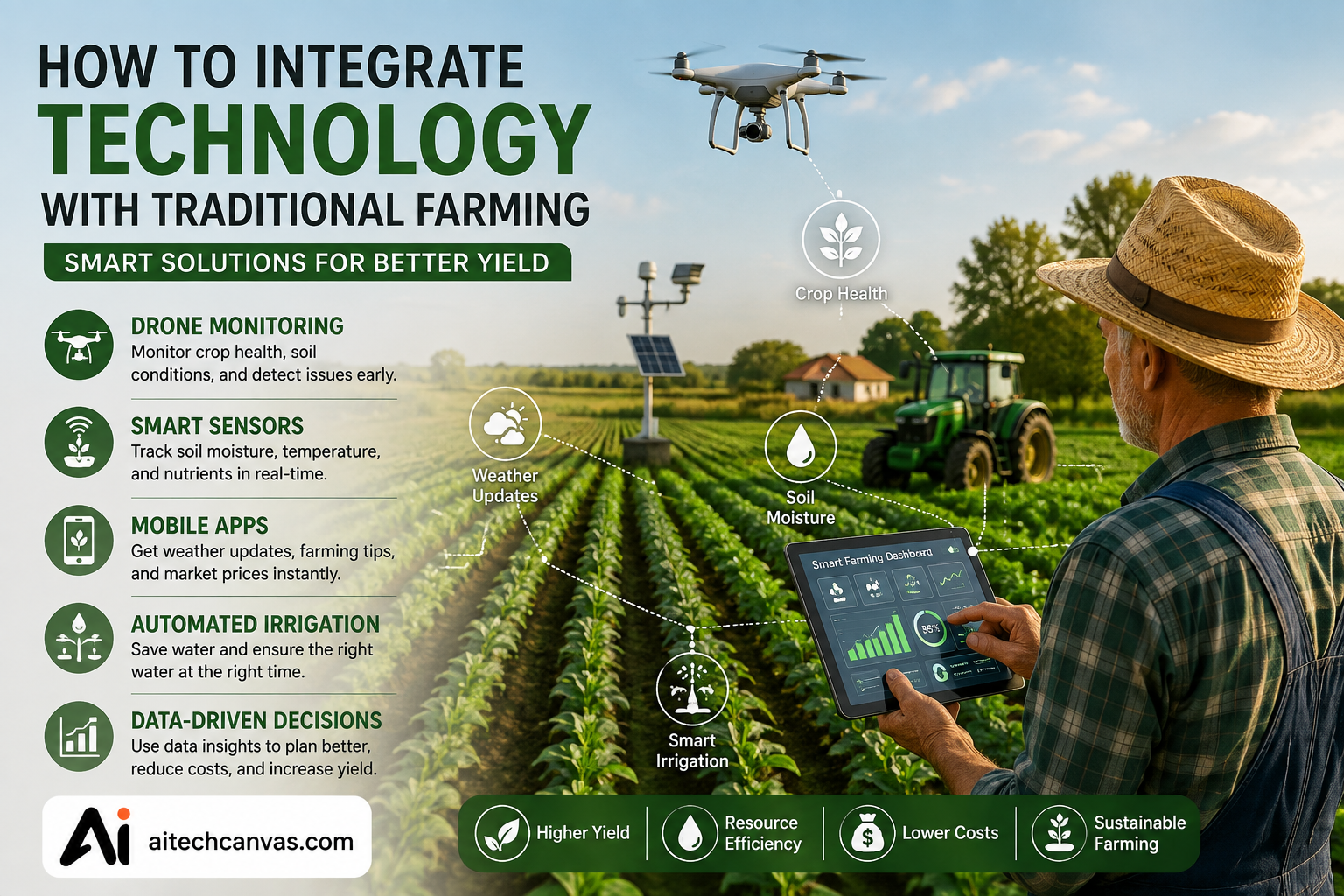
Consider a future agricultural system. Robots could operate equipment, AI could analyze crop conditions, sensors could monitor soil and weather, satellite systems could provide geographic information, edge computing could process local information, and renewable energy could power parts of the operation.
This example shows why future technology innovations may increasingly come from combinations of technologies.
Instead of asking only, “What new technology should we use?” businesses and individuals may need to ask, “What problem are we trying to solve, and which technologies can work together to solve it?”
Challenges of Modern Technology Innovation
Innovation also creates challenges.
Privacy becomes more important as devices and AI systems collect more information. Cybersecurity becomes increasingly critical as more machines and services become connected.
AI introduces additional questions around reliability, transparency, employment, accountability, and responsible use. Environmental concerns also matter because advanced computing requires electricity, cooling, semiconductor manufacturing, and physical infrastructure.
There is also a question of accessibility. If advanced technologies are too expensive or difficult to use, their benefits may not reach everyone.
Conclusion: The Future of Technological Innovation
So, what are innovations in technology? They are new or improved ways of using technology to solve problems, increase capabilities, improve efficiency, and create value.
From AI technology innovations and robotics to quantum computing, biotechnology, renewable energy, spatial computing, IoT, and advanced connectivity, technology innovation is changing nearly every major area of modern life.
The most important development may be the growing connection between these technologies. AI can work with robots, sensors can connect physical environments to software, biotechnology can use machine learning, and advanced computing can support scientific discovery.
Ultimately, successful innovation is not simply about creating technology that is more powerful. It is about creating technology that solves meaningful problems, improves people’s lives, works responsibly, and can be used sustainably.
FAQs
What is technology innovation?
Technology innovation is the creation, improvement, or combination of technologies to solve problems, improve efficiency, or create new value.
What are the biggest technology innovations today?
Major areas include artificial intelligence, generative AI, AI agents, robotics, quantum computing, biotechnology, advanced batteries, renewable energy, spatial computing, autonomous systems, and connected smart devices.
Why is artificial intelligence a technology innovation?
AI enables computers to perform tasks involving language, vision, prediction, generation, reasoning, and automation. Generative AI and AI agents have expanded the range of tasks computers can assist with.
How does technology innovation affect businesses?
It can help businesses automate repetitive tasks, reduce costs, analyze information, improve customer experiences, develop products, and compete more effectively.
What will technology innovation look like in the future?
Future innovation will likely involve greater convergence between AI, robotics, biotechnology, quantum computing, advanced materials, energy systems, sensors, and connectivity.
What are some examples of technological innovations?
Examples include smartphones, cloud computing, AI systems, robotics, GPS navigation, wearable devices, IoT systems, autonomous vehicles, renewable energy technologies, and advanced batteries.
What are the benefits of technology innovation?
Technology innovation can improve efficiency, productivity, communication, automation, research, customer experiences, and access to information while creating new products and services.
How do technological innovations improve our lives?
They can make everyday tasks faster and easier, improve communication, support healthcare and education, provide better access to information, and enable services that were previously difficult or expensive.
Why are innovations in technology important?
They help individuals and organizations solve problems, improve capabilities, increase efficiency, and adapt to changing economic and social needs.
What are the latest technology innovations in 2026?
Major areas of development include AI agents, generative AI, robotics, quantum computing, biotechnology, advanced energy systems, spatial computing, IoT, and increasingly connected technology ecosystems.