
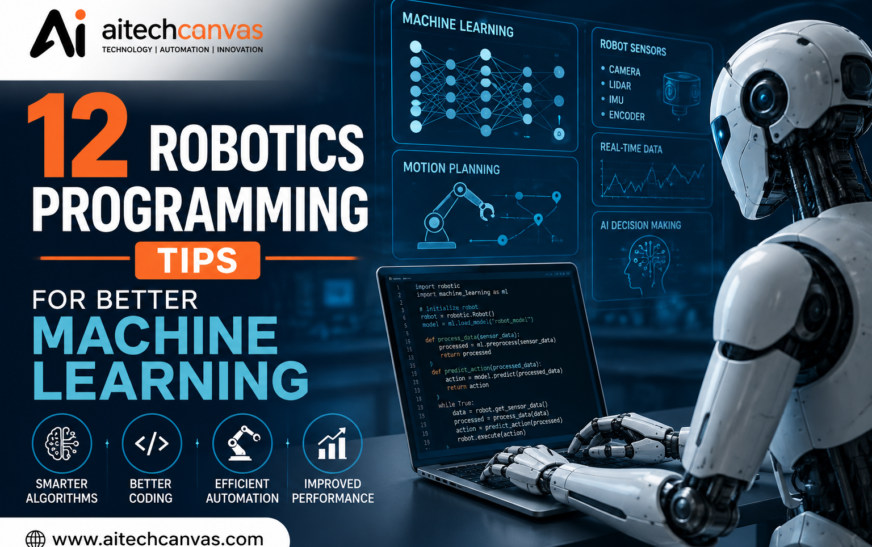
Robotics programming becomes more effective when developers combine clean code, reliable sensor data, simulation, machine learning models, computer vision, motion planning, and real-time testing. These practices help robots learn from data, make better decisions, and perform tasks more accurately.
Key Takeaways
- Choose programming languages that support robotics and AI development.
- Process sensor data accurately before feeding it into machine learning models.
- Use simulation to test robot behavior before real-world deployment.
- Optimize robotics code for speed, accuracy, and reliability.
- Apply machine learning algorithms according to the robot’s specific task.
- Use computer vision to improve robot perception.
- Improve motion planning for safer and more efficient movement.
- Test and debug robot programs regularly.
- Use real-time data to improve robot control.
- Prioritize safety and reliability in robotics programming.
1. Choose the Right Programming Language for Robotics and AI
Choosing the right programming language is one of the first robotics programming tips developers should consider. Python is widely used for machine learning, data processing, computer vision, and robotics experimentation. C++, meanwhile, is useful when robots require high performance and real-time control.
Best Programming Languages for Robotics and AI
Python and C++ are common choices for robotics software development because they support many robotics and AI frameworks. Python can simplify machine learning development, while C++ can provide the performance needed for demanding robotic control systems.
The best choice depends on the robot, hardware, operating environment, and machine learning requirements.
2. Improve Robot Sensor Data Processing
Robots depend on sensors to understand their surroundings. Cameras, LiDAR, ultrasonic sensors, encoders, and other devices generate information that can be used by AI systems.
Why Sensor Data Matters in Machine Learning Robotics
Poor-quality sensor data can negatively affect machine learning results. Developers should therefore clean, filter, normalize, and organize sensor information before using it to train or operate a model.
Effective robot sensor data processing helps robots understand movement, distance, objects, and environmental changes more accurately.
3. Use Robotics Simulation Software Before Deployment
Testing a robot directly on physical hardware can be expensive and time-consuming. Robotics simulation software allows developers to test programs in a virtual environment before deploying them to a real robot.
Benefits of Robot Simulation
Simulation can help developers identify programming errors, test navigation, evaluate sensors, and experiment with machine learning models.
It is particularly useful for machine learning in robotics because developers can test different scenarios without repeatedly putting physical hardware at risk.
4. Optimize Robot Code for Better Performance
Another important robotics programming practice is robotics code optimization. Machine learning models and robotic applications can require significant processing power.
How to Optimize Robotics Programming
Developers can improve performance by:
- Removing unnecessary code
- Reducing repeated calculations
- Optimizing sensor processing
- Managing memory efficiently
- Using appropriate algorithms
- Separating critical real-time tasks from slower processes
Efficient robot programming techniques can help robots respond faster and operate more consistently.
5. Apply the Right Machine Learning Models
Not every machine learning algorithm is suitable for every robotic application. Developers should select models based on the task, available data, hardware capabilities, and expected output.
Machine Learning Algorithms for Robots
Machine learning algorithms for robots can support tasks such as object recognition, navigation, prediction, classification, and decision-making.
For example, supervised learning can be useful when labeled training data is available, while reinforcement learning can help robots learn actions through rewards and feedback.
How to Train Robots Using Machine Learning
Training a robot usually involves collecting relevant data, preparing the dataset, selecting a model, training it, evaluating its performance, and deploying it carefully.
This approach allows developers to create more intelligent robot programming systems rather than relying entirely on manually defined rules.
6. Use Computer Vision to Improve Robot Perception
Computer vision is an important part of AI robotics programming. It enables robots to process images and video to identify objects, recognize patterns, estimate distances, and understand their surroundings.
Computer Vision in Robotics
A robot equipped with cameras can use computer vision to detect objects, track movement, identify obstacles, or navigate an environment.
Combining computer vision in robotics with machine learning can significantly improve robot perception and autonomous decision-making.
7. Improve Robot Motion Planning
A robot needs more than perception and intelligence; it also needs to determine how to move safely and efficiently.
Robot motion planning helps determine suitable paths and movements for robotic arms, mobile robots, autonomous vehicles, and other systems.
Machine Learning and Robot Motion Planning
Machine learning can help robots improve movement based on previous data and experiences. However, developers should combine learning-based approaches with reliable control and planning methods where appropriate. Good motion planning can reduce unnecessary movement, improve efficiency, and support safer robotic automation programming. When combined with robotics automation, these techniques can help robots perform tasks more accurately, efficiently, and safely in dynamic environments.
8. Test and Debug Robotics Programs Regularly
Robots operate in environments where programming errors can produce unexpected physical behavior. Regular testing and debugging are therefore essential.
Common Robotics Programming Mistakes
Some common problems include:
- Incorrect sensor readings
- Poorly configured motor controls
- Timing issues
- Inefficient algorithms
- Incorrect machine learning inputs
- Poorly handled edge cases
- Communication failures
Using structured robotics debugging techniques can help developers identify problems before they affect real-world operation.
9. Use Real-Time Data for Better Robot Control
Robots often need to react to their environment within milliseconds or seconds. Real-time robotics programming helps systems process incoming information and respond appropriately.
Machine Learning Robot Control
Machine learning robot control can use sensor information and learned models to support decisions about speed, direction, positioning, and other actions.
However, developers should carefully evaluate latency and hardware limitations. A model that works well in testing may not perform effectively if it cannot produce results quickly enough for the robot’s control requirements.
10. Focus on Robotics Safety and Reliability
Safety should be a fundamental part of robot programming best practices. Robots can interact with people, equipment, and unpredictable environments, so developers need to consider potential failures.
Robotics Safety Programming Best Practices
Developers should consider:
- Emergency-stop behavior
- Safe movement limits
- Sensor failure handling
- Communication failures
- Unexpected machine learning outputs
- Collision detection
- System monitoring
- Fail-safe behavior
11. Use Modular and Documented Code
Keep code modular and document important functions. Separate machine learning from safety-critical control logic where appropriate. This makes AI-based robotic systems easier to develop, maintain, and debug over time.
12. Continuously Evaluate and Improve Robot Performance
Monitor model performance with realistic data. Validate sensor inputs, test unusual and unexpected conditions, keep backup and recovery procedures, and continuously evaluate robot performance to ensure long-term reliability and improvement.
How AI and Machine Learning Work in Robotics
AI and machine learning can make robots more adaptable than traditional rule-based systems. Instead of programming every possible situation manually, developers can train models using data and allow robots to identify patterns.
For example, a warehouse robot can use sensors and machine learning to recognize obstacles, estimate its location, and choose an appropriate route.
This combination of robotics machine learning programming and automation can support applications in manufacturing, logistics, healthcare, agriculture, and other industries.
How to Make Robots Smarter With Machine Learning
Making robots smarter requires more than simply adding a machine learning model. The entire robotics system needs to work together.
A typical system may include:
Sensors → Data Processing → Machine Learning Model → Decision Making → Robot Control → Feedback
The robot collects information from its environment, processes the data, makes a prediction or decision, performs an action, and then receives new information. This feedback loop can allow the system to improve its performance.
Role of Robotics Automation in Machine Learning
Robotics automation combines robotic hardware, software, sensors, AI, and control systems to perform tasks with limited human intervention.
When machine learning is integrated into automation, robots can potentially handle tasks that involve changing environments or complex visual information.
For businesses, this can support robotics automation solutions for manufacturing, inspection, material handling, warehouse operations, and other repetitive processes.
Robotics Programming Best Practices for AI Systems
Following consistent robot programming best practices can make AI-based robotic systems easier to develop and maintain.
Developers should:
- Keep code modular.
- Document important functions.
- Separate machine learning from safety-critical control logic where appropriate.
- Test models with realistic data.
- Monitor model performance.
- Validate sensor inputs.
- Use simulation before physical deployment.
- Keep backup and recovery procedures.
- Test unusual and unexpected conditions.
- Continuously evaluate robot performance.
What Are the Benefits of Better Robotics Programming?
Better programming can improve several areas of robotic performance, including:
- Accuracy
- Response time
- Reliability
- Navigation
- Object recognition
- Energy efficiency
- Automation capabilities
- Machine learning performance
- System maintenance
These improvements can help organizations develop more capable AI automation and robotic systems.
Challenges of Machine Learning in Robotics
Although machine learning offers major opportunities, integrating it into robots also creates challenges.
These may include limited training data, hardware constraints, unpredictable environments, model accuracy issues, processing latency, safety requirements, and difficulty reproducing real-world conditions in training.
For this reason, successful machine learning in robotics requires careful testing rather than simply deploying a trained model.
Final Thoughts
The best robotics programming tips focus on building a complete system rather than treating programming and machine learning as separate technologies. Choosing the right programming language, processing sensor data, using simulation, optimizing code, selecting suitable machine learning algorithms, and improving computer vision can make robotic systems more capable.
At the same time, motion planning, debugging, real-time control, safety, and reliability remain essential. When these practices are combined with robotics automation, developers can create intelligent robotic systems that are more accurate, responsive, and practical for real-world applications.
FAQs
What programming language is best for robotics and machine learning?
Python is popular for machine learning, AI, and robotics development, while C++ is widely used for performance-focused robotic applications and real-time systems.
How does machine learning improve robotics?
Machine learning allows robots to learn patterns from data and use those patterns for tasks such as object recognition, navigation, prediction, and decision-making.
What is the role of computer vision in robotics?
Computer vision helps robots interpret visual information from cameras, allowing them to detect objects, recognize environments, track movement, and support autonomous behavior.
Why is simulation important in robotics programming?
Simulation allows developers to test robot programs, algorithms, sensors, and machine learning models before deploying them on physical hardware.
Can robotics automation use machine learning?
Yes. Machine learning can be integrated with robotics automation to support tasks involving perception, prediction, classification, navigation, and adaptive decision-making.