
If you want one versatile tool for studying, explaining reactions, solving practice questions, and working through organic chemistry concepts, ChatGPT is one of the strongest overall choices. However, specialized tools can be better for specific tasks. IBM RXN is designed around reaction prediction, Wolfram|Alpha is useful for calculations, PubChem provides chemical information, and CAS SciFinder is particularly valuable for literature, reaction data, and synthesis planning.The best approach is not to depend on one AI for every chemistry task. Use AI to understand concepts, generate practice, and explore possible solutions, then verify important chemical information with reliable databases, textbooks, instructors, or experimental evidence.
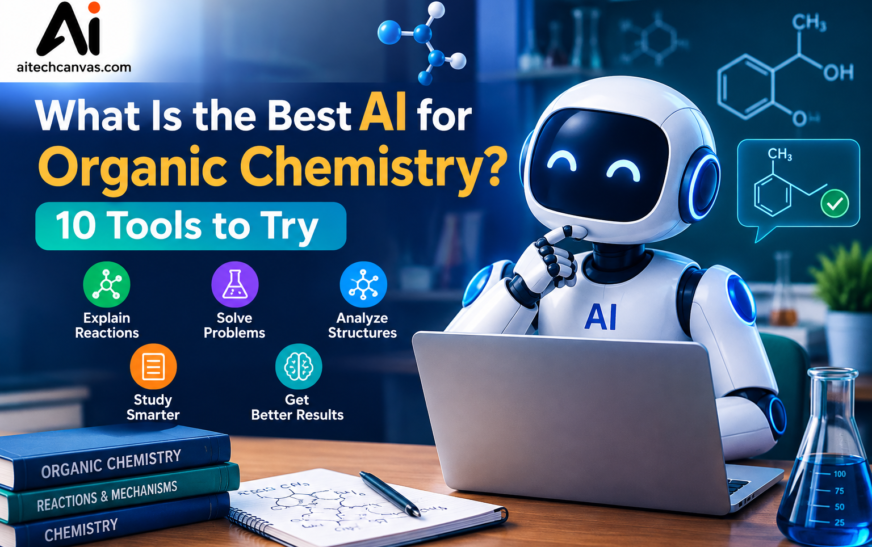
Stop Searching for Chemistry Answers Start Understanding Them. Organic chemistry can become much easier when an AI tool explains why a reaction happens instead of simply giving you the final answer. From reaction mechanisms and molecular structures to spectroscopy and synthesis problems, the right AI chemistry assistant can turn difficult topics into guided learning sessions. Organic chemistry combines structures, reactions, mechanisms, nomenclature, stereochemistry, spectroscopy, and multi-step reasoning. That makes it one of the subjects where students often need more than a traditional search engine.
Key Takeaways
- ChatGPT is a strong general-purpose option for organic chemistry explanations and study support.
- Gemini can be useful when students work with visual material and long study resources.
- Wolfram|Alpha is particularly useful for calculations and quantitative chemistry.
- ChemDraw is valuable for drawing and working with chemical structures.
- PubChem is a useful source for compound and chemical information.
- IBM RXN focuses on reaction prediction and retrosynthesis.
- CAS SciFinder combines curated chemical information, literature, reaction data, and AI-assisted synthesis planning.
- AI should support learning rather than replace chemical reasoning or verification.
The best tool depends on whether you need tutoring, calculations, structure analysis, reaction prediction, or research. Modern AI tools for organic chemistry can help students ask questions in natural language, work through problems step by step, analyze chemical structures, and review difficult concepts. General AI systems can support scientific reasoning, while specialized chemistry platforms can provide curated chemical information and reaction data.
But there is an important distinction: an AI chemistry solver is a study assistant, not an unquestionable authority. AI can produce confident answers that contain mistakes, so important chemical claims should be checked before they are used in coursework, research, or laboratory work. This guide compares the most useful options and explains which tools are best for different organic chemistry tasks
What Is an AI Tool for Organic Chemistry?
An AI tool for organic chemistry is software that uses artificial intelligence, computational chemistry, chemical databases, or a combination of these technologies to help users work with chemistry-related questions. Depending on the platform, an AI organic chemistry solver may explain a reaction, identify a compound, answer a chemistry question, analyze a structure, predict a possible reaction, or help organize research information.
General AI assistants are useful for conversational learning. You can ask why an SN1 reaction differs from an SN2 reaction, request a mechanism explanation, or create practice questions. Specialized chemistry platforms work differently. For example, CAS SciFinder provides access to curated substance, reaction, and reference data and now includes AI-assisted search and retrosynthesis capabilities. Therefore, AI for chemistry problems should be viewed as a category rather than a single type of technology.
How Can AI Help With Organic Chemistry?
AI can support many parts of organic chemistry education and research. The most useful applications depend on the tool and the complexity of the question.
Solving Organic Chemistry Problems
An AI chemistry problem solver can help break complicated questions into smaller steps. For example, instead of asking only for the final product, you can ask the AI to identify the reactant, reaction type, important functional groups, possible intermediate, and final product. This approach is more useful for learning because it encourages students to understand the reasoning behind an answer.
Explaining Organic Chemistry Reactions
One of the most useful applications of AI is explaining reactions in plain language.
Students can ask about:
- Addition and elimination reactions
- Substitution reactions
- Oxidation and reduction
- Electrophilic aromatic substitution
- Carbonyl reactions
- Grignard reactions
- Aldol reactions
- Esterification
- Hydrolysis
A conversational AI can explain the role of reagents and describe why certain products are favored.
Understanding Reaction Mechanisms
Mechanisms are often difficult because students must track electrons, charges, bonds, intermediates, and reaction conditions.
An AI reaction mechanism solver can help organize the process into individual stages. Students can ask why a nucleophile attacks a particular carbon, why a leaving group departs, or why a rearrangement occurs. However, curved-arrow mechanisms should always be checked carefully because an AI explanation can sound convincing even when an electron movement or formal charge is incorrect.
Analyzing Molecular Structures
Some chemistry tools can help students understand molecular structures, functional groups, formulas, and chemical properties.
This is particularly useful when studying:
- Functional groups
- Isomers
- Stereochemistry
- Molecular formulas
- Molecular weight
- Bonding
- Chemical structures
For calculation practice, students may also encounter questions such as How to Compute Molecular Mass from a molecular formula. An AI assistant can explain the calculation, while a dedicated calculation tool can be used to verify the result.
Learning Chemical Nomenclature
AI can help students practice IUPAC-style naming and identify common organic chemistry naming patterns. For example, students can provide a molecular structure and ask the AI to identify the parent chain, substituents, numbering, and final name. Because nomenclature can depend on structural details, students should verify complicated structures against an authoritative reference.
Solving Synthesis Problems
AI can help students think about synthetic routes by working backward from a target molecule. This is known as retrosynthesis. Specialized platforms can provide much more sophisticated support than a general chatbot. CAS SciFinder, for example, offers predictive retrosynthesis and lets users explore alternative steps, reagents, and conditions.
Answering Spectroscopy Questions
AI can also help students learn spectroscopy concepts involving:
- IR spectroscopy
- NMR spectroscopy
- Mass spectrometry
- Molecular formulas
- Functional-group identification
For example, you can ask an AI to explain what an IR absorption may indicate or how proton NMR signals can help identify a structure. For serious analytical work, however, AI explanations should be checked against reliable spectral databases and experimental data.
What Is the Best AI for Organic Chemistry?
The answer depends on what you need.For general learning, ChatGPT is a strong choice because it can explain concepts conversationally and support a wide range of scientific tasks. OpenAI says its models can support scientific questions, molecular-structure exploration, data analysis, and research workflows.
For reaction prediction, a specialized system such as IBM RXN may be more appropriate. For chemical literature and synthesis planning, CAS SciFinder has a major advantage because its AI capabilities are connected to curated chemical content and reaction data. So rather than asking which tool wins every category, choose the tool according to the chemistry task.
Which AI Is Best for Chemistry Problems?
For everyday chemistry questions, a general AI assistant can be a convenient starting point. It can explain calculations, concepts, reactions, and study material in conversational language.
For quantitative questions, a computational tool can provide additional verification. For specialized reaction and synthesis questions, dedicated chemistry platforms may provide stronger domain-specific information.
What AI Can Solve Organic Chemistry Problems?
AI can help with many common organic chemistry problems, including reaction identification, nomenclature, functional groups, mechanisms, molecular formulas, synthesis planning, and spectroscopy concepts.
However, the quality of the answer depends on the tool, prompt, input structure, and complexity of the problem.
Best AI for Solving Organic Chemistry Questions
For students, the best option is often a tool that explains the answer rather than simply producing it.
A useful workflow is:
- Enter the complete question.
- Ask for a step-by-step explanation.
- Ask the AI to identify assumptions.
- Check structures, charges, and atom conservation.
- Verify the final answer using a trusted source.
Best AI Tool for Organic Chemistry Students
Students should prioritize tools that provide explanations, practice questions, structure support, and opportunities to ask follow-up questions.
A good AI chemistry assistant should help you learn the method instead of encouraging you to copy an answer.
10 Best AI Tools for Organic Chemistry
1. ChatGPT
ChatGPT is a strong all-around option for students who want an interactive chemistry tutor. It can explain difficult concepts, create practice questions, analyze supplied information, and support scientific reasoning. OpenAI specifically describes its AI systems as useful across scientific disciplines including chemistry.
Best for: explanations, mechanisms, practice questions, study guides, and general chemistry assistance.
Pros:
- Conversational explanations
- Useful for step-by-step learning
- Flexible across many chemistry topics
- Can help generate quizzes and study material
Limitation: It can make confident mistakes, so important answers need verification.
2. Google Gemini
Google Gemini can be useful for students who want a general AI assistant for chemistry questions, explanations, and study material.
It can help organize notes, explain chemistry concepts, and work through questions. As with other general AI systems, students should verify complicated mechanisms and chemical predictions. Best for: general chemistry study, explanations, and working with study resources.
3. Wolfram|Alpha
Wolfram|Alpha is particularly useful when chemistry involves calculations. Students can use computational tools to check quantities, formulas, mathematical relationships, and other numerical work. For example, if you are learning How to Compute Molecular Mass , a computational approach can help verify the arithmetic after you understand the formula and atomic masses.
Best for: chemistry calculations, quantitative verification, and mathematical chemistry problems.
4. ChemDraw
ChemDraw is different from conversational AI tools because its major strength is chemical structure drawing and visualization. Students can use it to create chemical structures and reaction schemes, making it useful when working with complex organic molecules.
Best for: molecular structures, reaction diagrams, chemical drawing, and visualization.
5. ChemAI
Chemistry-focused AI tools can provide a more specialized experience than a general chatbot. Depending on the specific implementation, such tools may focus on chemistry questions, calculations, structures, or educational assistance.
Best for: chemistry-focused question answering and study support.
6. PubChem
PubChem is an important chemical information resource rather than a general conversational tutor. It can be useful when students need information about chemical compounds, structures, identifiers, and properties.
Best for: chemical compound information, structure lookup, and reference checking.
7. IBM RXN for Chemistry
IBM RXN is designed specifically around chemical reaction prediction and synthesis-related workflows. This makes it particularly relevant when the question is not simply “What is this reaction?” but instead involves predicting possible transformations or exploring synthetic routes.
Best for: reaction prediction and retrosynthesis.
8. CAS SciFinder
CAS SciFinder is particularly valuable for advanced chemistry research and academic work. CAS says its platform combines curated substance, reaction, and reference data with AI-assisted search and predictive retrosynthesis. Its search capabilities can work with structures, names, CAS Registry Numbers, and spectra data, while its retrosynthesis tools can explore alternative reagents, steps, and conditions.
Best for: literature research, reaction searching, chemical databases, and synthesis planning.
9. MolView
MolView is useful for visualizing and exploring molecular structures. It can be helpful for students who need a more visual way to understand molecules, bonds, and chemical structures.
Best for: molecular visualization and structure exploration.
10. Other AI Chemistry Assistants
Other specialized chemistry assistants can be useful for homework help, reaction explanations, structure analysis, and study practice.
The right choice depends on whether you prioritize free access, image input, calculations, reaction prediction, structure drawing, or research capabilities.
Best Organic Chemistry AI Tools for Students
Students have different requirements from professional researchers. A first-year student may primarily need explanations and practice, while an advanced chemistry student may need literature searching and synthesis planning.
AI Chemistry Software for Organic Chemistry
Chemistry software can range from general AI assistants to specialized molecular modeling, structure-drawing, reaction-prediction, and database platforms.
The best software is the one that matches the specific task.
Chemistry AI Assistant for Students
A chemistry AI assistant can function like an on-demand study partner. Students can ask for explanations, examples, practice questions, and alternative explanations when a textbook explanation is unclear.
Organic Chemistry Learning Tools
Useful learning tools should help students practice rather than simply provide answers.
For example, an AI can generate five questions about SN1 and SN2 reactions and then explain the student’s mistakes.
AI Chemistry Study Tools
AI can turn notes into:
- Flashcards
- Practice tests
- Concept summaries
- Reaction tables
- Quiz questions
- Study plans
This can make revision more interactive.
Best Chemistry AI Apps
The best chemistry AI app depends on the student’s goal. General assistants are useful for explanations, while specialized applications can be better for calculations, structures, or reaction prediction.
Free Chemistry AI Solver
Free AI chemistry tools can be useful for basic homework practice and concept explanations. However, free access does not necessarily mean that the tool is accurate enough for advanced chemistry.
Always verify important answers.
AI Molecular Structure Tools
Molecular structure tools are especially useful when students need to visualize compounds, compare structures, identify functional groups, or understand stereochemistry.
Best AI for Organic Chemistry Homework
Best AI Developer Platforms can make homework practice more efficient when students use it as a tutor instead of an answer generator.
Can AI Explain Organic Chemistry Mechanisms?
Yes. AI can explain mechanisms in stages, including reactants, reagents, intermediates, electron movement, and products.
For difficult mechanisms, ask the AI to explain each curved arrow separately and identify the electron source and electron destination.
Can AI Solve Organic Chemistry Questions?
AI can help solve many organic chemistry questions, but students should not assume that every response is correct.
A better prompt is:
“Solve this problem step by step, explain the chemistry behind each step, identify any assumptions, and check the final structure.”
Can AI Explain Chemical Reactions Step by Step?
Yes. A good chemistry prompt should ask for the reaction type, role of each reagent, mechanism, major product, possible side reactions, and reason for selectivity.
This turns the AI into a learning tool rather than a simple answer engine.
Free AI Tools for Organic Chemistry
Students often search for a free AI chemistry solver because paid chemistry platforms can be expensive.
Free options can be useful for:
- Basic chemistry questions
- Reaction explanations
- Homework practice
- Formula calculations
- Nomenclature practice
- Study notes
- Flashcards
However, specialized research platforms may require institutional or paid access.
Best Free Chemistry AI Solver
The best free option depends on the task. A general AI assistant may be sufficient for explanations, while a chemical database may be better for verifying compound information.
Free AI Chemistry Study Tools
Free tools are particularly useful for revision. Students can ask AI to create practice tests, explain mistakes, simplify textbook concepts, and compare related reactions.
Free AI Tools for Solving Organic Chemistry Problems
A free AI tool can help with common organic chemistry problems, but the safest workflow is to use it for reasoning and learning, then verify the result independently.
AI Reaction Prediction Software: What Can It Do?
AI reaction prediction tools are designed to analyze chemical reactions and estimate possible products or synthetic transformations.
Specialized systems can go beyond ordinary question answering. CAS SciFinder, for example, offers predictive retrosynthesis and lets users explore alternative synthetic routes.
Predicting Chemical Reactions
AI can identify patterns in reaction data and suggest possible transformations.
Understanding Reaction Products
Students can use reaction-prediction tools to explore what products might result from particular reactants and conditions.
Analyzing Reaction Pathways
More advanced systems can help explore multiple steps rather than focusing on a single transformation.
Supporting Organic Synthesis Planning
Retrosynthesis tools work backward from a target molecule to possible starting materials and reaction steps. CAS says its predictive retrosynthesis is supported by curated reaction data and AI trained on structured chemical information.
How to Choose the Best AI for Organic Chemistry
When choosing an AI chemistry tool, do not focus only on how impressive its answers sound.
Accuracy and Reliability
Check whether the tool provides verifiable information and whether you can confirm its results.
Reaction and Mechanism Support
If your main goal is organic chemistry, choose a tool that can explain mechanisms rather than only answer general questions.
Molecular Structure Analysis
Structure support becomes especially important for stereochemistry, functional groups, isomers, and complex molecules.
Ease of Use
Students are more likely to use a tool consistently if its interface is simple and its explanations are easy to understand.
Free vs Paid Features
Free tools may be sufficient for basic study, while advanced research features may require paid access or institutional subscriptions.
Student-Friendly Features
Look for features such as:
- Step-by-step explanations
- Practice questions
- Image or structure support
- Reaction explanations
- Calculation assistance
- Follow-up questions
- Study-note generation
AI for Organic Chemistry vs Traditional Study Methods
AI and traditional study methods do not have to compete.
Textbooks remain valuable because they provide structured explanations and established examples. Professors and instructors can identify misconceptions and provide expert feedback. Laboratory work provides practical experience that an AI system cannot replace.
AI adds another layer by providing interactive explanations and immediate practice.
For example, you can read a textbook chapter about carbonyl chemistry, then ask an AI to explain the difficult sections, generate practice questions, and review your answers.
The strongest approach combines AI + textbooks + instructors + practice + verification.
Benefits and Limitations of AI Chemistry Tools
Benefits of AI for Organic Chemistry
AI can:
- Explain difficult concepts in simpler language
- Provide instant practice questions
- Help students review reactions
- Generate customized quizzes
- Explain mechanisms step by step
- Support structure-based learning
- Help organize study notes
- Provide alternative explanations
AI can also make learning more interactive because students can continue asking follow-up questions instead of stopping after reading a single explanation.
Limitations of AI Chemistry Software
AI is not perfect.
It can:
- Misinterpret a molecular structure
- Produce an incorrect mechanism
- Give the wrong product
- Confuse similar reactions
- Make errors in calculations
- Provide outdated or unsupported information
- Sound confident even when incorrect
For example, even an apparently simple question involving How to Compute Molecular Mass should be checked by confirming the molecular formula and atomic masses rather than blindly trusting the generated result.
Why Human Verification Still Matters
Human verification is essential because chemistry involves precise relationships between atoms, bonds, charges, structures, conditions, and experimental evidence.
OpenAI itself warns that ChatGPT can produce incorrect or misleading outputs and recommends critically assessing important information.
For advanced research, curated chemistry resources can provide another layer of confidence. CAS SciFinder, for example, emphasizes scientist-curated chemical content and evidence-backed synthesis planning.
Final Verdict: Which AI Is Best for Organic Chemistry?
So, What Is the Best AI for Organic Chemistry? There is no single winner for every chemistry task.
For most students, ChatGPT is a strong overall choice for explanations, practice, mechanisms, and interactive learning. Gemini can also be useful for general study workflows, while Wolfram|Alpha is valuable for calculations. ChemDraw and MolView are useful for structure visualization, PubChem is valuable for chemical reference information, and IBM RXN is better suited to reaction prediction.
For advanced research and synthesis planning, CAS SciFinder stands out because it combines curated chemical data, literature, reaction information, and AI-assisted retrosynthesis.
The smartest strategy is to combine tools rather than expect one AI to do everything. Use a conversational AI to learn, specialized chemistry software to analyze, and trusted chemical resources to verify.
Most importantly, use AI to understand organic chemistry not just finish organic chemistry homework.
FAQs
What Is the Best AI for Organic Chemistry?
For general student use, ChatGPT is a strong all-purpose option for explanations, practice, and problem-solving support. Specialized tools may be better for reaction prediction, chemical databases, calculations, or synthesis planning.
What AI Can Solve Organic Chemistry Problems?
General AI assistants can help with reaction questions, mechanisms, nomenclature, molecular structures, spectroscopy, and synthesis problems. Specialized chemistry platforms can provide additional reaction and chemical-data capabilities.
Which AI Is Best for Chemistry Problems?
The best choice depends on the problem. Use a general AI assistant for explanations, computational tools for calculations, and specialized chemistry platforms for reaction prediction and synthesis planning.
What Is the Best AI Tool for Organic Chemistry Students?
Students should choose a tool that provides clear explanations, practice opportunities, structure support, and reliable ways to verify answers. A general conversational AI is often a good starting point.
Can AI Solve Organic Chemistry Homework?
AI can help solve and explain many homework questions, but students should verify important answers and understand the reasoning rather than simply copying the response.
Is There a Free AI Chemistry Solver?
Yes, several general and chemistry-focused AI tools offer free access or free features. The capabilities and usage limits vary, so students should check the current terms of each tool.
Can AI Explain Organic Chemistry Reactions?
Yes. AI can explain reaction types, reagents, mechanisms, intermediates, products, and selectivity. For complicated mechanisms, always verify the electron movement and chemical structures.
Can AI Solve Organic Chemistry Mechanisms?
AI can work through many common mechanisms, but it may make mistakes involving electron movement, stereochemistry, charges, or reaction conditions. Verification is important.
What Are the Best Organic Chemistry AI Tools?
Useful options include ChatGPT, Gemini, Wolfram|Alpha, ChemDraw, PubChem, IBM RXN, CAS SciFinder, and MolView. The best option depends on whether you need tutoring, calculations, structure analysis, reaction prediction, or research.
How Does AI Help With Organic Chemistry?
AI helps by explaining concepts, solving practice problems, generating quizzes, analyzing structures, explaining mechanisms, supporting reaction prediction, and helping students organize their study material.