
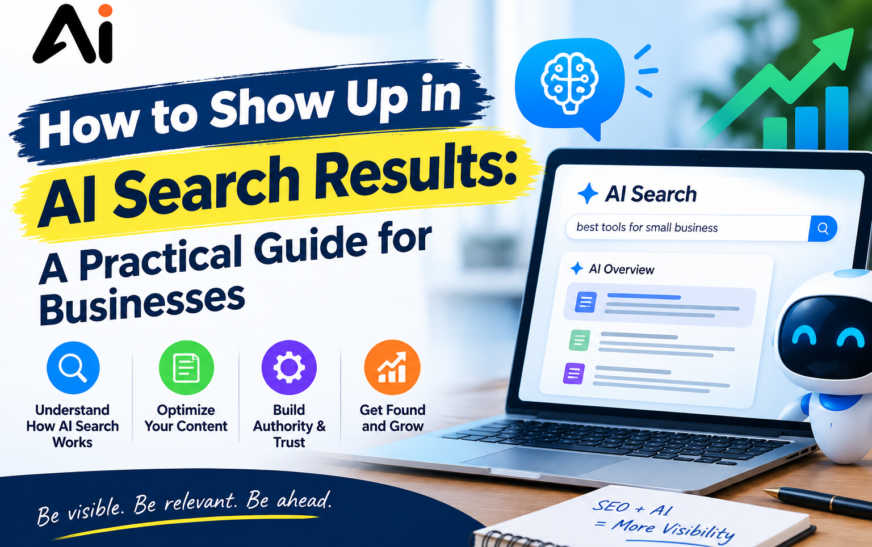
Your customers may no longer be searching for your business on Google first they may be asking an AI to recommend it. To improve your chances of appearing in AI search results, build a trustworthy digital presence beyond your website. Publish genuinely useful content, keep business information consistent across the web, earn credible third-party mentions and reviews, and make your expertise easy for AI-powered search systems to understand and verify.
AI search is changing how people discover businesses, products, and experts. Instead of comparing pages of search results, users can now ask platforms such as ChatGPT, Google’s AI search features, and Perplexity for a direct recommendation.
That shift is creating a new question for businesses:
When an AI system is asked to recommend a company in your industry, will your business be part of the answer?
As this change develops, businesses are looking beyond traditional SEO and paying closer attention to AI visibility, online reputation, authoritative content, and the information available about their brand across the web. For marketers and businesses looking to keep up with emerging AI tools and technologies, resources such as AI Tech Canvas can provide another useful source of information and industry insights.
Getting there requires more than traditional SEO. Businesses need accurate information across the web, useful content, strong third-party mentions, positive reviews, and a reputation that AI systems can understand and verify.
What Is AI Search Visibility?
AI search visibility is the ability of a business, website, product, or professional to appear in answers generated by AI-powered search and conversational systems.
Traditional SEO focuses heavily on helping a webpage rank for a search query. AI search works differently. A user might ask:
“What are the best digital marketing agencies for small businesses?”
Instead of receiving only a list of links, an AI system may summarize several businesses and explain why each one is relevant.
That means businesses need to build authority beyond a single webpage.
Your website still matters. But so do reviews, news coverage, industry publications, directories, expert profiles, and other trustworthy references.
Why Traditional SEO Alone Is No Longer Enough
Ranking well in Google remains valuable, but search behavior is expanding.
A business can have a technically strong website and still have limited visibility when people ask AI platforms for recommendations.
Why?
AI systems need enough reliable information to understand what a business does, where it operates, who it serves, and whether other sources consider it credible.
For example, a local business may have an excellent website but very little information elsewhere online. Another competitor might have consistent business listings, detailed reviews, industry mentions, interviews, and useful educational content.
The second business gives AI systems more information to work with.
What Information Can Influence AI Recommendations?
There isn’t a single publicly documented formula that guarantees an AI system will recommend a particular company.
Instead, businesses should focus on building a clear and trustworthy online identity.
1. Publish Useful, Expert Content
Create content that demonstrates genuine knowledge of your industry.
Instead of publishing dozens of shallow articles designed only around keywords, answer questions your customers actually ask.
For example, a cybersecurity company could publish:
- Guides explaining common security problems
- Original research and observations
- Expert commentary on major security developments
- Practical tutorials
- Case studies based on real client work
This gives search engines and AI systems more context about the company’s expertise.
2. Build Mentions Outside Your Website
Your own website is only one source of information about your business.
Industry publications, interviews, news websites, professional organizations, business directories, podcasts, and other independent sources can create additional references.
This is particularly useful when those sources clearly identify the business, its expertise, location, products, or services.
Quality matters more than simply collecting hundreds of low-value links.
3. Keep Business Information Consistent
Check how your business information appears across the internet.
Your:
- Business name
- Address
- Phone number
- Website
- Services
- Founder or expert information
- Industry/category
should be accurate and consistent wherever they appear.
An old address on a directory or an outdated service description can create confusion for both customers and automated systems.
4. Earn Genuine Customer Reviews
Reviews provide another source of information about customer experience.
Businesses should make it easy for genuine customers to leave honest feedback on relevant platforms.
Don’t manufacture reviews or manipulate ratings. A long-term reputation strategy depends on authentic customer experiences.
It is also useful to respond professionally to legitimate negative feedback. A thoughtful response can show prospective customers how the business handles problems.
Create Content That Answers Real Questions
One of the simplest ways to improve your AI-search strategy is to stop thinking only in terms of keywords.
Think about questions.
What would a customer actually type into ChatGPT?
A plumber might target questions such as:
“How much does it cost to replace a water heater?”
A software company might answer:
“Which project management software is best for a small remote team?”
A law firm might publish:
“What should you do after receiving a business contract dispute?”
The goal isn’t to predict every AI prompt.
The goal is to create genuinely useful information around the problems your business solves.
[INTERNAL LINK: Complete Guide to SEO Content Strategy]
Your About Page Matters More Than You Think
Don’t treat the About page as an afterthought.
Clearly explain who you are, what your company does, where you operate, what expertise you have, and who you serve.
For companies with recognizable founders or specialists, detailed author and expert profiles can also help establish context.
Make the information factual and easy to verify.
If your company claims to specialize in a particular service, there should be supporting evidence elsewhere on the website and across relevant third-party sources.
Get Your Business Mentioned in Relevant Publications
Digital PR can support an AI visibility strategy because it puts your business into contexts outside your own website.
You might contribute expert commentary, provide data for journalists, participate in interviews, publish research, or contribute useful insights to industry publications.
The objective shouldn’t be to collect random mentions.
A relevant article about your expertise is much more useful than a meaningless mention on an unrelated website.
Monitor What AI Says About Your Business
You don’t have to wait for customers to tell you what AI systems are saying.
Regularly test relevant prompts.
For example:
- “Best [service] companies in [city]”
- “Who are the leading [industry] experts?”
- “What companies specialize in [service]?”
- “What are the best alternatives to [competitor]?”
- “Which [product category] is best for [customer type]?”
Record whether your business appears, what information is shown, and whether anything is inaccurate.
AI-generated answers can change, so treat these checks as monitoring rather than a permanent ranking report.
Don’t Try to Game AI Search
The temptation is obvious: publish hundreds of pages, create artificial mentions, generate fake reviews, or stuff every possible phrase onto your website.
That is the wrong strategy.
AI visibility is ultimately tied to the information available about your business. If that information is inaccurate or artificially manufactured, it can damage your reputation rather than strengthen it.
Build something worth recommending first.
Then make sure the internet contains enough accurate information for AI systems and customers to understand why.
The Future of Search Is More Than Rankings
Search is moving beyond the simple question of “Where does my page rank?”
Businesses now need to consider a broader question:
What does the internet say about my company, and can AI systems understand it?
That means traditional SEO, content marketing, digital PR, reviews, local listings, and reputation management increasingly need to work together.
There is no legitimate shortcut that guarantees a business will be recommended by ChatGPT, Perplexity, Google, or another AI system.
The practical strategy is much simpler: publish useful information, maintain accurate business details, earn genuine third-party recognition, build real expertise, and monitor how your brand is represented online.
Start with your own digital footprint. Search your business name, check your major listings, review your recent coverage, and ask several AI systems the questions your customers are likely to ask.
That audit will show you where your biggest visibility gaps are and what to fix first.