
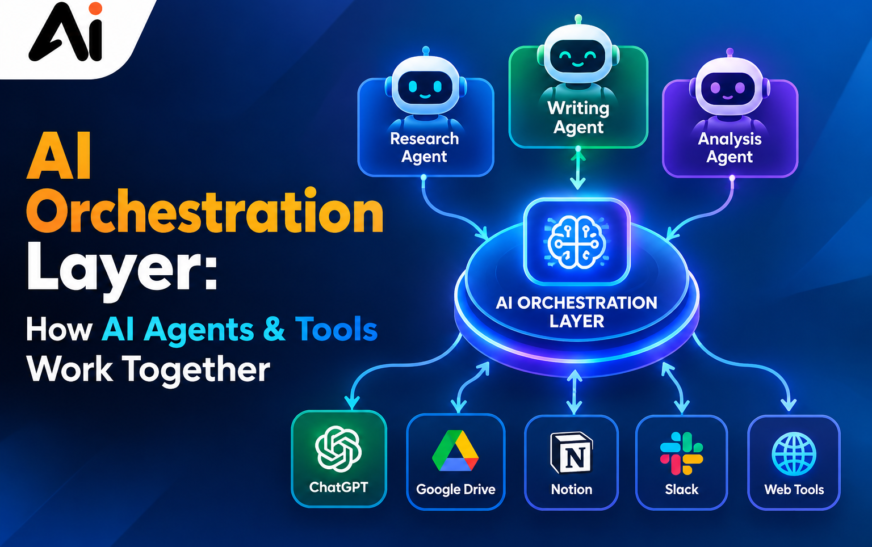
AI orchestration is becoming the coordination layer that helps AI models, agents, tools, data, and human teams work together instead of operating as disconnected systems.
AI orchestration is the process of coordinating multiple AI models, agents, tools, data sources, workflows, and decision engines so they can complete tasks as part of a connected process. An AI orchestration layer determines what should happen, which AI model or agent should be used, what tools it should access, what information it needs, and when a task should be automated or handed to a human.
In enterprise environments, AI orchestration can connect chatbots, recommendation engines, sentiment analysis, speech analytics, predictive routing, agent-assist systems, machine learning models, and automation workflows. This allows AI systems to maintain context, share information, adapt to changing conditions, and support more consistent business and customer experiences.
Key Takeaways
- AI orchestration coordinates multiple AI models, agents, tools, and workflows.
- An AI orchestration layer acts as a coordination and decision layer between AI systems, applications, data, and users.
- The three important pillars are AI integration, AI automation, and AI management.
- Agentic AI orchestration coordinates AI agents that can perform different tasks within a larger workflow.
- Multi-agent AI orchestration allows specialized agents to collaborate on complex tasks.
- Enterprise AI orchestration can connect customer service systems, analytics, automation, and human agents.
- Context management helps AI systems maintain relevant information across channels and interactions.
- Governance, monitoring, security, and human oversight remain important as AI workflows become more autonomous.
What Is AI Orchestration?
AI orchestration is the coordinated management of different AI models, agents, tools, applications, data sources, and decision engines within a single workflow.
Instead of asking one AI model to handle everything, an orchestration system can divide a task into smaller steps and determine which component should handle each step. One model might understand a customer’s request, another system might analyze sentiment, a tool might retrieve account information, and a human agent might handle an escalation.
This approach is particularly useful when organizations have multiple AI technologies operating across different departments. AI orchestration provides a way to connect these systems so they can communicate, exchange relevant information, and respond according to the requirements of a workflow.
AI Orchestration for Enterprise Businesses
Enterprise AI orchestration brings together AI systems that may otherwise operate independently. These can include chatbots, speech analytics, predictive routing, recommendation engines, machine learning models, agent-assist tools, and automation platforms.
The orchestration layer can determine when each component should be triggered and what information should be passed between them. This creates a more connected workflow instead of forcing employees or customers to move between isolated AI applications.
For example, an enterprise customer-service workflow could begin with a chatbot. If the conversation becomes complex, sentiment analysis could evaluate the interaction while an AI system retrieves relevant information. If escalation is necessary, the workflow can transfer the conversation to a human agent with the appropriate context.
AI Orchestration Across the Customer Journey
AI orchestration can operate across multiple customer touchpoints rather than treating every interaction as a separate event.
A customer might interact with a company through a website, mobile application, chatbot, phone call, or human support agent. When these systems are connected through orchestration, relevant context can move between channels.
This can help organizations create more consistent customer experiences because AI tools and human employees can work with connected information instead of starting from zero during every interaction.
AI Orchestration for Customer Service
Customer service is one of the clearest examples of how AI orchestration can coordinate multiple technologies.
Imagine a customer contacting a business about a delayed order. A virtual assistant can understand the request and retrieve order information. Sentiment analysis can identify whether the interaction is becoming negative. A recommendation or decision engine can determine the next appropriate action.
If the issue requires human assistance, the orchestration workflow can transfer the conversation to a live agent while preserving the relevant context.
This means AI orchestration is not simply about replacing customer service employees. It can coordinate AI and human capabilities so that each component performs the part of the workflow it is designed to handle.
What Is an AI Orchestration Layer?
An AI orchestration layer is the coordination layer that connects AI models, AI agents, applications, tools, data sources, and business workflows.
It can decide:
- Which AI model should process a task
- Which AI agent should perform an action
- Which tool or API should be called
- What information should be passed between systems
- When another model or agent should take over
- When a workflow should be automated
- When human intervention is required
- How workflow activity should be monitored
The AI orchestration layer, therefore, sits between individual AI capabilities and the larger business workflow.
Why Is an AI Orchestration Layer Important?
Using multiple AI tools independently can create fragmented workflows. Each system may have its own data, context, permissions, and processes.
An AI orchestration layer helps connect these components.
For example, a company could use one AI model for text generation, another for classification, a database for business information, an API for transactions, and a human employee for approval. The orchestration layer can coordinate these components into one workflow.
This makes AI infrastructure more flexible because organizations do not necessarily have to rely on one model or one AI provider for every task.
The Three Pillars of AI Orchestration
A useful way to understand AI orchestration is through three connected pillars:
- AI integration
- AI automation
- AI management
Together, these pillars help organizations connect AI systems, automate workflows, and monitor their operation.
AI Integration
AI integration connects models and AI capabilities with business applications, databases, APIs, data pipelines, and other technology systems.
For example, an AI assistant might need access to a customer database, a knowledge base, a ticketing platform, and an internal API. Integration allows these systems to work together.
AI Automation
AI automation allows orchestration systems to trigger actions based on events, decisions, or workflow conditions.
Instead of simply generating an answer, an AI system may analyze information, decide, call a tool, update a record, and move the workflow to its next step.
AI Management
AI management focuses on monitoring and controlling AI workflows throughout their lifecycle.
It can include:
- Performance monitoring
- Resource management
- Lifecycle management
- Centralized monitoring
- Governance
- Security
- Compliance
- Error handling
- Human oversight
These capabilities become increasingly important as organizations deploy more AI models and autonomous agents.
How Does AI Orchestration Work?
AI orchestration generally follows a sequence of coordinated steps.
1. Receive the Task
The system receives an input, event, request, or business objective.
2. Understand the Context
The orchestration layer evaluates the request and identifies relevant information from connected systems.
3. Select the Appropriate AI Capability
The system determines which model, AI agent, tool, or workflow should handle the next step.
4. Execute the Action
The selected component processes the task, generates an output, retrieves information, or performs an action through a connected tool.
5. Evaluate the Result
The orchestration workflow can evaluate whether the result is sufficient or whether another step is required.
6. Continue or Escalate
The system can continue to another AI agent, trigger an automation, request additional information, or transfer the task to a human.
This creates an AI workflow orchestration process where multiple components work together rather than functioning independently.
AI Orchestration Example
Consider an online retailer using AI marketing tool for customer support.
A customer asks, “Where is my order, and can I change the delivery address?”
The orchestration workflow could operate like this:
- A chatbot understands the customer’s question.
- The system retrieves the customer’s order information.
- A sentiment model evaluates the conversation.
- A business rules engine checks whether the address can still be changed.
- An AI agent requests the necessary information.
- An API updates the delivery address if permitted.
- The system confirms the change to the customer.
- If the request requires approval, the workflow sends it to a human employee.
Here, the chatbot is only one component. AI orchestration coordinates the entire workflow.
What Is Agentic AI Orchestration?
Agentic AI orchestration” refers to coordinating AI agents that can perform tasks, use tools, make intermediate decisions, and collaborate within a larger workflow.
An AI agent may be responsible for research, another for data analysis, and another for executing an action. The orchestration layer coordinates their activities.
This becomes especially useful for complex tasks where one AI agent cannot efficiently handle every step.
For example:
User request → Research agent → Analysis agent → Decision agent → Action agent → Human approval
The orchestration layer manages the transitions between these components.
What Is AI Agent Orchestration?
AI agent orchestration focuses specifically on coordinating multiple AI agents.
An AI agent can have a defined role, objective, toolset, and set of permissions. The orchestration system determines how agents communicate and when each agent should act.
For example:
- Research agent gathers information.
- A data agent analyzes structured data.
- A writing agent creates a response.
- A compliance agent checks requirements.
- A human reviewer provides final approval.
This creates an AI agent workflow rather than a single-agent interaction.
Multi-Agent AI Orchestration
Multi-agent AI orchestration involves several specialized AI agents collaborating to complete a larger objective.
Each agent can focus on a specific responsibility instead of requiring one model to handle every task.
A multi-agent workflow might include:
Planner → Researcher → Analyst → Executor → Reviewer
The planner divides the task, the researcher gathers information, the analyst processes it, the executor performs an approved action, and the reviewer checks the output.
This structure can make complex workflows easier to organize, monitor, and modify.
AI Orchestration Architecture
An AI orchestration architecture can contain several layers:
User/Application Layer
The user interacts with an application, assistant, website, or business system.
Orchestration Layer
The AI workflow engine determines what should happen next.
Agent and Model Layer
Different AI models and agents perform specialized tasks.
Tool and API Layer
Agents access databases, APIs, search systems, business applications, and external services.
Data Layer
Data pipelines, knowledge bases, documents, databases, and other information sources provide context.
Governance and Monitoring Layer
Security, permissions, observability, compliance, logging, and human oversight help control the workflow.
This architecture allows organizations to build AI systems that are more connected than isolated AI applications.
AI Workflow Orchestration and Data Pipelines
Data is a major part of AI workflow orchestration.
AI systems often need information from databases, documents, applications, customer records, analytics platforms, or other sources.
Data pipelines can move relevant information between systems so that AI models and agents have the context they need.
However, organizations also need to consider data quality, access permissions, privacy, security, and governance when connecting these sources.
AI Orchestration and Context Management
Context management is particularly important when AI workflows involve multiple steps or channels.
Suppose a customer begins a conversation with a chatbot and later speaks with a human agent. Without context management, the customer may have to repeat the entire issue.
With orchestration, relevant information from the earlier interaction can be passed to the next component.
Context management can therefore help AI systems understand:
- Previous interactions
- Customer requests
- Workflow status
- Relevant business information
- Previous actions
- Current task requirements
This is especially valuable for enterprise workflows involving multiple systems and customer touchpoints.
AI Orchestration for Personalized Experiences
AI orchestration can also support personalization by connecting different AI capabilities and information sources.
For example, a recommendation engine can use customer information while another AI system analyzes the current interaction. The orchestration layer can coordinate these components so the experience adapts to the current situation.
In customer service, sentiment analysis could identify frustration and influence how a virtual assistant responds or whether the interaction should be escalated to a human agent.
The objective is not simply to generate more AI responses but to coordinate AI capabilities around the user’s current context.
AI Orchestration Tools and Frameworks
Different types of technologies can support AI orchestration.
Common categories include:
- AI orchestration platforms
- AI agent frameworks
- Workflow engines
- LLM orchestration frameworks
- Model-routing systems
- API orchestration tools
- Automation platforms
- Observability platforms
- Data pipeline systems
- Enterprise integration platforms
The appropriate technology depends on the workflow, models, infrastructure, security requirements, and level of autonomy an organization needs.
AI Model Orchestration and LLM Routing
AI model orchestration involves coordinating multiple AI models based on their capabilities, cost, latency, or task requirements.
For example, a workflow could use:
- A smaller model for simple classification
- A larger model for complex reasoning
- A specialized model for document processing
- A vision model for image analysis
- A speech model for voice interactions
LLM routing can determine which language model should receive a particular request.
This can help organizations avoid using the most expensive or resource-intensive model for every task.
AI Orchestration vs. Automation
AI automation generally focuses on automatically completing tasks.
AI orchestration is broader because it coordinates multiple systems and decisions across an entire workflow.
For example:
Automation: Automatically send an email when an order is shipped.
AI orchestration: Understand the customer’s request, retrieve order information, analyze sentiment, determine the appropriate response, update the CRM, and escalate the issue when required.
Automation can therefore be one component within a larger AI orchestration workflow.
AI Orchestration vs. AI Agents
An AI agent performs tasks toward a defined objective.
AI orchestration coordinates agents, models, tools, data, applications, and humans.
A useful way to think about the difference is:
AI agent = worker
AI orchestration = coordinator
A single agent can complete a task independently, while an orchestration layer can manage a larger workflow involving multiple agents and systems.
AI Orchestration vs. RPA, Chatbots, and Point AI
Traditional RPA generally follows predefined rules and workflows. Chatbots primarily focus on conversational interactions. Point AI tools usually solve a specific problem, such as summarization, image generation, sentiment analysis, or recommendation.
AI orchestration connects these capabilities into a broader workflow.
For example, a customer-service system could combine a chatbot, sentiment analysis, predictive routing, RPA automation, an AI agent, and a human employee.
The orchestration layer determines how these components work together.
AI Orchestration Use Cases
AI orchestration can support many business and technical use cases.
Customer Service
Coordinate chatbots, sentiment analysis, agent assist, knowledge systems, predictive routing, and human support.
Marketing
Connect customer data, content generation, personalization, analytics, and campaign automation.
Software Development
Coordinate coding agents, testing systems, documentation tools, code analysis, and human review.
IT Operations
Connect monitoring systems, AI troubleshooting agents, automation tools, ticketing platforms, and human IT teams.
Healthcare Technology
Coordinate information retrieval, administrative workflows, AI analysis, alerts, and human review where appropriate.
Financial Services
Coordinate document processing, risk analysis, customer interactions, fraud detection systems, and approval workflows.
Business Automation
Connect AI agents with CRM systems, databases, APIs, workflow engines, and business applications.
Benefits of AI Orchestration
Better AI Integration
Organizations can connect multiple AI technologies instead of operating each system independently.
Improved Workflow Efficiency
Automated coordination can reduce unnecessary manual steps and move tasks between systems more efficiently.
Consistent Customer Experiences
AI orchestration can maintain relevant context across channels and systems, helping customer-facing AI tools and human agents work from connected information.
Better Scalability
Organizations can add models, agents, tools, and workflows without rebuilding the entire AI infrastructure.
Flexible Model Selection
Model orchestration allows different models to be used for different requirements.
Centralized Monitoring
AI management can provide greater visibility into workflows, performance, resource usage, and failures.
Human-AI Collaboration
Orchestration can determine when AI should act independently and when a human should review, approve, or take over.
Governance and Control
Organizations can establish permissions, monitoring, compliance processes, and approval requirements around AI workflows.
How to Build an AI Orchestration System
Building an AI orchestration system starts with defining the business problem rather than simply choosing an AI model.
Step 1: Define the Workflow
Identify the complete process you want AI to support.
Step 2: Identify AI Capabilities
Determine which tasks require language models, predictive models, computer vision, speech systems, agents, or traditional software.
Step 3: Connect Data Sources
Identify databases, documents, APIs, applications, and other systems required by the workflow.
Step 4: Create the Orchestration Logic
Define how tasks move between models, agents, tools, and people.
Step 5: Add Tool Calling
Allow approved AI components to interact with external systems through APIs and functions.
Step 6: Add Monitoring
Track errors, latency, costs, workflow completion, model performance, and other relevant metrics.
Step 7: Add Human Oversight
Define which decisions require human approval or intervention.
Step 8: Test and Improve
Test the complete workflow with realistic scenarios before expanding it across the organization.
Advanced AI Orchestration Technologies
Modern AI orchestration can include several advanced capabilities.
Tool Calling
AI agents can call approved tools and APIs to retrieve information or perform actions.
Function Calling
Models can interact with predefined functions instead of generating text alone.
Model Routing
Requests can be directed to different models based on task requirements.
Memory and Context
Systems can preserve relevant information across multiple workflow steps.
Observability
Organizations can monitor AI workflows, model behavior, costs, latency, and failures.
Human-in-the-Loop AI
Humans can review important outputs or approve sensitive actions before execution.
These technologies help transform AI from an isolated response generator into a connected workflow system.
Challenges of AI Orchestration
Complexity: Connecting multiple agents, models, APIs, and applications can make workflows difficult to design and maintain.
Data Quality: Poor or incomplete data can affect downstream AI decisions.
Security and Permissions: AI agents with access to business systems require carefully controlled permissions.
Higher Costs: Using multiple models and tools can increase infrastructure and API costs.
System Failures: A failure in one component can affect the entire workflow.
Governance: Organizations need policies for model usage, data access, monitoring, auditing, and human approval.
Context Errors: Passing incorrect or irrelevant context between systems can produce poor results.
Operational Management: Successful AI orchestration requires both strong technical architecture and effective operational management.
AI Governance and Human Oversight
As AI workflows become more autonomous, governance becomes increasingly important. Organizations should define which actions AI can perform independently and which actions require human review. Human oversight can also provide a mechanism for handling unusual situations, incorrect outputs, policy exceptions, and sensitive workflows. AI orchestration should therefore include governance from the beginning rather than treating it as an afterthought.
The Future of Agentic AI Orchestration
The future of agentic AI orchestration is likely to involve increasingly connected workflows in which AI agents can coordinate tasks, use specialized tools, communicate with other agents, and interact with enterprise applications. The goal is not simply to create more autonomous AI. It is to create reliable systems in which models, agents, tools, data, automation, and people can work together within a controlled workflow.
Conclusion
AI orchestration provides a way to connect AI models, AI agents, tools, data, automation, applications, and human teams into coordinated workflows. An AI orchestration layer acts as the central coordination mechanism that determines what should happen, which AI capability should be used, what information should be shared, and when human intervention is necessary.
As agentic AI orchestration and multi-agent systems continue to develop, orchestration will remain important for managing how autonomous AI components interact with business systems while maintaining context, governance, security, and human oversight.
FAQs About AI Orchestration
What is AI orchestration?
AI orchestration is the coordination of AI models, agents, tools, data, applications, and workflows to complete tasks as part of a connected process.
What is an AI orchestration layer?
An AI orchestration layer is a coordination layer that manages communication and workflow between AI models, agents, tools, data sources, applications, and humans.
What is agentic AI orchestration?
Agentic AI orchestration coordinates AI agents that can perform different tasks, use tools, make decisions, and collaborate within a larger workflow.
What is AI agent orchestration?
AI agent orchestration is the process of coordinating multiple AI agents so that each agent can perform a specialized role within a larger workflow.
What are the three pillars of AI orchestration?
The three key pillars are AI integration, AI automation, and AI management. They cover connecting AI systems, automating workflows, and monitoring and managing AI operations.
How does AI orchestration help customer service?
AI orchestration can connect chatbots, sentiment analysis, recommendation systems, predictive routing, agent-assist tools, and human agents while helping maintain relevant customer context.
What is multi-agent AI orchestration?
Multi-agent AI orchestration coordinates multiple specialized AI agents to complete complex workflows. Each agent can handle a different part of the overall task.
Is AI orchestration the same as AI automation?
No. AI automation focuses on automatically completing tasks, while AI orchestration coordinates multiple AI systems, tools, data sources, automation processes, and human actions across a workflow.
Why is human oversight important in AI orchestration?
Human oversight provides control over important decisions and allows people to review sensitive actions, handle exceptions, and intervene when an AI workflow produces an uncertain or inappropriate result.
What is the future of AI orchestration?
AI orchestration is increasingly connected with agentic AI, multi-agent systems, model routing, tool calling, workflow automation, context management, observability, and enterprise AI governance.