
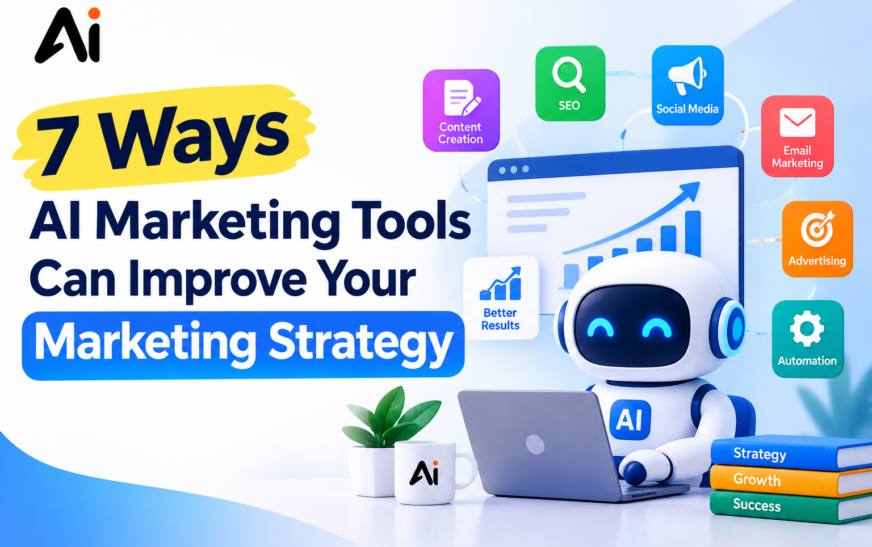
Marketing is changing faster than ever, and AI marketing tools are helping businesses create content, improve SEO, automate campaigns, understand customers, and make smarter decisions without spending countless hours on repetitive tasks. AI marketing tools are software platforms that use artificial intelligence to automate, simplify, and improve different marketing activities. They can help with content creation, SEO, social media, email campaigns, advertising, customer research, analytics, and marketing automation.
The best AI marketing tool depends on what you need. Some platforms are designed for content and copywriting, while others focus on SEO, social media, email marketing, advertising, analytics, or complete marketing automation.
Artificial intelligence has quickly become one of the most useful technologies in modern digital marketing. Businesses no longer have to depend entirely on manual research, repetitive content creation, or time-consuming data analysis. With the right AI tools for marketing, marketers can automate routine activities and spend more time on strategy, creativity, and customer relationships.
What Are AI Marketing Tools?
AI marketing tools are software applications that use artificial intelligence technologies to assist with marketing activities. These technologies can include machine learning, natural language processing, predictive analytics, generative AI, automation, and data analysis.
Traditional marketing software usually follows predefined rules. AI marketing software can go further by analyzing information and generating recommendations or content based on patterns in the data.
For example, an AI content tool can analyze a topic and generate a draft article. An AI SEO platform can identify keyword opportunities and suggest ways to improve content. An AI email marketing system can help personalize messages based on customer behavior.
The goal is not necessarily to replace marketers. Instead, these tools are designed to help marketing teams work faster, automate repetitive processes, and make more informed decisions.From writing marketing copy to analyzing campaign performance, AI-powered marketing tools can support almost every stage of a digital marketing strategy. These tools can analyze large amounts of information, recognize patterns, generate content, predict customer behavior, and provide recommendations that would take humans much longer to produce manually.
This is especially useful for small businesses and marketing agencies that often have limited budgets and small teams. Instead of hiring separate specialists for every marketing task, companies can use different AI marketing software solutions to improve productivity across multiple channels.
In this guide, we will explore what AI marketing tools are, how they work, their major benefits, the features marketers should look for, popular use cases, and how to choose the right platform for your business.
How Do AI Marketing Tools Work?
Most modern AI tools for digital marketing work by processing large amounts of data and using AI models to identify patterns, generate outputs, or make predictions.
A typical workflow may look like this:
- Data collection: The platform collects information such as website activity, customer behavior, search queries, campaign performance, or marketing content.
- AI analysis: Artificial intelligence analyzes the available information and identifies patterns.
- Prediction or generation: The system generates content, recommendations, insights, or predictions.
- Automation: Some platforms automatically perform actions based on those insights.
- Human review: Marketers review the output, make decisions, and adjust campaigns when necessary.
For example, an AI marketing assistant may analyze a product description and create several advertising headlines. A marketer can then review those suggestions and choose the most appropriate version.
This combination of automation and human judgment is often more effective than relying entirely on either manual work or AI-generated results.
Why Are AI Marketing Tools Important for Businesses?
Businesses are dealing with increasing amounts of marketing data and growing competition across search engines, social networks, email, and paid advertising platforms.
Manually managing every activity can become expensive and inefficient. AI marketing tools for businesses can help reduce repetitive work while allowing teams to process information more efficiently.
For example, an online business may use AI to:
- Generate product descriptions
- Research content ideas
- Analyze customer behavior
- Optimize website content
- Create social media posts
- Personalize email campaigns
- Monitor advertising performance
- Identify potential customers
- Automate repetitive workflows
AI can also help marketers experiment with different approaches. Instead of creating one headline manually, a marketer can generate multiple variations and test which one performs best.
Best AI Marketing Tools
The best AI marketing tools help businesses automate and improve different areas of digital marketing. AI content marketing tools can generate ideas, outlines, and marketing copy, while AI SEO marketing tools help with keyword research and content optimization. AI social media marketing tools can assist with creating, scheduling, and analyzing posts. Similarly, AI email marketing tools help personalize campaigns and improve customer engagement. Businesses can also use AI advertising tools to create ad variations and analyze campaign performance. AI marketing automation tools connect repetitive tasks and workflows, helping teams work more efficiently.
Benefits of AI Marketing Tools
One of the biggest benefits of AI marketing tools is saving time and resources. AI can handle repetitive tasks, allowing marketers to focus on strategy and creativity. These tools can also increase marketing productivity by helping teams create and analyze content faster. AI supports personalization by using customer data to deliver more relevant messages and recommendations. In addition, AI can turn large amounts of marketing data into useful insights, supporting better decision-making. Businesses can also use AI to monitor website and campaign performance, helping identify issues such as a shadow on monitor screen when marketers are working with large amounts of visual data.
Types of AI Marketing Tools
There are several types of AI marketing tools, including AI content creation tools, AI SEO tools, AI social media tools, AI email marketing tools, AI analytics tools, AI advertising tools, and AI marketing automation tools. Each category addresses a specific marketing need. Marketers who work remotely may also use different devices and displays, making it useful to understand common technical issues such as monitor shadow, shadow on laptop screen, or a dark shadow on computer screen that can affect their ability to review visual marketing content.
How to Choose the Best AI Marketing Tools
When choosing an AI marketing tool, consider its features, pricing, ease of use, integrations, scalability, and data privacy. Select a platform that fits your marketing goals and existing workflow. If your team frequently creates or reviews visual content, make sure employees have reliable displays and understand how to troubleshoot issues such as a shadow on laptop screen or a dark shadow on computer screen, since display problems can affect productivity.
Free vs Paid AI Marketing Tools
Free AI marketing tools are useful for beginners and small projects, while paid platforms usually offer advanced features, higher limits, automation, integrations, and better support. Before investing in paid software, businesses should also consider the hardware used by their marketing teams. A recurring monitor shadow or shadow on monitor screen can make it harder to evaluate images, advertisements, videos, and other visual marketing assets accurately.
AI Marketing Tools for Small Businesses
AI marketing tools for small businesses can reduce workload and help smaller teams manage content, SEO, social media, email campaigns, advertising, and analytics more efficiently. Small businesses often have employees handling multiple responsibilities, so reliable software and hardware are important. Problems such as a shadow on laptop screen or a dark shadow on computer screen can become distracting when employees spend long hours creating and reviewing marketing materials.
AI Marketing Tools for Agencies
Marketing agencies can use AI to manage multiple campaigns, create content faster, analyze client data, automate workflows, and improve productivity across different accounts. Because agencies often review graphics, advertisements, website designs, and video content for multiple clients, clear displays are important. If an employee notices a shadow on monitor screen, monitor shadow, or dark shadow on computer screen, resolving the display issue can help ensure visual marketing assets are reviewed accurately.
Key Benefits of AI-Powered Marketing Tools
Save Time With AI Marketing Automation
One of the biggest advantages of AI marketing automation tools is their ability to reduce repetitive work.
Marketing teams regularly perform tasks such as scheduling social media posts, organizing leads, sending emails, analyzing reports, and creating content drafts. Many of these processes can be partially or fully automated.
For example, a business could create an automated workflow that sends a welcome email when a customer subscribes to its newsletter. AI can further personalize the message based on customer information or previous interactions.
This allows marketers to spend more time on planning and creative work instead of repetitive administrative activities.
Create Content Faster With AI Content Marketing Tools
Content creation can take significant time. Marketers need to research topics, create outlines, write drafts, develop headlines, and optimize content.
AI content marketing tools can accelerate these processes by generating ideas, outlines, drafts, headlines, product descriptions, social posts, and other marketing materials.
However, AI-generated content should not simply be published without review. Human marketers should check facts, brand voice, originality, accuracy, and usefulness.
The strongest approach is to use AI as a productivity assistant while keeping human expertise involved in the final content.
Improve Search Performance With AI SEO Marketing Tools
Search engine optimization involves keyword research, content optimization, competitor analysis, technical checks, and performance monitoring.
AI SEO marketing tools can assist marketers by identifying keyword opportunities, analyzing content, suggesting related topics, and highlighting potential optimization improvements.
AI can also help organize large keyword lists and identify relationships between search topics.
Still, SEO success depends on more than adding keywords. Helpful content, strong user experience, technical performance, search intent, authority, and originality remain important.
Manage Social Platforms With AI Social Media Marketing Tools
Social media teams often need to create and publish content across several platforms.
AI social media marketing tools can help generate post ideas, captions, content variations, scheduling suggestions, and audience insights.
A marketer could provide a topic and ask an AI system to create different versions for LinkedIn, Instagram, Facebook, or other platforms.
The marketer can then adjust each post to match the audience and platform rather than publishing identical content everywhere.
Personalize Customer Experiences
Customers increasingly expect brands to provide relevant experiences.
AI can analyze customer behavior and help marketers personalize recommendations, messages, offers, and communication.
For example, an online retailer may use customer browsing or purchase information to recommend related products.
Personalization can make marketing communication more relevant, but businesses should use customer information responsibly and respect privacy requirements.
Analyze Marketing Data More Effectively
Modern marketing generates enormous amounts of data.
Marketers may need to analyze website traffic, conversion rates, email performance, advertising results, customer behavior, and social media engagement.
AI can help organize and analyze this information more efficiently. Some platforms can identify unusual patterns, summarize performance, and highlight areas that may deserve attention.
This can make marketing reporting faster and help teams focus on meaningful insights rather than manually reviewing every data point.
Optimize Campaigns With AI Advertising Tools
Paid advertising involves testing different audiences, messages, keywords, creatives, and budgets.
AI advertising tools can help marketers analyze campaign performance and identify opportunities for optimization.
Some platforms can assist with audience targeting, ad copy generation, creative variations, bidding strategies, and performance analysis.
However, marketers should still monitor advertising campaigns carefully. AI recommendations are not automatically correct for every business or audience.
Key Features to Look for in AI Marketing Software
Not every AI marketing software platform offers the same capabilities. Before choosing one, consider the following features.
AI Content Generation
Look for tools that can generate useful content while allowing you to control tone, style, structure, and brand messaging.
SEO and Keyword Optimization
If organic search is important to your business, consider tools that support keyword research, content optimization, competitor analysis, and SEO reporting.
Social Media Automation
Businesses that depend heavily on social networks may benefit from tools that support content creation, scheduling, publishing, analytics, and social listening.
AI Email Marketing Tools
AI email marketing tools can help create subject lines, email copy, personalized messages, audience segments, and automated campaigns.
Marketing Analytics and Reporting
Good analytics features can help marketers understand what is working and where improvements are needed.
Customer Personalization
If personalization is important, look for AI capabilities that can help create targeted experiences based on customer behavior.
CRM and Third-Party Integrations
Integration with CRM, analytics, email, advertising, content management, and productivity platforms can make an AI marketing workflow much easier to manage.
10 Best AI Marketing Tools in 2026
The market contains many different AI platforms, and the best option depends on your specific marketing needs. Rather than selecting a tool simply because it is popular, consider the tasks you want to automate or improve.
1. ChatGPT: Best AI Marketing Assistant
ChatGPT can be useful for brainstorming, content outlines, marketing copy, campaign ideas, audience research, summaries, and many other marketing tasks.
It can act as an AI marketing assistant for marketers who need help moving quickly from an idea to a working draft.
Its biggest advantage is flexibility. Instead of being limited to one marketing task, it can support multiple stages of the workflow.
2. Jasper: AI Content Marketing
Jasper is designed around business and marketing content workflows. It can help teams create marketing copy, campaigns, and content while maintaining a consistent brand voice.
It can be particularly useful for teams that produce large amounts of marketing content.
3. HubSpot: Marketing Automation
HubSpot combines CRM, marketing, sales, customer service, and automation capabilities.
Its AI features can assist marketers with content, customer engagement, reporting, and workflow automation.
For businesses looking for an integrated marketing platform rather than a single-purpose AI application, a platform like HubSpot can be worth considering.
4. Semrush: SEO and Digital Marketing
Semrush is widely used for SEO, keyword research, competitor analysis, content marketing, and digital marketing research.
Its AI-related capabilities can assist marketers with content and search optimization workflows.
It can be particularly valuable for businesses that want to combine traditional SEO data with AI-assisted marketing processes.
5. Surfer: Content Optimization
Surfer focuses heavily on content optimization and SEO workflows.
It can help marketers evaluate content against search-related factors and identify opportunities for improvement.
For content teams that publish articles regularly, an AI-assisted optimization workflow can help make content production more systematic.
6. Canva: AI Design and Marketing Content
Canva is useful for creating visual marketing assets such as social media graphics, presentations, advertisements, and promotional materials.
Its AI features can accelerate design and content creation, making it easier for small teams to produce professional-looking marketing materials.
7. Copy.ai: Marketing Workflows
Copy.ai focuses on AI-powered content and marketing workflows.
It can help businesses create marketing copy and automate certain go-to-market processes.
It may be particularly useful for teams that want to combine AI content generation with structured workflows.
8. Buffer : Social Media Marketing
Buffer is a social media management platform that can help businesses organize, schedule, and analyze social media content.
Its AI capabilities can assist with content creation and ideation.
This can make it easier for small marketing teams to maintain a consistent publishing schedule.
9. Mailchimp: Email Marketing
Mailchimp provides email marketing and automation capabilities, along with AI-assisted features.
Businesses can use it to create campaigns, manage audiences, automate communication, and evaluate email performance.
For companies that rely heavily on newsletters and email campaigns, an AI-supported email workflow can save time.
10. Grammarly: Marketing Writing
Grammarly can assist marketers with grammar, clarity, tone, rewriting, and overall writing quality.
Marketing teams can use it when preparing emails, website copy, social media posts, advertisements, and other written materials.
It is especially useful as a final editing layer in an AI-assisted content workflow.
Best AI Tools for Digital Marketing
The best AI digital marketing tools depend on the specific channel you want to improve.
For SEO, marketers may prioritize keyword research and content optimization tools. For social media, content creation and scheduling capabilities may be more important. For email marketing, personalization and automation may be the main priorities.
A complete digital marketing strategy may therefore use several Best AI Developer Platforms rather than relying on a single platform.
For example:
| Marketing Activity | Useful AI Capability |
| Content Creation | Writing and brainstorming |
| SEO | Keyword and content analysis |
| Social Media | Content generation and scheduling |
| Email Marketing | Personalization and automation |
| Advertising | Ad optimization and testing |
| Analytics | Data analysis and reporting |
| Design | AI-assisted graphics |
| Customer Support | AI assistants and chatbots |
Best AI Marketing Tools for Small Businesses
AI tools for small businesses can be especially valuable because small teams often have limited time and resources.
A small company could use AI for:
- Blog content ideas
- Social media captions
- Email campaigns
- Customer communication
- SEO research
- Advertising copy
- Market research
- Data analysis
- Graphic design
- Workflow automation
The key is to avoid buying too many tools at once. Start with the marketing activity that consumes the most time or has the greatest business impact.
For example, if content creation is the biggest challenge, start with an AI content tool. If managing customer leads is the problem, prioritize CRM and automation capabilities.
Best AI Marketing Tools for Agencies
Marketing agencies often manage multiple clients, campaigns, platforms, and content calendars.
AI marketing tools for agencies can help reduce repetitive work and improve workflow consistency.
Agencies can use AI to:
- Generate campaign ideas
- Develop content outlines
- Create social media variation
- Analyze SEO opportunities
- Summarize reports
- Prepare client updates
- Organize marketing workflows
- Generate ad variations
- Personalize content
However, agencies should maintain human review. Clients expect strategic expertise, brand understanding, and accurate recommendations not simply automatically generated content.
Best Free AI Marketing Tools
There are many free AI marketing tools and platforms with free plans or limited free features.
Free tools can be a good starting point for freelancers, students, startups, and small businesses that want to test AI before paying for advanced functionality.
However, free versions may include limitations such as:
- Usage limits
- Fewer integrations
- Restricted features
- Limited automation
- Smaller data allowances
- Fewer customization options
Before upgrading, test whether the tool actually saves enough time or improves enough performance to justify the cost.
AI Marketing Tools Comparison
Choosing between platforms can be difficult because different tools solve different problems.
| Tool Category | Best For | Main Advantage |
| AI Writing Tools | Content teams | Faster content creation |
| AI SEO Tools | SEO professionals | Search optimization |
| AI Social Tools | Social media teams | Content and scheduling |
| AI Email Tools | Email marketers | Personalization and automation |
| AI Advertising Tools | Paid media teams | Campaign optimization |
| AI Analytics Tools | Marketing managers | Data insights |
| AI Design Tools | Creative teams | Faster visual production |
| AI Automation Tools | Businesses and agencies | Workflow automation |
Instead of asking which tool is universally the best, ask which tool best solves your current marketing problem.
Free vs. Paid AI Marketing Tools: Which Is Better?
Free tools can be useful for experimentation, but paid platforms often provide more advanced capabilities.
A free tool may be sufficient for an individual who only needs occasional content ideas. A growing business may require integrations, automation, analytics, collaboration, and higher usage limits.
When comparing AI marketing software pricing, consider the total value rather than simply choosing the cheapest option.
Ask:
- How much time will the tool save?
- How frequently will the team use it?
- Does it replace repetitive manual work?
- Does it integrate with existing software?
- Can multiple team members use it?
- Does it provide useful analytics?
- Can it scale as the business grows?
A tool that costs more but saves many hours every month may provide greater value than a cheap tool that nobody regularly uses.
How to Choose the Best AI Marketing Software
Choosing the right platform becomes easier when you start with your goals.
Consider Your Marketing Goals
First, identify what you want AI to accomplish.
Do you want more website traffic? Faster content creation? Better social media engagement? More leads? Improved email campaigns?
Your answer should guide your tool selection.
Compare Features and Integrations
Make sure the tool supports the tasks you actually perform.
Integration is also important. A powerful AI application may not be useful if it cannot connect with your existing marketing systems.
Check AI Marketing Software Pricing
Compare pricing based on actual usage rather than headline prices.
Some platforms charge according to users, features, credits, contacts, or usage volume.
Evaluate Ease of Use
A complicated platform can reduce productivity if employees need extensive training.
Look for a system that your team can learn and use consistently.
Consider Scalability
Your needs may change as your business grows.
Choose a platform that can support additional users, campaigns, customers, content, and integrations when necessary.
How Can Marketers Use AI Effectively?
AI works best when marketers treat it as a productivity and decision-support tool rather than a complete replacement for human expertise.
A strong workflow can look like this:
Research → AI Assistance → Human Review → Testing → Optimization
For example, a marketer might use AI to generate ten campaign ideas, select the three most promising ideas, refine them manually, launch a test, analyze the results, and then improve the campaign.
This approach combines AI speed with human judgment.
Marketers should also verify important information produced by AI. Generated content can contain errors, outdated information, unsupported claims, or wording that does not match the brand.
Are AI Marketing Tools Worth It for Businesses?
For many businesses, AI marketing tools can be worth the investment when they solve a clear problem.
The strongest use cases usually involve repetitive or time-consuming activities.
If an AI platform saves several hours every week, improves workflow efficiency, or helps marketers analyze information faster, it can provide meaningful value.
However, AI is not automatically beneficial simply because it is AI. A business should evaluate the actual results.
Track metrics such as:
- Time saved
- Content production
- Website traffic
- Conversion rates
- Lead generation
- Email engagement
- Advertising performance
- Customer satisfaction
- Marketing costs
These measurements can help determine whether an AI investment is actually producing business value.
Common Mistakes When Using AI Marketing Tools
Businesses can make several mistakes when adopting AI.
Publishing AI Content Without Review
AI-generated content should be reviewed for accuracy, usefulness, originality, and brand consistency.
Using Too Many Tools
A large collection of disconnected AI applications can make workflows more complicated rather than simpler.
Ignoring Customer Privacy
Businesses should handle customer information responsibly and understand the privacy requirements relevant to their operations.
Focusing Only on Cost
The cheapest tool is not necessarily the best tool. Productivity, integrations, reliability, and results should also be considered.
Replacing Strategy With Automation
Automation can execute tasks, but successful marketing still requires positioning, creativity, audience understanding, and strategic decision-making.
Future of AI Marketing Tools
The future of AI marketing platforms is likely to involve deeper automation, stronger personalization, better analytics, and more capable AI agents.
Instead of using separate tools for every task, businesses may increasingly use connected AI systems that can coordinate multiple parts of a marketing workflow.
For example, an AI system could potentially analyze campaign performance, identify an underperforming audience, suggest new content, create campaign variations, and prepare a performance report.
Human oversight will remain important, particularly for brand strategy, privacy, accuracy, creative direction, and high-impact decisions. What Is Smart Response Technology? also highlights how intelligent response systems can support faster and more personalized interactions, making them a useful part of modern AI-powered marketing and customer engagement strategies.
As AI technology develops, marketers who learn how to combine AI capabilities with human expertise may gain a significant productivity advantage.
Conclusion
AI marketing tools are changing how businesses approach digital marketing. From content creation and SEO to social media, email marketing, advertising, analytics, and automation, AI can reduce repetitive work and help marketers make better use of their time.
The best AI marketing tools are not necessarily the most expensive or most popular platforms. The right choice depends on your goals, workflow, budget, team size, and required features.
Small businesses can use AI to compete more efficiently with larger organizations, while agencies can use AI to manage repetitive client work at scale. Experienced marketing teams can combine AI automation with human creativity, strategy, and judgment.
The most effective approach is to start with a specific problem, test an appropriate AI solution, measure the results, and expand your use of AI as you identify genuine business value.
FAQs About AI Marketing Tools
What are AI marketing tools?
AI marketing tools are software applications that use artificial intelligence to help businesses perform marketing tasks such as content creation, SEO, social media management, email marketing, advertising, analytics, personalization, and automation.
What are the best AI marketing tools?
The best tool depends on your needs. ChatGPT can support a wide range of marketing tasks, while specialized platforms focus on SEO, content, social media, email marketing, advertising, design, or automation.
Which AI tools are best for digital marketing?
The best AI tools for digital marketing depend on your channel. SEO platforms are useful for search optimization, AI writing tools support content creation, social media tools help manage publishing, and automation platforms can streamline workflows.
What is the best AI marketing software for small businesses?
Small businesses should choose software based on their biggest marketing challenge. An affordable platform that solves a specific problem and is easy for the team to use can often be more valuable than a complex enterprise solution.
Are there free AI marketing tools?
Yes. Many platforms offer free tools or free plans with limitations. They can be useful for testing AI marketing workflows before investing in paid features.
How does marketing automation with AI work?
Marketing automation with AI uses artificial intelligence to analyze information, generate content or recommendations, personalize communication, and automate repetitive marketing workflows.
Can AI marketing tools replace marketers?
AI marketing tools are better viewed as assistants rather than complete replacements for marketers. Human expertise remains important for strategy, creativity, brand decisions, fact-checking, ethics, and understanding customers.
What is an AI marketing assistant?
An AI marketing assistant is an AI-powered system that helps marketers with tasks such as brainstorming, content creation, research, campaign planning, analysis, and communication.
Are AI marketing tools worth paying for?
They can be worthwhile when they save significant time, improve productivity, increase marketing performance, or automate repetitive tasks. Businesses should measure actual results before committing to long-term costs.
How can small businesses start using AI for marketing?
Start with one high-impact task, such as content creation, social media management, email marketing, SEO research, or customer communication. Test the tool, measure the results, and expand gradually.