

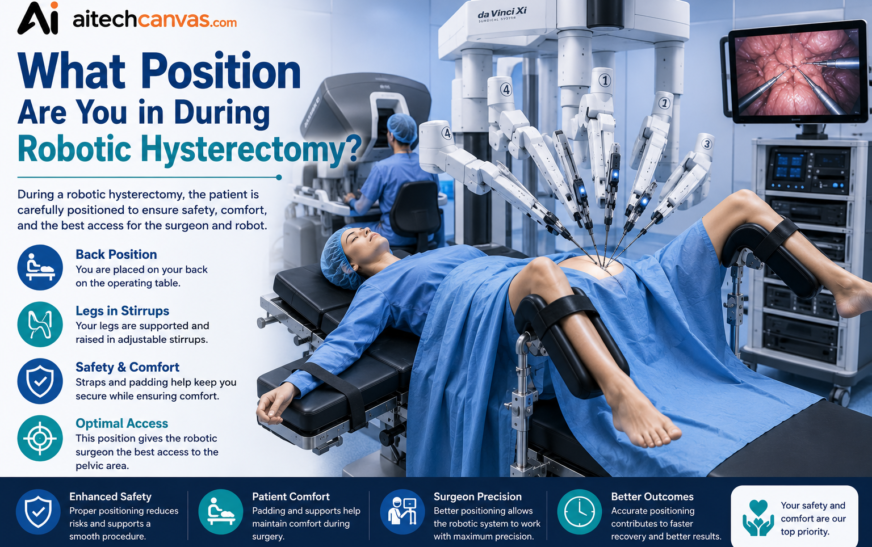
Wondering what position you are in during robotic hysterectomy? Before the procedure begins, your surgical team carefully positions you on the operating table so the surgeon can safely access the pelvic area. The most common setup involves lying on your back with your legs supported, often in a lithotomy position, followed by a head-down tilt called the Trendelenburg position.
Understanding the robotic hysterectomy position can make the procedure feel less unfamiliar. Although the exact patient position for robotic hysterectomy may vary depending on the operation and your individual circumstances, positioning is an important part of robotic surgery.
This article provides general educational information. Your surgeon and anesthesia team can explain exactly how you will be positioned for your specific procedure.
Key Takeaways
- The typical robotic hysterectomy body position involves lying on your back.
- Your legs are generally supported in an elevated position.
- The lithotomy position robotic hysterectomy setup provides access to the pelvic region.
- The operating table may be tilted into the Trendelenburg position.
- Robotic surgery positioning helps provide the surgeon with a suitable working area.
- The surgical team takes precautions to protect pressure points, nerves, and other areas of the body.
- The exact patient position for robotic hysterectomy can vary depending on the procedure and individual patient factors.
- Your surgeon or anesthesia team can explain the positioning planned for your operation.
What Position Are You in During Robotic Hysterectomy?
The usual robotic hysterectomy position starts with the patient lying on her back. The legs are placed in supportive devices that keep them comfortably elevated and positioned for the operation.
This arrangement is commonly referred to as the lithotomy position. Once the patient is under anesthesia and safely positioned, the operating table can be tilted into Trendelenburg.
The combination of these positions helps create a better surgical environment for a minimally invasive hysterectomy. The surgeon can operate through small abdominal incisions while the robotic system provides controlled movement of surgical instruments.
The exact surgery position for hysterectomy is determined by the surgical team according to the procedure being performed.During robotic hysterectomy, patients are generally placed on their backs with their legs supported and elevated. This is commonly called the lithotomy position. The operating table may also be tilted into the Trendelenburg position, where the head is positioned lower than the feet.
This position during robotic hysterectomy helps the surgeon access the pelvis and operate using robotic instruments. Because you are under anesthesia, the surgical team carefully supports and secures your body throughout the procedure.
What Is the Lithotomy Position?
The lithotomy position is a surgical position in which the patient lies on their back while their legs are supported and elevated.
In a lithotomy position robotic hysterectomy, the legs are placed in padded supports. The supports help keep the legs stable while allowing the surgical team access to the pelvic region.
The position is commonly used in gynecologic procedures because the pelvis needs to remain accessible to the surgeon.
Why Is the Lithotomy Position Used?
The main reason for using this position is to provide appropriate access to the pelvic area. It can also allow the surgical team to work efficiently around the patient’s abdomen and pelvis.
The patient’s legs are supported carefully because positioning needs to consider comfort, pressure points, circulation, and nerve protection.
The Role of Anesthesia in Surgical Positioning
Anesthesia and surgical positioning are deeply connected during robotic hysterectomy. Before positioning, the anesthesia team reviews the patient’s medical history, allergies, and airway risks. Once general anesthesia is administered, the patient becomes unconscious, making positioning a critical safety responsibility.
The Trendelenburg position presents specific challenges. The head-down tilt shifts abdominal organs toward the diaphragm, reducing lung capacity and affecting ventilation. Anesthesiologists must carefully manage the endotracheal tube, adjust ventilator settings, and continuously monitor oxygen levels and blood pressure.
Prolonged tilt can also influence circulation, potentially causing hemodynamic changes. The anesthesia team adjusts fluid intake, monitors vital signs, and coordinates with the surgeon on the degree of table tilt. Proper collaboration ensures the patient remains safely positioned, well-oxygenated, and stable throughout the procedure.
Together, anesthesia and careful positioning form the foundation of patient safety during robotic hysterectomy.
Why Is the Trendelenburg Position Used in Robotic Hysterectomy?
The Trendelenburg position robotic surgery commonly refers to tilting the operating table so the patient’s head is lower than the feet.
During robotic hysterectomy, this position can help move some abdominal organs away from the pelvis because of gravity. This may give the surgeon a clearer working area around the uterus and other pelvic structures.
Robotic systems are frequently used for minimally invasive pelvic procedures, so creating adequate space and visibility inside the abdomen is important.
The degree and duration of the Trendelenburg position can vary depending on the procedure.
Why Are Your Legs Raised During Robotic Hysterectomy?
One common question is, “Why are your legs raised during robotic hysterectomy?”
The legs are supported and elevated primarily as part of the surgical positioning needed for access to the pelvic area. This arrangement is associated with the lithotomy position.
The surgical team uses padded supports and positioning techniques to keep the legs stable and reduce unnecessary pressure during the operation.
Your legs are not raised simply because of the robotic technology itself. Rather, the position is related to the requirements of the gynecologic surgical procedure.
Do You Lie on Your Back During Robotic Hysterectomy?
Yes, patients are generally positioned on their backs for robotic hysterectomy.
However, lying on your back does not necessarily mean remaining completely flat throughout the procedure. After you are positioned, the operating table may be tilted into the Trendelenburg position.
Therefore, when asking “Do you lie on your back during robotic hysterectomy?”, the short answer is generally yes, but the table may be angled during surgery.
Is Robotic Hysterectomy Performed in the Lithotomy Position?
In many robotic gynecologic procedures, the patient is positioned in lithotomy. However, the exact setup can depend on the surgical technique, surgeon preference, equipment, and patient’s individual needs.
The lithotomy position in robotic hysterectomy allows the surgical team to access the pelvic region while the robotic instruments operate through small abdominal incisions.
Your surgeon should explain the specific positioning that will be used for your procedure.
How Does Positioning Affect Robotic Hysterectomy?
How does positioning affect robotic hysterectomy? Positioning can influence the surgeon’s access, visibility, and ability to maneuver instruments during minimally invasive surgery.
A carefully planned position can help:
- Provide access to the pelvic area
- Create an appropriate working space
- Support visualization of pelvic structures
- Keep the patient’s body stable
- Allow the robotic equipment to be positioned correctly
- Help the surgical team monitor the patient throughout the operation
Positioning is therefore an important part of robotic surgery positioning, not simply a matter of patient comfort.
How Long Are You in the Trendelenburg Position?
There is no single amount of time that applies to every patient.
The time spent in Trendelenburg can depend on factors such as:
- The type of hysterectomy
- The complexity of the procedure
- Whether additional procedures are performed
- Surgical progress
- Individual patient considerations
For this reason, “How long are you in the Trendelenburg position?” is best answered by your surgical team for your particular operation.
The team continuously monitors you while you are under anesthesia and adjusts the surgical setup as needed.
What Happens to Your Body During Robotic Hysterectomy?
Before surgery, you are prepared for anesthesia and monitored by the anesthesia team. Once you are asleep, the surgical team positions your body carefully.
The typical sequence may involve:
- You are placed on your back.
- Your legs are positioned and supported.
- Padding and supports are used where appropriate.
- You are secured safely on the operating table.
- The table may be tilted into Trendelenburg.
- The surgeon performs the minimally invasive procedure using robotic instruments.
- After surgery, the table is returned to a more neutral position.
- You are moved to the recovery area as you wake from anesthesia.
Because you are asleep during the operation, you generally will not be consciously aware of the positioning process.
Can the Surgical Position Cause Discomfort?
Surgical positioning can sometimes contribute to temporary discomfort after the procedure. Patients may notice soreness in areas such as the shoulders, hips, legs, or back.
However, the surgical team takes precautions to reduce pressure and maintain safe positioning.
This may include:
- Using padding
- Supporting the legs appropriately
- Checking pressure points
- Securing the patient safely
- Monitoring the patient’s position during surgery
If you experience unusual pain, numbness, weakness, or persistent discomfort after surgery, tell your healthcare provider.
What Are the Risks of Robotic Surgery Positioning?
Like any surgical positioning, robotic surgery positioning has potential risks. These risks are one reason why the operating team pays close attention to how the patient’s body is supported.
Potential positioning-related concerns can include pressure-related discomfort or, less commonly, nerve or circulation problems.
The risk can depend on factors such as:
- Length of the surgery
- Degree of table tilt
- Patient’s individual anatomy
- Existing health conditions
- Surgical positioning technique
The medical team evaluates these factors before and during surgery.
What Happens Before You Are Placed in Position?
Before the procedure, you will usually go through preparation for surgery and anesthesia.
Depending on your hospital and procedure, preparation may include:
- Changing into a hospital gown
- Reviewing medications and medical history
- Establishing monitoring
- Starting an IV
- Meeting the anesthesia team
- Discussing the procedure
- Receiving anesthesia
- Positioning you on the operating table
The team checks that the necessary equipment is ready before the procedure begins.
What Should You Expect During Robotic Hysterectomy?
If you are preparing for robotic hysterectomy, understanding the general process can make the experience less confusing. You can also learn more about How Much Do Surgical Technology Make? and the role of surgical technology in the operating room.
Before Surgery
Your healthcare team provides instructions about preparation, medications, eating and drinking, and arrival time.
During Surgery
You receive anesthesia and are positioned on the operating table. The surgeon then performs the hysterectomy using a minimally invasive approach, with the robotic system assisting with instrument control.
After Surgery
When the procedure is finished, you are moved into a recovery area. Your healthcare team monitors you as you wake from anesthesia and provides instructions about recovery.
Your individual recovery experience depends on the type of procedure and your overall circumstances.
What Is Robotic-Assisted Hysterectomy?
A robotic-assisted hysterectomy is a minimally invasive surgical procedure in which a surgeon uses a robotic surgical system to control specialized instruments.
Importantly, the robot does not independently perform the hysterectomy. The surgeon controls the robotic instruments.
The approach may involve several small abdominal incisions through which surgical instruments and a camera are inserted.
The surgeon uses the camera’s view and controls to perform the operation.
How Does Robotic Hysterectomy Differ From Traditional Hysterectomy?
Both robotic and traditional hysterectomy are surgical procedures used to remove the uterus, but their surgical approaches can differ.
Robotic hysterectomy is generally performed through small incisions using a camera and robotic instruments. Traditional abdominal hysterectomy involves a larger abdominal incision.
The appropriate surgical method depends on factors such as the patient’s condition, medical history, anatomy, and the surgeon’s assessment.
It is important to remember that robotic surgery is still surgery performed by a qualified surgeon; the robotic system is an assistive technology.
How Should You Prepare for Robotic Hysterectomy?
Your healthcare team will provide specific instructions before surgery. These instructions can vary depending on your procedure and medical history.
Preparation may involve:
- Following fasting instructions
- Reviewing your medications with your healthcare provider
- Arranging transportation home when required
- Preparing your recovery area
- Following instructions about bathing or other preoperative preparation
- Asking questions about anesthesia and the procedure
Do not stop prescription medication unless your healthcare provider tells you to do so.
If you are unsure about any preparation instruction, contact your surgical team rather than relying on general online advice.
What Is Recovery Like After Robotic Hysterectomy?
Hysterectomy recovery varies from person to person. After surgery, you may experience tiredness, soreness, or discomfort around the surgical sites.
Your healthcare provider will give you instructions about:
- Wound care
- Pain management
- Physical activity
- Follow-up appointments
- Returning to work
- Exercise
- When to seek medical attention
Your recovery timeline can depend on the type of hysterectomy, your general health, and whether other procedures were performed.
Robotic Hysterectomy Risks and Positioning: What Should You Know?
It is useful to understand that there are two different concepts: the risks associated with the hysterectomy itself and the potential risks associated with surgical positioning.
Robotic hysterectomy risks can include risks related to anesthesia, bleeding, infection, injury to nearby organs, blood clots, or other surgical complications. Positioning adds another consideration because the patient remains in a carefully controlled surgical position while the procedure takes place.
Conclusion
So, what position are you in during robotic hysterectomy? In most cases, you are positioned on your back with your legs supported in a raised lithotomy position. The operating table may then be tilted into the Trendelenburg position to improve access to the pelvic area.
The exact robotic hysterectomy position and length of time in that position can vary depending on the procedure and your individual circumstances. If you are preparing for surgery, ask your surgeon or anesthesia team exactly how you are positioned during robotic hysterectomy and what precautions will be used to keep you safe and comfortable.
Frequently Asked Questions
Do you lie flat during robotic hysterectomy?
You generally start on your back, but the operating table may be tilted into the Trendelenburg position during surgery.
Are your legs raised during robotic hysterectomy?
Yes, the legs are commonly supported and elevated as part of the lithotomy position used for many robotic gynecologic procedures.
Is robotic hysterectomy done in Trendelenburg position?
The operating table is commonly tilted into Trendelenburg during robotic pelvic surgery, although the exact angle and duration depend on the procedure and patient.
Is lithotomy position safe during robotic surgery?
Lithotomy is widely used in surgical procedures, but every surgical position has potential risks. The medical team uses appropriate supports, padding, and monitoring to promote patient safety.
Can you move during robotic hysterectomy?
You are under anesthesia during the operation, so you are not expected to move voluntarily. The surgical team carefully positions and secures you before the procedure.
How long does robotic hysterectomy take?
The duration can vary depending on the type and complexity of the procedure and whether additional procedures are performed. Your surgeon can provide a more specific estimate.