

Everyone quoted the AWS CEO saying developers won’t write code much longer. Almost nobody quoted what he said next.
No. AWS CEO Matt Garman did not say AI will replace software developers. He said coding may stop being how developers spend their time, while the job itself grows more valuable and he has separately attacked the idea of cutting junior developer hiring because of AI.
That distinction got lost. One remark travelled as a prediction of obsolescence; the other, which directly contradicts the obsolescence reading, barely travelled at all. This article reconstructs both, checks them against what AI coding tools can currently do, compares Garman’s position to other tech leaders who disagree with him, and identifies which developer roles carry real exposure.
Key Takeaways
- The viral quote is real but truncated. Garman suggested developers may write far less code within a few years, on the reasoning that coding is how we talk to computers rather than the point of the work.
- He has publicly opposed replacing juniors with AI, arguing they are the cheapest, most AI-fluent, and most recently trained engineers on any team.
- Measured productivity gains are narrower than marketing suggests, and at least one controlled study found experienced developers were slower with AI assistance while believing they were faster.
- Amazon’s own conduct complicates his position. The company has cut large numbers of corporate roles while its cloud CEO defends junior hiring.
- Exposure is uneven. Routine implementation, internal tooling, and manual QA carry the most risk; embedded systems, platform, security, and domain-heavy engineering carry the least.
- The useful test for any AI forecast is separating the direction claim from the timeline claim, and acting only on the former.
What the AWS CEO Actually Said About AI and Developers
In an interview widely circulated across tech media, Garman told an audience that within roughly twenty-four months most developers might not be coding. The sentence reads like a layoff memo if you stop reading there, which is roughly what happened. It got attached to subsequent rounds of tech job cuts as supporting evidence that even the hyperscalers expect software engineering to hollow out.
Coding is just the language we talk to computers in. It isn’t the skill. The skill is understanding a customer problem well enough to build something that solves it. Matt Garman, CEO, Amazon Web Services. The fuller argument inverts the headline. Garman’s framing was that if the language used to instruct computers changes, the underlying capability does not vanish; it relocates to a higher level of abstraction. What a developer gets paid for is understanding a problem well enough to design a system that solves it. Typing syntax is the delivery mechanism.
The comment almost nobody quoted
The second remark should have led the coverage. Asked about companies freezing or reducing junior developer hiring on the theory that AI now covers entry-level work, Garman rejected the reasoning in unusually blunt terms.
Replacing your junior people with AI is the dumbest thing I’ve ever heard. Matt Garman
His stated reasoning was economic rather than sentimental. Junior developers are typically the cheapest engineers on a payroll. They are also, on average, the most fluent with new AI tooling, having learned to work with it rather than around it. And their training is the most recent on the team, so they arrive with current practice instead of habits set a decade ago.
Then the structural point: an organisation that stops hiring juniors has no seniors in eight years. Senior engineers are not recruited into existence. They are produced by the pipeline that a hiring freeze eliminates, which makes the freeze a loan against future capability at an interest rate nobody calculates.
Why both statements are consistent
Read together, the two positions do not conflict. The first is a claim about task composition, meaning what developers spend their hours doing. The second is a claim about workforce strategy, meaning how many developers you employ and at what seniority. Conflating them produced misleading coverage.
An incentive check is also worth applying, and it cuts in your favour as a reader rather than against. AWS sells developer tooling; developers are the customer. A cloud CEO forecasting the extinction of his own buyer base would be a strange commercial move. Read the prediction as a bet on tooling adoption accelerating, not as a workforce forecast.
How Garman’s Position Compares to Other Tech Leaders
The pessimists
Garman is not the consensus. Anthropic CEO Dario Amodei has publicly warned that AI could eliminate a large share of entry-level white-collar work within a few years, framing it as a risk policymakers are underestimating rather than a product pitch. Other Technology Leaders Meta’s Mark Zuckerberg has suggested AI would handle work equivalent to mid-level engineers. Salesforce’s Marc Benioff has cited engineering productivity gains as a reason for slowing engineering hiring. These positions matter for reading Garman fairly. He is arguing against a live industry trend, not against a strawman, and several of the executives on the other side run companies with as much visibility into AI deployment as AWS has.
Why the disagreement exists
The executives are not actually disputing capability so much as disputing what capability implies for headcount. Nearly everyone agrees the generation is getting better fast. The split is over whether cheaper software expands demand enough to absorb the freed capacity, and over how quickly organisations can restructure to exploit it.
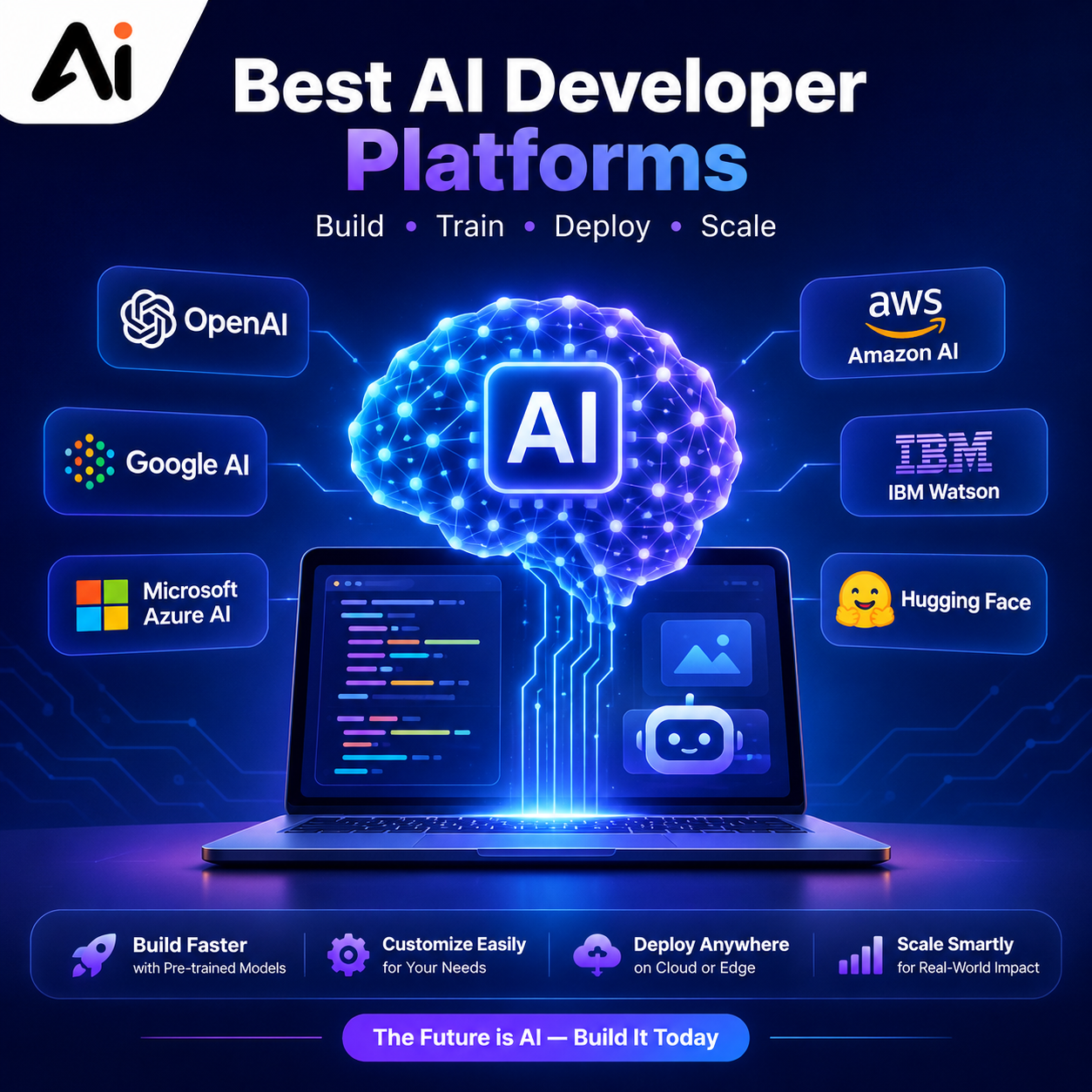
Incentives track the disagreement closely enough to be worth naming. Vendors selling developer tooling benefit from a story where developers become more valuable. Best AI Developer Platforms can help developers leverage AI to improve productivity and streamline development workflows. Companies justifying headcount reductions benefit from a story where AI substitutes for people. Frontier labs raising capital benefit from a story where the technology is transformative enough to be dangerous. None of these people are lying, and all of them are positioned.
Will AI Replace Software Developers? The Honest Answer
What AI coding tools genuinely do well
The current generation of assistants GitHub Copilot, Cursor, Claude Code, Amazon Q Developer, and Google’s Gemini Code Assist among them are legitimately strong across a defined band of work. Boilerplate generation, translation between languages and frameworks, test authoring against clear specifications, explanation of unfamiliar code, and first drafts of well-bounded functions all go materially faster. Denying this is no longer a defensible position.
But the measured picture is messier than the marketing. A controlled study of experienced open-source developers found they completed tasks slower with AI assistance while reporting that they felt faster. That gap between perceived and actual gain is the single most important finding in this space, because it means self-reported productivity data from your own team may be unreliable in a specific and predictable direction.
The reconciling explanation is task-dependence. Gains concentrate on well-specified, low-ambiguity, low-stakes work and shrink as tasks become novel, entangled with existing systems, or consequential to get wrong. Greenfield scaffolding is fast. A subtle concurrency bug in a fifteen-year-old payments service is not.
What AI still cannot do in software development
The durable constraint is specification. Knowing what to build, for whom, under which constraints, and with which failure modes tolerated requires context that lives in customer conversations, regulatory requirements, commercial tradeoffs, and institutional history rather than in the repository. A model that writes flawless code against a wrong specification has produced a faster failure.
Architecture is the second constraint. Decisions about system boundaries, data ownership, consistency guarantees, and where to concentrate complexity carry consequences measured in years and resist reversal. They are judgment calls made under uncertainty with incomplete information, and they depend on guessing which future requirements are plausible.
Accountability is the third, and under current legal and organisational norms it has no automated substitute. Someone must be answerable when a deployment takes down a service or exposes customer data. Organisations that behave as though a tool can hold that responsibility discover the gap during their first serious incident, when “who approved this” has no satisfying answer.
The review bottleneck nobody budgets for
Generated code has to be read, understood, and verified by someone accountable for it, and that cost rarely appears in the productivity headline. When output volume rises faster than review capacity, teams do not get faster. They accumulate code nobody fully understands, which is a debt that comes due at unpredictable moments.
Here is the concrete failure mode, and it is worth internalising because it does not look like a bug. A model generates a pagination function that handles the common case correctly, uses an off-by-one boundary on the final page, and returns plausible results in testing because the test fixture has an exact multiple of the page size. It reads as clean, idiomatic code. Nothing about it triggers suspicion. It ships, and surfaces months later as an intermittent data-completeness complaint from one customer.
That class of error syntactically correct, stylistically clean, semantically wrong in a way that requires an independent mental model to catch is what review capacity actually protects against. It is also the class of error that increases fastest as generation volume rises, and the one least likely to be caught by a reviewer who did not write the code and is under delivery pressure.
AI vs Human Developers: Where the Line Sits
The division of labour, task by task
| Task | Stronger performer | Why |
| Boilerplate and scaffolding | AI | Known patterns, high volume, verifiable |
| Language and framework translation | AI | Broad surface familiarity |
| Writing tests to a clear spec | AI | Well-bounded, mechanical |
| Explaining unfamiliar code | AI | Fast comprehension aid for onboarding |
| Dependency and version upgrades | AI | Repetitive, pattern-matched |
| Deciding what to build | Human | Requires customer and commercial context |
| System architecture | Human | Long-horizon judgment under uncertainty |
| Debugging entangled legacy systems | Human | Depends on undocumented history |
| Catching subtly wrong output | Human | Needs an independent mental model |
| Security and threat modelling | Human | Adversarial reasoning, high stakes |
| Accountability for production | Human | No automated substitute exists |
| Cross-team negotiation and tradeoffs | Human | Organisational, not technical |
What humans hold that models do not
The advantage is context that never got written down: why a previous approach failed, which stakeholder will object, which subsystem is fragile for historical reasons nobody documented. This tacit organisational knowledge separates a technically correct solution from one that survives contact with the actual company.
The other advantage is recognising wrongness in unfamiliar shapes. Models produce confident, well-formatted output regardless of correctness. Catching a subtly incorrect result requires an independent model of the problem which is exactly what an engineer loses by delegating the problems they do not yet understand.
How the Developer Role Is Changing
Which roles carry the most exposure
| Exposure | Roles and work types | Reasoning |
| Highest | Routine CRUD implementation, template-driven front-end work, manual QA scripting, simple internal tooling, high-volume outsourced implementation | Well-specified, low-ambiguity, verifiable — the exact profile AI handles best |
| Moderate | General-purpose back-end feature work, data pipeline plumbing, straightforward mobile development | Substantial assistance available, but system context still required |
| Lowest | Embedded and real-time systems, platform and infrastructure engineering, security engineering, ML infrastructure, regulated-domain engineering (medical devices, avionics, clearing systems) | High stakes, deep domain constraints, adversarial or safety-critical reasoning, sparse training data |
The pattern is not seniority. It is ambiguous, consequence, and how much undocumented context the work requires. A senior engineer doing routine implementation is more exposed than a junior on a safety-critical embedded team.
Fewer jobs, or different jobs?
Compilers, high-level languages, open-source libraries, and cloud infrastructure each removed enormous quantities of manual work from software development, and each period broadly coincided with growth in developer employment rather than contraction. The proposed mechanism is consistent: falling cost per unit of software expanded the range of problems worth solving with software.
Whether that holds this time is genuinely open, and certainty in either direction is overselling. What is observable now is compositional change work shifting from writing toward specifying, reviewing, integrating, and debugging. For anyone making a career decision, the aggregate headcount number matters far less than where their own work sits on the exposure table above.
Why the junior squeeze is the real risk
If there is a labour risk worth taking seriously, it is the entry-level bottleneck rather than mass replacement, which is precisely what Garman targeted. Traditional entry-level work has been the routine implementation that AI handles best. If firms respond by not hiring juniors, the result is a demographic gap in the profession rather than a shrinking of it.
That outcome would be self-inflicted rather than technologically determined, which is why it is worth arguing about. The technology creates a temptation; the hiring decision remains a choice. Firms that restructure junior roles toward supervised architecture exposure and review work will have senior engineers in a decade. Firms that remove the rung will not, and no tooling manufactures the seniority they skipped.
AWS’s Own Position, and the Contradiction Inside Amazon
The layoffs problem
Garman’s defence of junior hiring sits awkwardly inside Amazon. The company has announced substantial corporate role reductions, and CEO Andy Jassy has stated that AI will reduce the size of Amazon’s corporate workforce over time. [VERIFY — confirm figures, dates, and whether reductions touched engineering specifically] [SOURCE] A reader encountering Garman’s comments without this context is getting an incomplete picture.
Three readings are available, and honesty requires holding all of them. The reductions may have been concentrated in non-engineering corporate functions, in which case Garman’s position on developers is consistent with company action. AWS may be genuinely diverging from Amazon retail on hiring philosophy, which happens inside large conglomerates. Or the public position and the operating reality may simply differ, which would not be unusual for any large employer. The available evidence does not cleanly settle which. [VERIFY — check AWS engineering and new-graduate hiring data specifically]
Why the vendor’s incentives are worth noting
AWS hosts a large share of the world’s production software and sells the infrastructure that AI development runs on, which gives Garman better-than-average visibility into what enterprises deploy rather than announce. That is part of why his comments carried weight.
It also means the comments arrive with commercial context attached. Predicting that developers will work at a higher abstraction level is conveniently a prediction that demand rises for managed services, agentic tooling, and cloud platforms. That does not make it wrong. It does make it a forecast from an interested party, worth triangulating against independent hiring data.
What AWS actually ships to developers
AWS’s developer tooling has moved toward AI-assisted and increasingly agentic workflows: Amazon Q Developer for code generation, completion, and automated upgrades; Kiro as an agentic development environment; and Amazon Bedrock as the model-access layer teams build on.
Notably, none of that roadmap implies fewer developers. Every product in the category assumes a human operator who defines intent, evaluates output, and owns what ships. The product direction and the “AI replaces developers” narrative point different ways, which is itself evidence about which reading of Garman is accurate.
How Enterprises Are Actually Using AI in Software Development
Where adoption is working
The clearest wins are unglamorous: test generation, documentation, code explanation for onboarding, dependency and framework upgrades, and migration of legacy code between languages. These tasks are well-specified, individually low-risk, verifiable, and historically staffed with reluctance.
Teams reporting durable gains tend to share a pattern. They measure delivery outcomes rather than tool adoption, keep human review mandatory on anything touching production, and target named bottlenecks instead of rolling tooling out horizontally. The gain comes from task selection.
Where it is quietly failing
The common failure is volume without verification. Teams generate more code than they can meaningfully review, merge under delivery pressure, and inherit a codebase with degraded collective understanding. The productivity dashboard looks excellent until the first incident nobody can diagnose quickly.
The second failure is skill atrophy on hard problems, and the study finding above suggests why it goes unnoticed: teams may report speed gains they are not actually getting. When engineers reach for a generation on tasks they do not yet understand, they stop building the mental models that make them useful during outages and architectural decisions. The cost is invisible quarterly and expensive at exactly the wrong moment.
What Developers Should Do Now
Four moves, in rough order of return:
- Move toward design, review, and systems thinking. Systems design, data modelling, performance and reliability reasoning, and security thinking all rise in value as generated code volume rises, because they determine whether that volume is an asset or a liability.
- Treat code review as a primary skill. Catching plausible-looking logic that is subtly wrong . The pagination case above is distinct, trainable, and now on the critical path of most teams’ delivery.
- Apply a review test before generating. Ask: if this output is wrong in a non-obvious way, can I catch it? If yes, generate freely. If no, that is a signal you are outsourcing the part of the job you most need to keep.
- Build domain depth. Understanding healthcare billing, derivatives clearing, industrial control systems, or logistics operations well enough to know what “correct” means in that context transfers poorly to a general model and compounds over a career.
Why domain depth is the strongest position
A worked example makes the point. A model asked to implement a discount calculation will produce clean, correct arithmetic. An engineer who knows the relevant jurisdiction’s rules on whether tax applies before or after discount is the one who notices the output is legally wrong while being mathematically perfect.
That is the combination Garman’s own logic points to: systems judgment plus domain grounding. Developers holding both gain leverage as mechanical work gets cheaper, because they are the ones who can tell a fast correct answer from a fast wrong one.
How to Read Predictions Like This One
Separate the direction claim from the timeline claim
Almost every AI forecast bundles two different assertions: where things are heading, and how fast. The direction claimed in Garman’s comments is well supported by shipping products. The timeline is far more speculative, and specific timelines in this field have a poor record in both directions.
Separating them makes a prediction usable. You can act on a direction claim by adjusting which skills you invest in, which is reversible and cheap. Acting on a timeline claim means making irreversible decisions, a hiring freeze, a career change on the least reliable part of the forecast.
Watch hiring data, not headlines
Executive statements signal intent and what a company wants the market to believe. Job postings, seniority mix in new hires, and internal mobility patterns signal what is happening. The two diverge more often than coverage suggests.
To assess whether AI is replacing developers at a given company, the informative questions are whether it still hires juniors and new graduates, whether senior postings have shifted toward architecture and platform work, and whether headcount reductions were announced alongside AI or alongside a bad quarter.
Conclusion
The AWS CEO AI developer replacement story is a case study in a nuanced argument flattened into a threat. Garman’s position holds two things at once: the mechanics of the job are changing faster than most organisations are prepared for, and responding by cutting developer pipelines is a mistake. The tension between those is the useful part, and Amazon’s own layoffs make it sharper rather than resolving it.
For individual developers, “will AI replace software developers” matters less than which developers. The exposure table above is a more honest answer than any headline: routine implementation is under real pressure, while ambiguity, consequence, and domain depth remain protective. For companies, the message from someone with unusually good visibility into the industry is unambiguous. The AI-driven case for not hiring juniors is bad reasoning, and the bill arrives in eight years.
Frequently Asked Questions
Will AI replace software developers?
Not on current evidence. AI is automating parts of coding while specification, architecture, review, and accountability remain human work.
What did the AWS CEO say about AI and developers?
Matt Garman suggested developers may write far less code in the coming years, while separately arguing strongly against cutting junior developer hiring because of AI.
Can AI replace programmers completely?
No. AI can generate code from a specification but cannot reliably decide what to build, own architectural tradeoffs, or be accountable for production failures.
Which developer jobs are safest from AI?
Embedded and real-time systems, platform and infrastructure engineering, security engineering, and regulated-domain work high-stakes roles requiring deep context.
What skills will developers need in the AI era?
Systems design, critical code review, problem specification, security and reliability reasoning, and deep domain knowledge.
Is it too late to become a software developer?
No, but the entry path is harder and rewards specialisation over generalist implementation skills earlier than it used to.
Will AI lower software developer salaries?
Unclear, and the evidence is thin. Compression is plausible at the routine-implementation end while specialist and systems-level pay holds or rises.
Do I still need a computer science degree?
It remains useful for the fundamentals that make review and architecture possible, though it has never been the only route in.